

134
6 Dynamics of Quantum Mechanical Macroscopic Systems
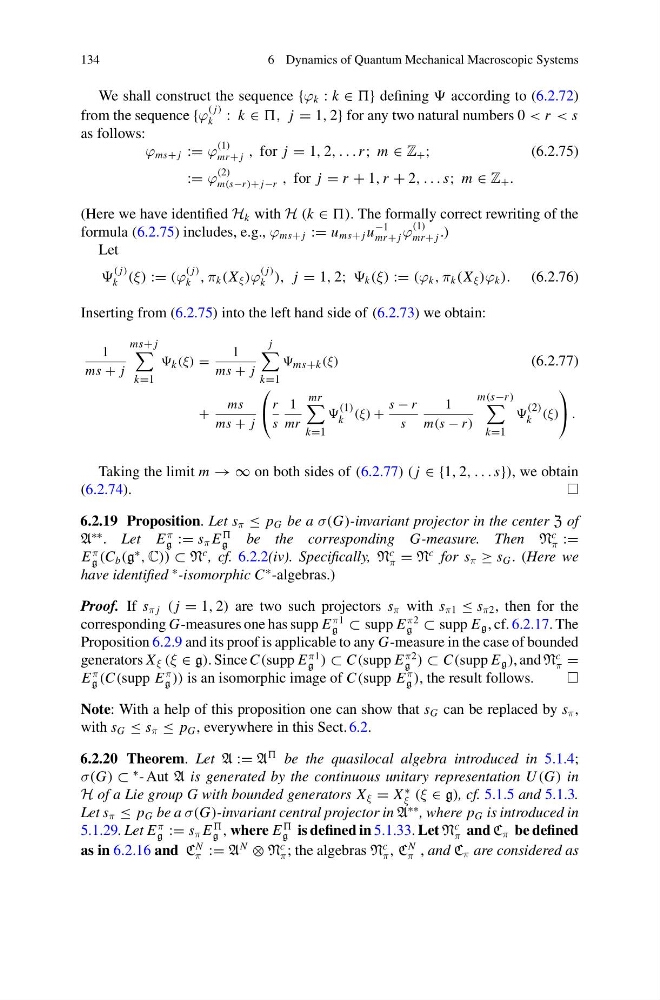
We shall construct the sequence {ϕ k : k ∈ } defining according to (6.2.72)
from the sequence {ϕ
( j)
k : k ∈ , j = 1, 2} for any two natural numbers 0 < r < s
as follows:
ϕ ms+ j := ϕ
(1)
mr+ j , for j = 1, 2, . . . r ; m ∈ Z + ;
(6.2.75)
:= ϕ
(2)
m(s−r )+ j−r , for j = r + 1, r + 2, . . . s; m ∈ Z + .
(Here we have identified H k with H (k ∈ ). The formally correct rewriting of the
formula (6.2.75) includes, e.g., ϕ ms+ j := u ms+ j u
−1
mr+ j ϕ
(1)
mr+ j .)
Let
( j)
k (ξ) := (ϕ
( j)
k , π k (X ξ )ϕ
( j)
k ), j = 1, 2; k (ξ) := (ϕ k , π k (X ξ )ϕ k ). (6.2.76)
Inserting from (6.2.75) into the left hand side of (6.2.73) we obtain:
1
ms + j
ms+ j
k=1
k (ξ) =
1
ms + j
j
k=1
ms+k (ξ)
(6.2.77)
+
ms
ms + j
⎛
⎝ r
s
1
mr
mr
k=1
(1)
k (ξ) +
s − r
s
1
m(s − r )
m(s−r )
k=1
(2)
k (ξ)
⎞
⎠ .
Taking the limit m → ∞ on both sides of (6.2.77) ( j ∈ {1, 2, . . . s}), we obtain
(6.2.74).
6.2.19 Proposition. Let s π ≤ p G be a σ(G)-invariant projector in the center Z of
A
∗∗ . Let E
π
g := s π E
g
be the corresponding G-measure. Then N
c
π :=
E
π
g (C b (g
∗
, C)) ⊂ N
c , cf. 6.2.2(iv). Specifically, N
c
π = N
c for s π ≥ s G . (Here we
have identified
∗ -isomorphic C
∗ -algebras.)
Proof. If s π j ( j = 1, 2) are two such projectors s π with s π1 ≤ s π2 , then for the
corresponding G-measures one has supp E
π1
g ⊂ supp E
π2
g ⊂ supp E g , cf. 6.2.17. The
Proposition 6.2.9 and its proof is applicable to any G-measure in the case of bounded
generators X ξ (ξ ∈ g). Since C(supp E
π1
g ) ⊂ C(supp E
π2
g ) ⊂ C(supp E g ), and N
c
π =
E
π
g (C(supp E
π
g )) is an isomorphic image of C(supp E
π
g ), the result follows.
Note: With a help of this proposition one can show that s G can be replaced by s π ,
with s G ≤ s π ≤ p G , everywhere in this Sect. 6.2.
6.2.20 Theorem. Let A := A
be the quasilocal algebra introduced in 5.1.4;
σ(G) ⊂
∗ - Aut A is generated by the continuous unitary representation U (G) in
H of a Lie group G with bounded generators X ξ = X
∗
ξ (ξ ∈ g), cf. 5.1.5 and 5.1.3.
Let s π ≤ p G be a σ(G)-invariant central projector in A
∗∗ , where p G is introduced in
5.1.29. Let E
π
g := s π E
g , where E
g is defined in 5.1.33. Let N
c
π and C π be defined
as in 6.2.16 and C
N
π := A
N
⊗ N
c
π ; the algebras N
c
π , C
N
π , and C π are considered as
6 Dynamics of Quantum Mechanical Macroscopic Systems
We shall construct the sequence {ϕ k : k ∈ } defining according to (6.2.72)
from the sequence {ϕ
( j)
k : k ∈ , j = 1, 2} for any two natural numbers 0 < r < s
as follows:
ϕ ms+ j := ϕ
(1)
mr+ j , for j = 1, 2, . . . r ; m ∈ Z + ;
(6.2.75)
:= ϕ
(2)
m(s−r )+ j−r , for j = r + 1, r + 2, . . . s; m ∈ Z + .
(Here we have identified H k with H (k ∈ ). The formally correct rewriting of the
formula (6.2.75) includes, e.g., ϕ ms+ j := u ms+ j u
−1
mr+ j ϕ
(1)
mr+ j .)
Let
( j)
k (ξ) := (ϕ
( j)
k , π k (X ξ )ϕ
( j)
k ), j = 1, 2; k (ξ) := (ϕ k , π k (X ξ )ϕ k ). (6.2.76)
Inserting from (6.2.75) into the left hand side of (6.2.73) we obtain:
1
ms + j
ms+ j
k=1
k (ξ) =
1
ms + j
j
k=1
ms+k (ξ)
(6.2.77)
+
ms
ms + j
⎛
⎝ r
s
1
mr
mr
k=1
(1)
k (ξ) +
s − r
s
1
m(s − r )
m(s−r )
k=1
(2)
k (ξ)
⎞
⎠ .
Taking the limit m → ∞ on both sides of (6.2.77) ( j ∈ {1, 2, . . . s}), we obtain
(6.2.74).
6.2.19 Proposition. Let s π ≤ p G be a σ(G)-invariant projector in the center Z of
A
∗∗ . Let E
π
g := s π E
g
be the corresponding G-measure. Then N
c
π :=
E
π
g (C b (g
∗
, C)) ⊂ N
c , cf. 6.2.2(iv). Specifically, N
c
π = N
c for s π ≥ s G . (Here we
have identified
∗ -isomorphic C
∗ -algebras.)
Proof. If s π j ( j = 1, 2) are two such projectors s π with s π1 ≤ s π2 , then for the
corresponding G-measures one has supp E
π1
g ⊂ supp E
π2
g ⊂ supp E g , cf. 6.2.17. The
Proposition 6.2.9 and its proof is applicable to any G-measure in the case of bounded
generators X ξ (ξ ∈ g). Since C(supp E
π1
g ) ⊂ C(supp E
π2
g ) ⊂ C(supp E g ), and N
c
π =
E
π
g (C(supp E
π
g )) is an isomorphic image of C(supp E
π
g ), the result follows.
Note: With a help of this proposition one can show that s G can be replaced by s π ,
with s G ≤ s π ≤ p G , everywhere in this Sect. 6.2.
6.2.20 Theorem. Let A := A
be the quasilocal algebra introduced in 5.1.4;
σ(G) ⊂
∗ - Aut A is generated by the continuous unitary representation U (G) in
H of a Lie group G with bounded generators X ξ = X
∗
ξ (ξ ∈ g), cf. 5.1.5 and 5.1.3.
Let s π ≤ p G be a σ(G)-invariant central projector in A
∗∗ , where p G is introduced in
5.1.29. Let E
π
g := s π E
g , where E
g is defined in 5.1.33. Let N
c
π and C π be defined
as in 6.2.16 and C
N
π := A
N
⊗ N
c
π ; the algebras N
c
π , C
N
π , and C π are considered as