

136
6 Dynamics of Quantum Mechanical Macroscopic Systems
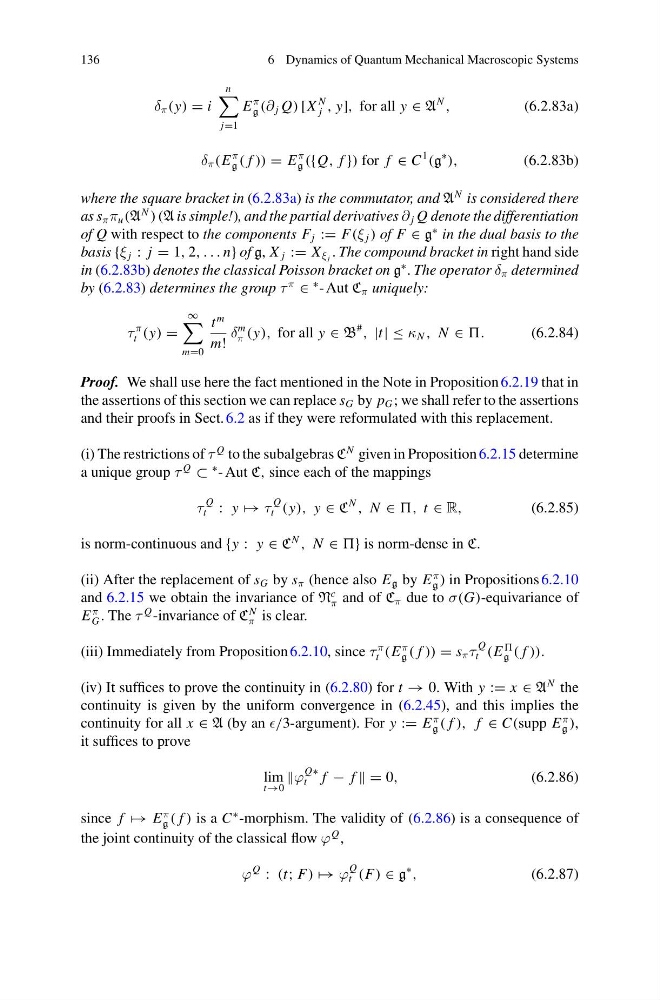
δ π (y) = i
n
j=1
E
π
g (∂ j Q) [X
N
j , y], for all y ∈ A
N
,
(6.2.83a)
δ π (E
π
g ( f )) = E
π
g ({Q, f }) for f ∈ C
1
(g
∗
),
(6.2.83b)
where the square bracket in (6.2.83a) is the commutator, and A
N is considered there
as s π π u (A
N
) (A is simple!), and the partial derivatives ∂ j Q denote the differentiation
of Q with respect to the components F j := F(ξ j ) of F ∈ g
∗ in the dual basis to the
basis {ξ j : j = 1, 2, . . . n} of g, X j := X ξ j . The compound bracket in right hand side
in (6.2.83b) denotes the classical Poisson bracket on g
∗ . The operator δ π determined
by (6.2.83) determines the group τ
π
∈
∗ - Aut C π uniquely:
τ
π
t (y) =
∞
m=0
t
m
m!
δ
m
π (y), for all y ∈ B
#
, |t| ≤ κ N , N ∈ .
(6.2.84)
Proof. We shall use here the fact mentioned in the Note in Proposition 6.2.19 that in
the assertions of this section we can replace s G by p G ; we shall refer to the assertions
and their proofs in Sect. 6.2 as if they were reformulated with this replacement.
(i) The restrictions of τ
Q to the subalgebras C
N given in Proposition 6.2.15 determine
a unique group τ
Q
⊂
∗ - Aut C, since each of the mappings
τ
Q
t : y → τ
Q
t (y), y ∈ C
N
, N ∈ , t ∈ R,
(6.2.85)
is norm-continuous and {y : y ∈ C
N
, N ∈ } is norm-dense in C.
(ii) After the replacement of s G by s π (hence also E g by E
π
g ) in Propositions 6.2.10
and 6.2.15 we obtain the invariance of N
c
π and of C π due to σ(G)-equivariance of
E
π
G . The τ
Q -invariance of C
N
π is clear.
(iii) Immediately from Proposition 6.2.10, since τ
π
t (E
π
g ( f )) = s π τ
Q
t (E
g ( f )).
(iv) It suffices to prove the continuity in (6.2.80) for t → 0. With y := x ∈ A
N the
continuity is given by the uniform convergence in (6.2.45), and this implies the
continuity for all x ∈ A (by an /3-argument). For y := E
π
g ( f ), f ∈ C(supp E
π
g ),
it suffices to prove
lim
t→0
ϕ
Q∗
t f − f = 0,
(6.2.86)
since f → E
π
g ( f ) is a C
∗ -morphism. The validity of (6.2.86) is a consequence of
the joint continuity of the classical flow ϕ
Q ,
ϕ
Q
: (t; F) → ϕ
Q
t (F) ∈ g
∗
,
(6.2.87)
6 Dynamics of Quantum Mechanical Macroscopic Systems
δ π (y) = i
n
j=1
E
π
g (∂ j Q) [X
N
j , y], for all y ∈ A
N
,
(6.2.83a)
δ π (E
π
g ( f )) = E
π
g ({Q, f }) for f ∈ C
1
(g
∗
),
(6.2.83b)
where the square bracket in (6.2.83a) is the commutator, and A
N is considered there
as s π π u (A
N
) (A is simple!), and the partial derivatives ∂ j Q denote the differentiation
of Q with respect to the components F j := F(ξ j ) of F ∈ g
∗ in the dual basis to the
basis {ξ j : j = 1, 2, . . . n} of g, X j := X ξ j . The compound bracket in right hand side
in (6.2.83b) denotes the classical Poisson bracket on g
∗ . The operator δ π determined
by (6.2.83) determines the group τ
π
∈
∗ - Aut C π uniquely:
τ
π
t (y) =
∞
m=0
t
m
m!
δ
m
π (y), for all y ∈ B
#
, |t| ≤ κ N , N ∈ .
(6.2.84)
Proof. We shall use here the fact mentioned in the Note in Proposition 6.2.19 that in
the assertions of this section we can replace s G by p G ; we shall refer to the assertions
and their proofs in Sect. 6.2 as if they were reformulated with this replacement.
(i) The restrictions of τ
Q to the subalgebras C
N given in Proposition 6.2.15 determine
a unique group τ
Q
⊂
∗ - Aut C, since each of the mappings
τ
Q
t : y → τ
Q
t (y), y ∈ C
N
, N ∈ , t ∈ R,
(6.2.85)
is norm-continuous and {y : y ∈ C
N
, N ∈ } is norm-dense in C.
(ii) After the replacement of s G by s π (hence also E g by E
π
g ) in Propositions 6.2.10
and 6.2.15 we obtain the invariance of N
c
π and of C π due to σ(G)-equivariance of
E
π
G . The τ
Q -invariance of C
N
π is clear.
(iii) Immediately from Proposition 6.2.10, since τ
π
t (E
π
g ( f )) = s π τ
Q
t (E
g ( f )).
(iv) It suffices to prove the continuity in (6.2.80) for t → 0. With y := x ∈ A
N the
continuity is given by the uniform convergence in (6.2.45), and this implies the
continuity for all x ∈ A (by an /3-argument). For y := E
π
g ( f ), f ∈ C(supp E
π
g ),
it suffices to prove
lim
t→0
ϕ
Q∗
t f − f = 0,
(6.2.86)
since f → E
π
g ( f ) is a C
∗ -morphism. The validity of (6.2.86) is a consequence of
the joint continuity of the classical flow ϕ
Q ,
ϕ
Q
: (t; F) → ϕ
Q
t (F) ∈ g
∗
,
(6.2.87)