

3.8 Theoretical Basis
79
All the variables of the equation have been explained previously except for h c ,
which is the convective coefficient [9].
Radiation depends on the characteristics of the surfaces i.e. the emissivity and
reflectivity. Surfaces with high reflectivity absorb little heat and objects with high
emissivity will absorb large amounts of heat by radiation. The human body can be
considered as a black body over most of the thermal spectrum. Thornton and Nair
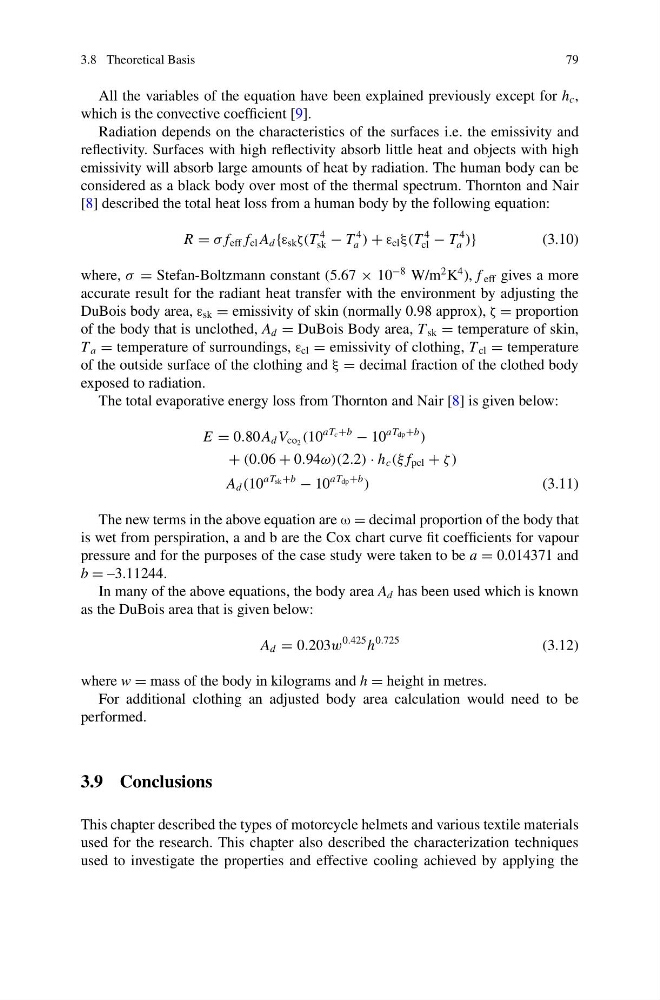
[8] described the total heat loss from a human body by the following equation:
R = σ f eff f cl A d {ε sk ζ(T
4
sk − T
4
a ) + ε cl ξ(T
4
cl − T
4
a )}
(3.10)
where, σ = Stefan-Boltzmann constant (5.67 × 10
−8 W/m
2 K
4 ), f eff gives a more
accurate result for the radiant heat transfer with the environment by adjusting the
DuBois body area, ε sk = emissivity of skin (normally 0.98 approx), ζ = proportion
of the body that is unclothed, A d = DuBois Body area, T sk = temperature of skin,
T a = temperature of surroundings, ε cl = emissivity of clothing, T cl = temperature
of the outside surface of the clothing and ξ = decimal fraction of the clothed body
exposed to radiation.
The total evaporative energy loss from Thornton and Nair [8] is given below:
E = 0.80 A d V co 2 (10
aT c +b
− 10
aT dp +b
)
+ (0.06 + 0.94ω)(2.2) · h c (ξ f pcl + ζ )
A d (10
aT sk +b
− 10
aT dp +b
)
(3.11)
The new terms in the above equation are ω = decimal proportion of the body that
is wet from perspiration, a and b are the Cox chart curve fit coefficients for vapour
pressure and for the purposes of the case study were taken to be a = 0.014371 and
b = –3.11244.
In many of the above equations, the body area A d has been used which is known
as the DuBois area that is given below:
A d = 0.203w
0.425 h
0.725
(3.12)
where w = mass of the body in kilograms and h = height in metres.
For additional clothing an adjusted body area calculation would need to be
performed.
3.9 Conclusions
This chapter described the types of motorcycle helmets and various textile materials
used for the research. This chapter also described the characterization techniques
used to investigate the properties and effective cooling achieved by applying the
79
All the variables of the equation have been explained previously except for h c ,
which is the convective coefficient [9].
Radiation depends on the characteristics of the surfaces i.e. the emissivity and
reflectivity. Surfaces with high reflectivity absorb little heat and objects with high
emissivity will absorb large amounts of heat by radiation. The human body can be
considered as a black body over most of the thermal spectrum. Thornton and Nair
[8] described the total heat loss from a human body by the following equation:
R = σ f eff f cl A d {ε sk ζ(T
4
sk − T
4
a ) + ε cl ξ(T
4
cl − T
4
a )}
(3.10)
where, σ = Stefan-Boltzmann constant (5.67 × 10
−8 W/m
2 K
4 ), f eff gives a more
accurate result for the radiant heat transfer with the environment by adjusting the
DuBois body area, ε sk = emissivity of skin (normally 0.98 approx), ζ = proportion
of the body that is unclothed, A d = DuBois Body area, T sk = temperature of skin,
T a = temperature of surroundings, ε cl = emissivity of clothing, T cl = temperature
of the outside surface of the clothing and ξ = decimal fraction of the clothed body
exposed to radiation.
The total evaporative energy loss from Thornton and Nair [8] is given below:
E = 0.80 A d V co 2 (10
aT c +b
− 10
aT dp +b
)
+ (0.06 + 0.94ω)(2.2) · h c (ξ f pcl + ζ )
A d (10
aT sk +b
− 10
aT dp +b
)
(3.11)
The new terms in the above equation are ω = decimal proportion of the body that
is wet from perspiration, a and b are the Cox chart curve fit coefficients for vapour
pressure and for the purposes of the case study were taken to be a = 0.014371 and
b = –3.11244.
In many of the above equations, the body area A d has been used which is known
as the DuBois area that is given below:
A d = 0.203w
0.425 h
0.725
(3.12)
where w = mass of the body in kilograms and h = height in metres.
For additional clothing an adjusted body area calculation would need to be
performed.
3.9 Conclusions
This chapter described the types of motorcycle helmets and various textile materials
used for the research. This chapter also described the characterization techniques
used to investigate the properties and effective cooling achieved by applying the