

78
3 Experimental Techniques
overall energy equation was derived by the standard ASHRAE to model human
thermoregulation and is given below:
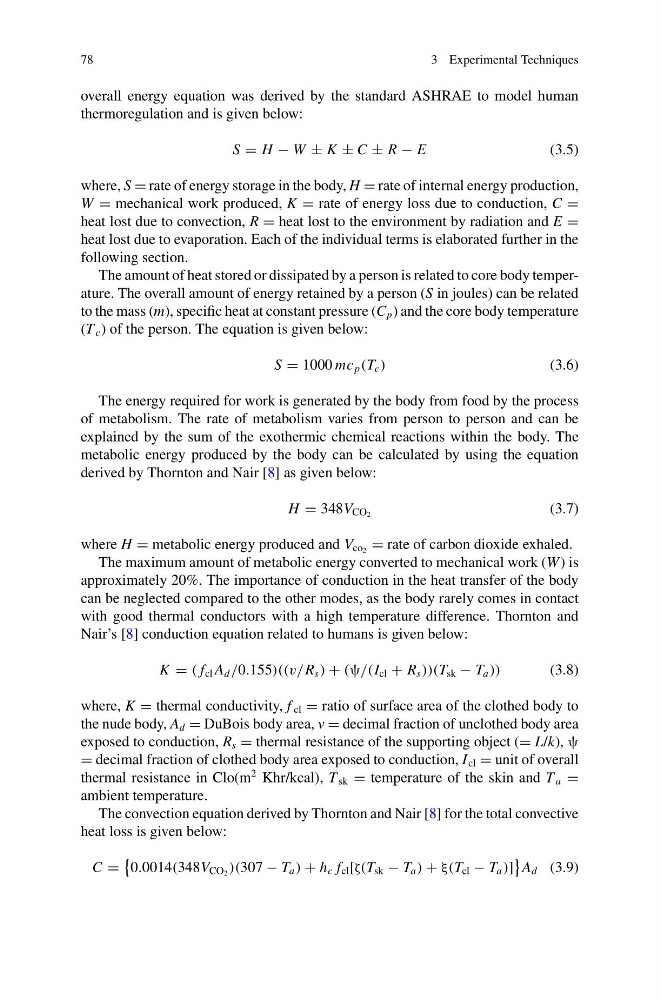
S = H − W ± K ± C ± R − E
(3.5)
where, S = rate of energy storage in the body, H = rate of internal energy production,
W = mechanical work produced, K = rate of energy loss due to conduction, C =
heat lost due to convection, R = heat lost to the environment by radiation and E =
heat lost due to evaporation. Each of the individual terms is elaborated further in the
following section.
The amount of heat stored or dissipated by a person is related to core body temperature. The overall amount of energy retained by a person (S in joules) can be related
to the mass (m), specific heat at constant pressure (C p ) and the core body temperature
(T c ) of the person. The equation is given below:
S = 1000 mc p (T c )
(3.6)
The energy required for work is generated by the body from food by the process
of metabolism. The rate of metabolism varies from person to person and can be
explained by the sum of the exothermic chemical reactions within the body. The
metabolic energy produced by the body can be calculated by using the equation
derived by Thornton and Nair [8] as given below:
H = 348V CO 2
(3.7)
where H = metabolic energy produced and V co 2 = rate of carbon dioxide exhaled.
The maximum amount of metabolic energy converted to mechanical work (W ) is
approximately 20%. The importance of conduction in the heat transfer of the body
can be neglected compared to the other modes, as the body rarely comes in contact
with good thermal conductors with a high temperature difference. Thornton and
Nair’s [8] conduction equation related to humans is given below:
K = ( f cl A d /0.155)((v/R s ) + (ψ/(I cl + R s ))(T sk − T a ))
(3.8)
where, K = thermal conductivity, f cl = ratio of surface area of the clothed body to
the nude body, A d = DuBois body area, v = decimal fraction of unclothed body area
exposed to conduction, R s = thermal resistance of the supporting object (= L/k), ψ
= decimal fraction of clothed body area exposed to conduction, I cl = unit of overall
thermal resistance in Clo(m
2 Khr/kcal), T sk = temperature of the skin and T a =
ambient temperature.
The convection equation derived by Thornton and Nair [8] for the total convective
heat loss is given below:
C =
0.0014(348V CO 2 )(307 − T a ) + h c f cl [ζ(T sk − T a ) + ξ(T cl − T a )]
A d (3.9)
3 Experimental Techniques
overall energy equation was derived by the standard ASHRAE to model human
thermoregulation and is given below:
S = H − W ± K ± C ± R − E
(3.5)
where, S = rate of energy storage in the body, H = rate of internal energy production,
W = mechanical work produced, K = rate of energy loss due to conduction, C =
heat lost due to convection, R = heat lost to the environment by radiation and E =
heat lost due to evaporation. Each of the individual terms is elaborated further in the
following section.
The amount of heat stored or dissipated by a person is related to core body temperature. The overall amount of energy retained by a person (S in joules) can be related
to the mass (m), specific heat at constant pressure (C p ) and the core body temperature
(T c ) of the person. The equation is given below:
S = 1000 mc p (T c )
(3.6)
The energy required for work is generated by the body from food by the process
of metabolism. The rate of metabolism varies from person to person and can be
explained by the sum of the exothermic chemical reactions within the body. The
metabolic energy produced by the body can be calculated by using the equation
derived by Thornton and Nair [8] as given below:
H = 348V CO 2
(3.7)
where H = metabolic energy produced and V co 2 = rate of carbon dioxide exhaled.
The maximum amount of metabolic energy converted to mechanical work (W ) is
approximately 20%. The importance of conduction in the heat transfer of the body
can be neglected compared to the other modes, as the body rarely comes in contact
with good thermal conductors with a high temperature difference. Thornton and
Nair’s [8] conduction equation related to humans is given below:
K = ( f cl A d /0.155)((v/R s ) + (ψ/(I cl + R s ))(T sk − T a ))
(3.8)
where, K = thermal conductivity, f cl = ratio of surface area of the clothed body to
the nude body, A d = DuBois body area, v = decimal fraction of unclothed body area
exposed to conduction, R s = thermal resistance of the supporting object (= L/k), ψ
= decimal fraction of clothed body area exposed to conduction, I cl = unit of overall
thermal resistance in Clo(m
2 Khr/kcal), T sk = temperature of the skin and T a =
ambient temperature.
The convection equation derived by Thornton and Nair [8] for the total convective
heat loss is given below:
C =
0.0014(348V CO 2 )(307 − T a ) + h c f cl [ζ(T sk − T a ) + ξ(T cl − T a )]
A d (3.9)