

3.8 Theoretical Basis
77
3.8 Theoretical Basis
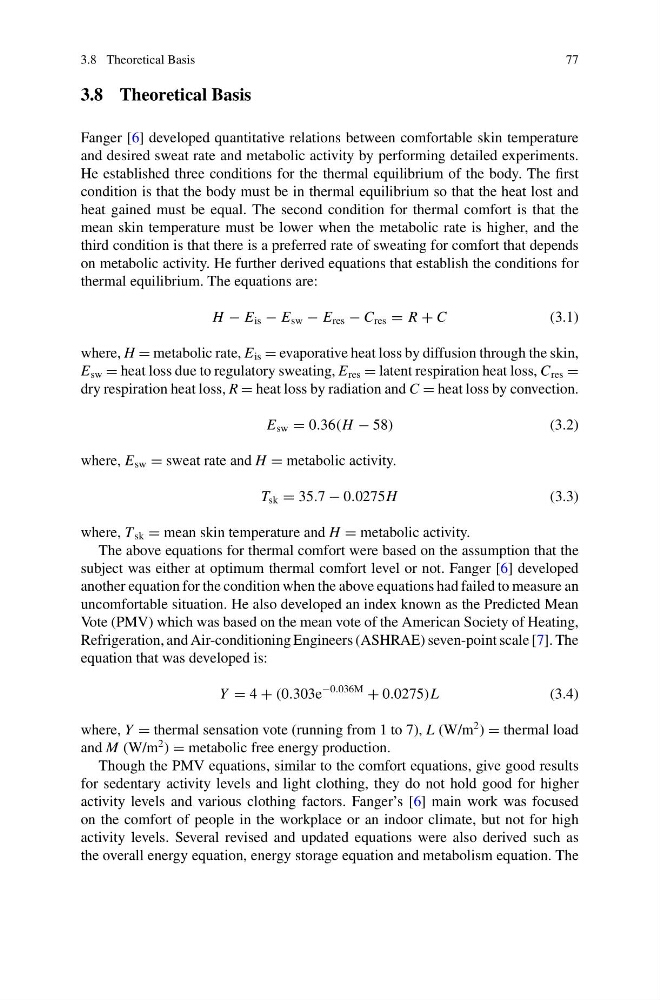
Fanger [6] developed quantitative relations between comfortable skin temperature
and desired sweat rate and metabolic activity by performing detailed experiments.
He established three conditions for the thermal equilibrium of the body. The first
condition is that the body must be in thermal equilibrium so that the heat lost and
heat gained must be equal. The second condition for thermal comfort is that the
mean skin temperature must be lower when the metabolic rate is higher, and the
third condition is that there is a preferred rate of sweating for comfort that depends
on metabolic activity. He further derived equations that establish the conditions for
thermal equilibrium. The equations are:
H − E is − E sw − E res − C res = R + C
(3.1)
where, H = metabolic rate, E is = evaporative heat loss by diffusion through the skin,
E sw = heat loss due to regulatory sweating, E res = latent respiration heat loss, C res =
dry respiration heat loss, R = heat loss by radiation and C = heat loss by convection.
E sw = 0.36(H − 58)
(3.2)
where, E sw = sweat rate and H = metabolic activity.
T sk = 35.7 − 0.0275H
(3.3)
where, T sk = mean skin temperature and H = metabolic activity.
The above equations for thermal comfort were based on the assumption that the
subject was either at optimum thermal comfort level or not. Fanger [6] developed
another equation for the condition when the above equations had failed to measure an
uncomfortable situation. He also developed an index known as the Predicted Mean
Vote (PMV) which was based on the mean vote of the American Society of Heating,
Refrigeration, and Air-conditioning Engineers (ASHRAE) seven-point scale [7]. The
equation that was developed is:
Y = 4 + (0.303e
−0.036M
+ 0.0275)L
(3.4)
where, Y = thermal sensation vote (running from 1 to 7), L (W/m
2 ) = thermal load
and M (W/m
2 ) = metabolic free energy production.
Though the PMV equations, similar to the comfort equations, give good results
for sedentary activity levels and light clothing, they do not hold good for higher
activity levels and various clothing factors. Fanger’s [6] main work was focused
on the comfort of people in the workplace or an indoor climate, but not for high
activity levels. Several revised and updated equations were also derived such as
the overall energy equation, energy storage equation and metabolism equation. The
77
3.8 Theoretical Basis
Fanger [6] developed quantitative relations between comfortable skin temperature
and desired sweat rate and metabolic activity by performing detailed experiments.
He established three conditions for the thermal equilibrium of the body. The first
condition is that the body must be in thermal equilibrium so that the heat lost and
heat gained must be equal. The second condition for thermal comfort is that the
mean skin temperature must be lower when the metabolic rate is higher, and the
third condition is that there is a preferred rate of sweating for comfort that depends
on metabolic activity. He further derived equations that establish the conditions for
thermal equilibrium. The equations are:
H − E is − E sw − E res − C res = R + C
(3.1)
where, H = metabolic rate, E is = evaporative heat loss by diffusion through the skin,
E sw = heat loss due to regulatory sweating, E res = latent respiration heat loss, C res =
dry respiration heat loss, R = heat loss by radiation and C = heat loss by convection.
E sw = 0.36(H − 58)
(3.2)
where, E sw = sweat rate and H = metabolic activity.
T sk = 35.7 − 0.0275H
(3.3)
where, T sk = mean skin temperature and H = metabolic activity.
The above equations for thermal comfort were based on the assumption that the
subject was either at optimum thermal comfort level or not. Fanger [6] developed
another equation for the condition when the above equations had failed to measure an
uncomfortable situation. He also developed an index known as the Predicted Mean
Vote (PMV) which was based on the mean vote of the American Society of Heating,
Refrigeration, and Air-conditioning Engineers (ASHRAE) seven-point scale [7]. The
equation that was developed is:
Y = 4 + (0.303e
−0.036M
+ 0.0275)L
(3.4)
where, Y = thermal sensation vote (running from 1 to 7), L (W/m
2 ) = thermal load
and M (W/m
2 ) = metabolic free energy production.
Though the PMV equations, similar to the comfort equations, give good results
for sedentary activity levels and light clothing, they do not hold good for higher
activity levels and various clothing factors. Fanger’s [6] main work was focused
on the comfort of people in the workplace or an indoor climate, but not for high
activity levels. Several revised and updated equations were also derived such as
the overall energy equation, energy storage equation and metabolism equation. The