

3.5 Methodology
67
Visor-closed helmet
Liner material
PCM fabric
Liner material
PCM foam
Liner material
PCM nonwoven
Liner material
PCM comp.
(fabric + foam)
Liner material
PWAT material
Road velocity test
● 55 kph
Ambient
+10 0 C
Closed circuit
wind tunnel
Ambient
+20 0 C
Low velocity tests*
● 0 kph
● 15 kph
● 35 kph
● 75 kph
● 75 kph
Evaluation of
results
*Preliminary tests to frame the base parameters for the research
PCM = Phase Change Material, PWAT = Polymeric Water Absorbent Textile
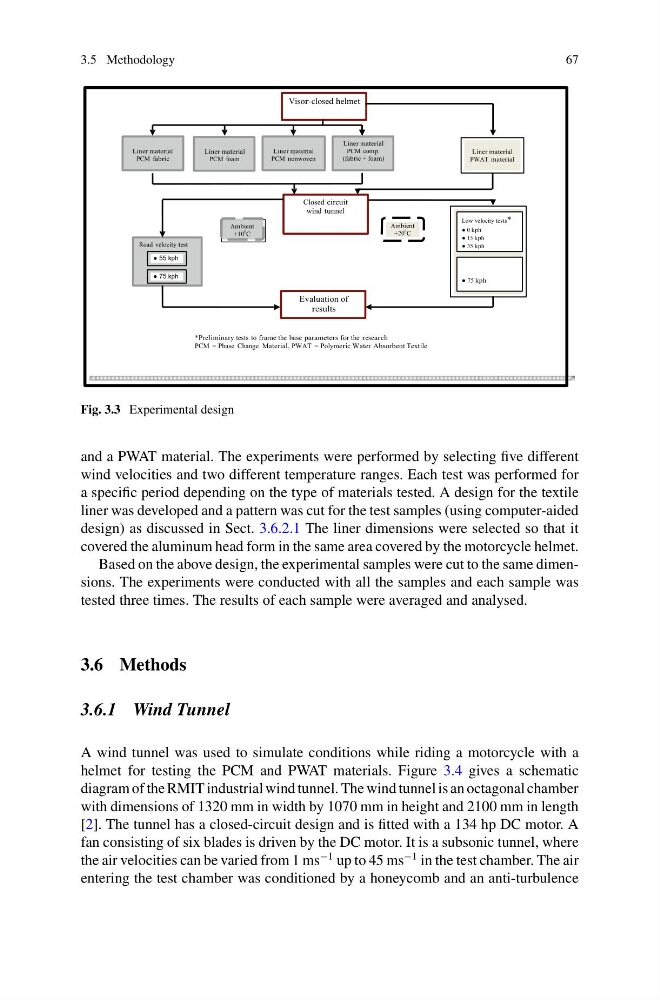
Fig. 3.3 Experimental design
and a PWAT material. The experiments were performed by selecting five different
wind velocities and two different temperature ranges. Each test was performed for
a specific period depending on the type of materials tested. A design for the textile
liner was developed and a pattern was cut for the test samples (using computer-aided
design) as discussed in Sect. 3.6.2.1 The liner dimensions were selected so that it
covered the aluminum head form in the same area covered by the motorcycle helmet.
Based on the above design, the experimental samples were cut to the same dimensions. The experiments were conducted with all the samples and each sample was
tested three times. The results of each sample were averaged and analysed.
3.6 Methods
3.6.1 Wind Tunnel
A wind tunnel was used to simulate conditions while riding a motorcycle with a
helmet for testing the PCM and PWAT materials. Figure 3.4 gives a schematic
diagram of the RMIT industrial wind tunnel. The wind tunnel is an octagonal chamber
with dimensions of 1320 mm in width by 1070 mm in height and 2100 mm in length
[2]. The tunnel has a closed-circuit design and is fitted with a 134 hp DC motor. A
fan consisting of six blades is driven by the DC motor. It is a subsonic tunnel, where
the air velocities can be varied from 1 ms
−1 up to 45 ms
−1 in the test chamber. The air
entering the test chamber was conditioned by a honeycomb and an anti-turbulence
67
Visor-closed helmet
Liner material
PCM fabric
Liner material
PCM foam
Liner material
PCM nonwoven
Liner material
PCM comp.
(fabric + foam)
Liner material
PWAT material
Road velocity test
● 55 kph
Ambient
+10 0 C
Closed circuit
wind tunnel
Ambient
+20 0 C
Low velocity tests*
● 0 kph
● 15 kph
● 35 kph
● 75 kph
● 75 kph
Evaluation of
results
*Preliminary tests to frame the base parameters for the research
PCM = Phase Change Material, PWAT = Polymeric Water Absorbent Textile
Fig. 3.3 Experimental design
and a PWAT material. The experiments were performed by selecting five different
wind velocities and two different temperature ranges. Each test was performed for
a specific period depending on the type of materials tested. A design for the textile
liner was developed and a pattern was cut for the test samples (using computer-aided
design) as discussed in Sect. 3.6.2.1 The liner dimensions were selected so that it
covered the aluminum head form in the same area covered by the motorcycle helmet.
Based on the above design, the experimental samples were cut to the same dimensions. The experiments were conducted with all the samples and each sample was
tested three times. The results of each sample were averaged and analysed.
3.6 Methods
3.6.1 Wind Tunnel
A wind tunnel was used to simulate conditions while riding a motorcycle with a
helmet for testing the PCM and PWAT materials. Figure 3.4 gives a schematic
diagram of the RMIT industrial wind tunnel. The wind tunnel is an octagonal chamber
with dimensions of 1320 mm in width by 1070 mm in height and 2100 mm in length
[2]. The tunnel has a closed-circuit design and is fitted with a 134 hp DC motor. A
fan consisting of six blades is driven by the DC motor. It is a subsonic tunnel, where
the air velocities can be varied from 1 ms
−1 up to 45 ms
−1 in the test chamber. The air
entering the test chamber was conditioned by a honeycomb and an anti-turbulence