

30
2 Review of Literature: Motorcycle helmet
2.13 Phase Change Materials
Phase change materials (PCM) are substances that undergo the process of phase
change when the temperature changes [133]. PCM are also substances with a high
heat of fusion which melt and solidify at a certain temperature and are also capable of
storing and releasing large amounts of energy. NASA developed PCM technology in
the late 1970s to early 1980s, in order to protect delicate instruments and astronauts
from the extreme temperatures of space [134]. The further potential of PCM was
developed by the Triangular Research and Development Co., who subsequently gave
the licence to Outlast Technologies based in Boulder, Colorado. Outlast Technologies
exploited the potential of PCM in textile fibres and fabric coatings; as a result, PCM
capsules are now applied to all types of materials [135, 136].
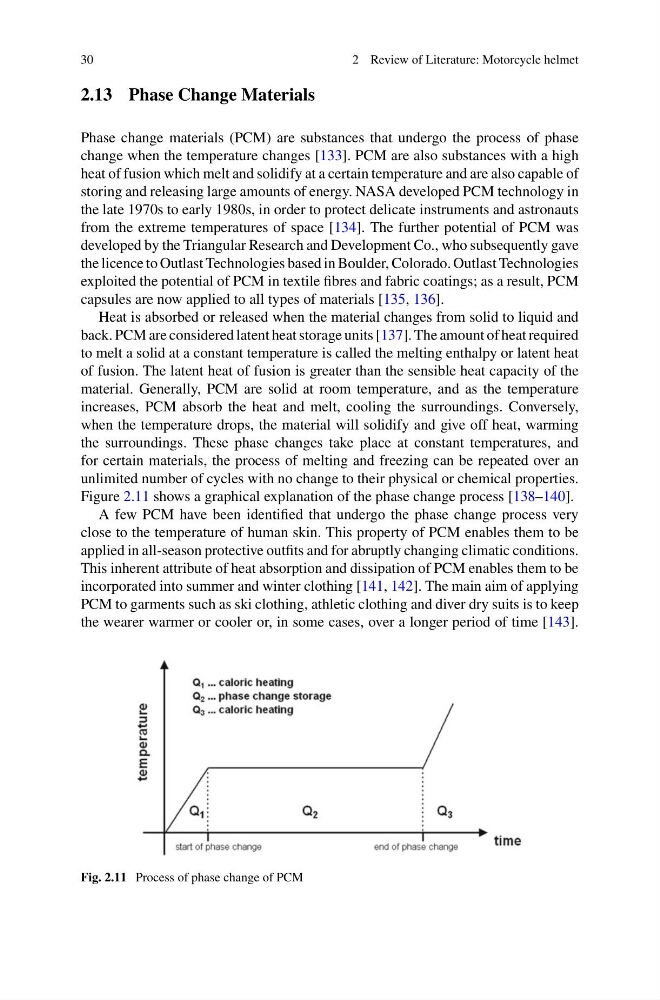
Heat is absorbed or released when the material changes from solid to liquid and
back. PCM are considered latent heat storage units [137]. The amount of heat required
to melt a solid at a constant temperature is called the melting enthalpy or latent heat
of fusion. The latent heat of fusion is greater than the sensible heat capacity of the
material. Generally, PCM are solid at room temperature, and as the temperature
increases, PCM absorb the heat and melt, cooling the surroundings. Conversely,
when the temperature drops, the material will solidify and give off heat, warming
the surroundings. These phase changes take place at constant temperatures, and
for certain materials, the process of melting and freezing can be repeated over an
unlimited number of cycles with no change to their physical or chemical properties.
Figure 2.11 shows a graphical explanation of the phase change process [138–140].
A few PCM have been identified that undergo the phase change process very
close to the temperature of human skin. This property of PCM enables them to be
applied in all-season protective outfits and for abruptly changing climatic conditions.
This inherent attribute of heat absorption and dissipation of PCM enables them to be
incorporated into summer and winter clothing [141, 142]. The main aim of applying
PCM to garments such as ski clothing, athletic clothing and diver dry suits is to keep
the wearer warmer or cooler or, in some cases, over a longer period of time [143].
Fig. 2.11 Process of phase change of PCM
2 Review of Literature: Motorcycle helmet
2.13 Phase Change Materials
Phase change materials (PCM) are substances that undergo the process of phase
change when the temperature changes [133]. PCM are also substances with a high
heat of fusion which melt and solidify at a certain temperature and are also capable of
storing and releasing large amounts of energy. NASA developed PCM technology in
the late 1970s to early 1980s, in order to protect delicate instruments and astronauts
from the extreme temperatures of space [134]. The further potential of PCM was
developed by the Triangular Research and Development Co., who subsequently gave
the licence to Outlast Technologies based in Boulder, Colorado. Outlast Technologies
exploited the potential of PCM in textile fibres and fabric coatings; as a result, PCM
capsules are now applied to all types of materials [135, 136].
Heat is absorbed or released when the material changes from solid to liquid and
back. PCM are considered latent heat storage units [137]. The amount of heat required
to melt a solid at a constant temperature is called the melting enthalpy or latent heat
of fusion. The latent heat of fusion is greater than the sensible heat capacity of the
material. Generally, PCM are solid at room temperature, and as the temperature
increases, PCM absorb the heat and melt, cooling the surroundings. Conversely,
when the temperature drops, the material will solidify and give off heat, warming
the surroundings. These phase changes take place at constant temperatures, and
for certain materials, the process of melting and freezing can be repeated over an
unlimited number of cycles with no change to their physical or chemical properties.
Figure 2.11 shows a graphical explanation of the phase change process [138–140].
A few PCM have been identified that undergo the phase change process very
close to the temperature of human skin. This property of PCM enables them to be
applied in all-season protective outfits and for abruptly changing climatic conditions.
This inherent attribute of heat absorption and dissipation of PCM enables them to be
incorporated into summer and winter clothing [141, 142]. The main aim of applying
PCM to garments such as ski clothing, athletic clothing and diver dry suits is to keep
the wearer warmer or cooler or, in some cases, over a longer period of time [143].
Fig. 2.11 Process of phase change of PCM