

2.12 Thermal Energy Storage Systems
29
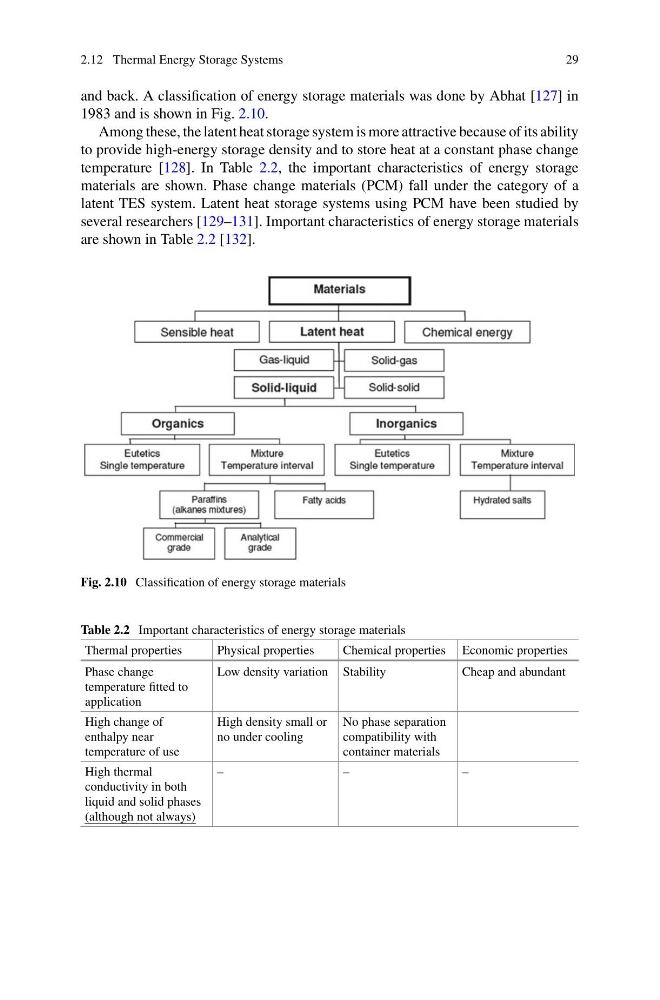
and back. A classification of energy storage materials was done by Abhat [127] in
1983 and is shown in Fig. 2.10.
Among these, the latent heat storage system is more attractive because of its ability
to provide high-energy storage density and to store heat at a constant phase change
temperature [128]. In Table 2.2, the important characteristics of energy storage
materials are shown. Phase change materials (PCM) fall under the category of a
latent TES system. Latent heat storage systems using PCM have been studied by
several researchers [129–131]. Important characteristics of energy storage materials
are shown in Table 2.2 [132].
Fig. 2.10 Classification of energy storage materials
Table 2.2 Important characteristics of energy storage materials
Thermal properties
Physical properties
Chemical properties Economic properties
Phase change
temperature fitted to
application
Low density variation Stability
Cheap and abundant
High change of
enthalpy near
temperature of use
High density small or
no under cooling
No phase separation
compatibility with
container materials
High thermal
conductivity in both
liquid and solid phases
(although not always)
–
–
–
29
and back. A classification of energy storage materials was done by Abhat [127] in
1983 and is shown in Fig. 2.10.
Among these, the latent heat storage system is more attractive because of its ability
to provide high-energy storage density and to store heat at a constant phase change
temperature [128]. In Table 2.2, the important characteristics of energy storage
materials are shown. Phase change materials (PCM) fall under the category of a
latent TES system. Latent heat storage systems using PCM have been studied by
several researchers [129–131]. Important characteristics of energy storage materials
are shown in Table 2.2 [132].
Fig. 2.10 Classification of energy storage materials
Table 2.2 Important characteristics of energy storage materials
Thermal properties
Physical properties
Chemical properties Economic properties
Phase change
temperature fitted to
application
Low density variation Stability
Cheap and abundant
High change of
enthalpy near
temperature of use
High density small or
no under cooling
No phase separation
compatibility with
container materials
High thermal
conductivity in both
liquid and solid phases
(although not always)
–
–
–