

4.5 Temperature Drop with PCM Materials
111
cooling was achieved by the forced convection of air in the wind tunnel at 75 kph
speed. After the PCM contained in the textile liner is melted (attaining the highest
drop in temperature), there would not be further absorption of heat.
It can be observed from the individual results of paraffinic PCM as shown in
Tables 4.3 and 4.4 that the differences in the readings of the maximum drop in
temperature at the speed of 55 and 75 kph are not markedly different. This was
due to the contribution of forced convection to achieve further cooling. In these
experiments, the temperatures of the PCM were not near enough to the melting
points of the PCM to obtain maximum heat absorption. To facilitate the maximum
amount of heat absorption, the temperature should exceed the melting points of the
PCM where all microcapsules present would have melted. It also depends upon the
amount of microcapsules present in the PCM materials. All the PCM materials used
in these experiments have the same surface area equivalent to the surface area of the
head. But the density and thickness of the PCM materials are different, and hence,
the amount of microcapsules also varies to a limited extent. In addition, the weights
of the PCM materials are different even though they have the same surface area.
4.6 Heat Absorbed by Paraffinic PCM Materials
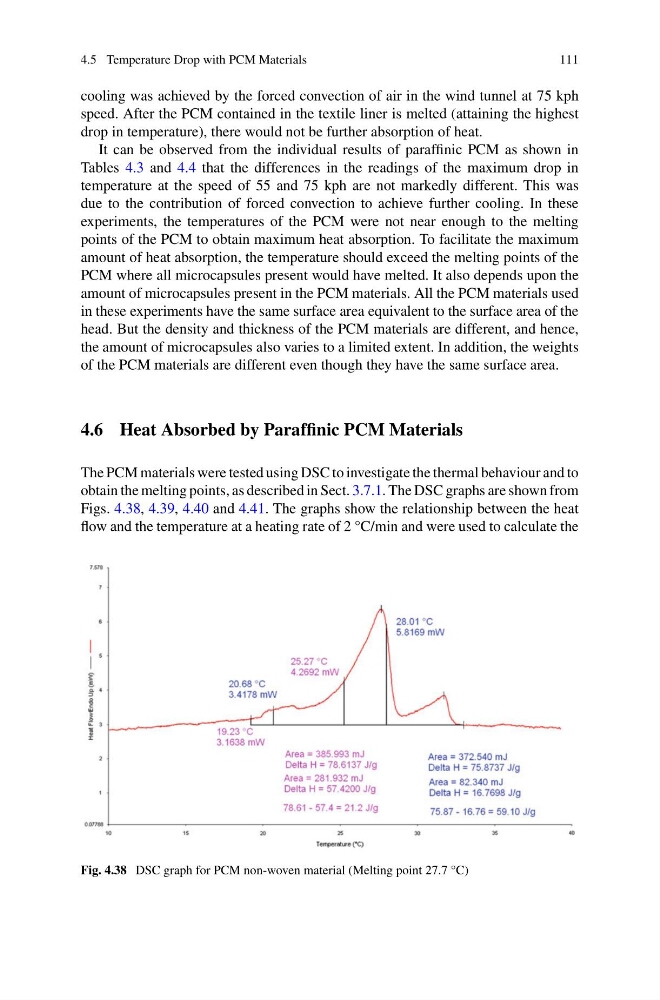
The PCM materials were tested using DSC to investigate the thermal behaviour and to
obtain the melting points, as described in Sect. 3.7.1. The DSC graphs are shown from
Figs. 4.38, 4.39, 4.40 and 4.41. The graphs show the relationship between the heat
flow and the temperature at a heating rate of 2 °C/min and were used to calculate the
Fig. 4.38 DSC graph for PCM non-woven material (Melting point 27.7 °C)
111
cooling was achieved by the forced convection of air in the wind tunnel at 75 kph
speed. After the PCM contained in the textile liner is melted (attaining the highest
drop in temperature), there would not be further absorption of heat.
It can be observed from the individual results of paraffinic PCM as shown in
Tables 4.3 and 4.4 that the differences in the readings of the maximum drop in
temperature at the speed of 55 and 75 kph are not markedly different. This was
due to the contribution of forced convection to achieve further cooling. In these
experiments, the temperatures of the PCM were not near enough to the melting
points of the PCM to obtain maximum heat absorption. To facilitate the maximum
amount of heat absorption, the temperature should exceed the melting points of the
PCM where all microcapsules present would have melted. It also depends upon the
amount of microcapsules present in the PCM materials. All the PCM materials used
in these experiments have the same surface area equivalent to the surface area of the
head. But the density and thickness of the PCM materials are different, and hence,
the amount of microcapsules also varies to a limited extent. In addition, the weights
of the PCM materials are different even though they have the same surface area.
4.6 Heat Absorbed by Paraffinic PCM Materials
The PCM materials were tested using DSC to investigate the thermal behaviour and to
obtain the melting points, as described in Sect. 3.7.1. The DSC graphs are shown from
Figs. 4.38, 4.39, 4.40 and 4.41. The graphs show the relationship between the heat
flow and the temperature at a heating rate of 2 °C/min and were used to calculate the
Fig. 4.38 DSC graph for PCM non-woven material (Melting point 27.7 °C)