

102
4 Results and Discussion
Heat absorbed in Watts
25
20
(75, 22.3)
(55, 19.5)
15
(35, 16.7)
(0, 13.1)
10
(15, 14.3)
5
0
0
1 0
2 0
3 0
4 0
5 0
6 0
7 0
8 0
Speed in kph
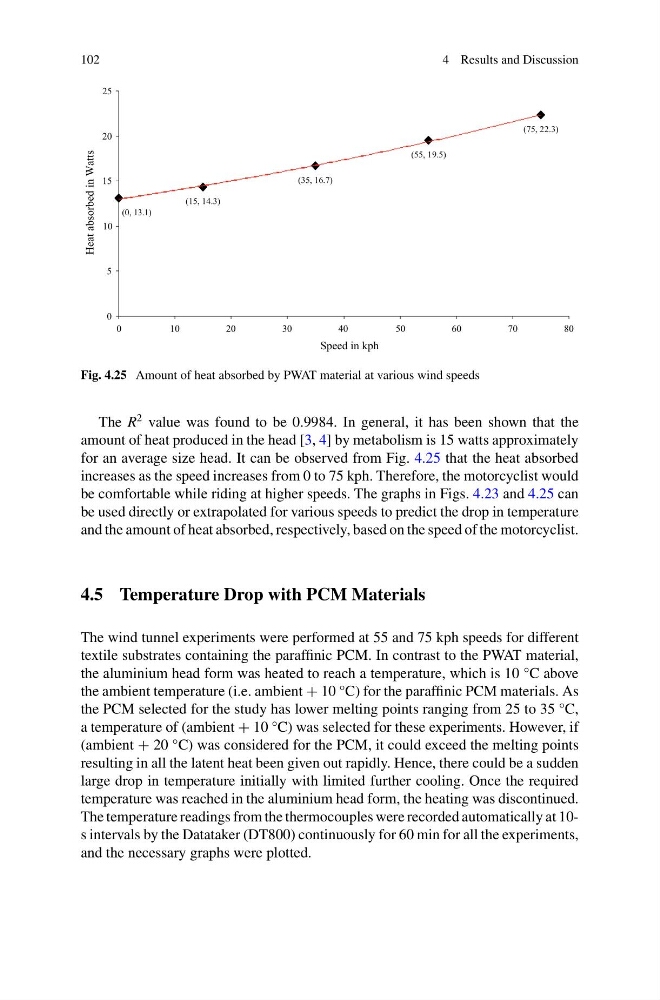
Fig. 4.25 Amount of heat absorbed by PWAT material at various wind speeds
The R
2 value was found to be 0.9984. In general, it has been shown that the
amount of heat produced in the head [3, 4] by metabolism is 15 watts approximately
for an average size head. It can be observed from Fig. 4.25 that the heat absorbed
increases as the speed increases from 0 to 75 kph. Therefore, the motorcyclist would
be comfortable while riding at higher speeds. The graphs in Figs. 4.23 and 4.25 can
be used directly or extrapolated for various speeds to predict the drop in temperature
and the amount of heat absorbed, respectively, based on the speed of the motorcyclist.
4.5 Temperature Drop with PCM Materials
The wind tunnel experiments were performed at 55 and 75 kph speeds for different
textile substrates containing the paraffinic PCM. In contrast to the PWAT material,
the aluminium head form was heated to reach a temperature, which is 10 °C above
the ambient temperature (i.e. ambient + 10 °C) for the paraffinic PCM materials. As
the PCM selected for the study has lower melting points ranging from 25 to 35 °C,
a temperature of (ambient + 10 °C) was selected for these experiments. However, if
(ambient + 20 °C) was considered for the PCM, it could exceed the melting points
resulting in all the latent heat been given out rapidly. Hence, there could be a sudden
large drop in temperature initially with limited further cooling. Once the required
temperature was reached in the aluminium head form, the heating was discontinued.
The temperature readings from the thermocouples were recorded automatically at 10s intervals by the Datataker (DT800) continuously for 60 min for all the experiments,
and the necessary graphs were plotted.
4 Results and Discussion
Heat absorbed in Watts
25
20
(75, 22.3)
(55, 19.5)
15
(35, 16.7)
(0, 13.1)
10
(15, 14.3)
5
0
0
1 0
2 0
3 0
4 0
5 0
6 0
7 0
8 0
Speed in kph
Fig. 4.25 Amount of heat absorbed by PWAT material at various wind speeds
The R
2 value was found to be 0.9984. In general, it has been shown that the
amount of heat produced in the head [3, 4] by metabolism is 15 watts approximately
for an average size head. It can be observed from Fig. 4.25 that the heat absorbed
increases as the speed increases from 0 to 75 kph. Therefore, the motorcyclist would
be comfortable while riding at higher speeds. The graphs in Figs. 4.23 and 4.25 can
be used directly or extrapolated for various speeds to predict the drop in temperature
and the amount of heat absorbed, respectively, based on the speed of the motorcyclist.
4.5 Temperature Drop with PCM Materials
The wind tunnel experiments were performed at 55 and 75 kph speeds for different
textile substrates containing the paraffinic PCM. In contrast to the PWAT material,
the aluminium head form was heated to reach a temperature, which is 10 °C above
the ambient temperature (i.e. ambient + 10 °C) for the paraffinic PCM materials. As
the PCM selected for the study has lower melting points ranging from 25 to 35 °C,
a temperature of (ambient + 10 °C) was selected for these experiments. However, if
(ambient + 20 °C) was considered for the PCM, it could exceed the melting points
resulting in all the latent heat been given out rapidly. Hence, there could be a sudden
large drop in temperature initially with limited further cooling. Once the required
temperature was reached in the aluminium head form, the heating was discontinued.
The temperature readings from the thermocouples were recorded automatically at 10s intervals by the Datataker (DT800) continuously for 60 min for all the experiments,
and the necessary graphs were plotted.