

4.4 Amount of Heat Removed from the Head Form for Thermal Equilibrium
101
S = H − W − K − C − R − E
(4.2)
The parameters of the above equation have been explained in Sect. 3.8. The
calculated values for the above thermal balance equations are as follows:
K = 15.5, R = 18.3, C = 144.5, E = 208.6, W = 42.8 and H = 428.4
Using the above-calculated values of all the parameters in the thermal balance
equation, the value of energy storage (S) was calculated to be −1.3 W which is close
to zero, which implies that the motorcyclist is in thermal equilibrium under the stated
conditions.
4.4.2 Heat Absorbed by PWAT Material at Various Speeds
The amount of heat absorbed by PWAT material at various speeds was calculated
from the amount of water evaporated using the following equation [2]:
E = 60W t 0.68/A d
W/m
2
(4.3)
where E is the evaporative heat loss, W t is the rate of change of body weight in g/min,
0.68 is the latent heat of sweat in J/g, and A d is the DuBois body area in m
2 .
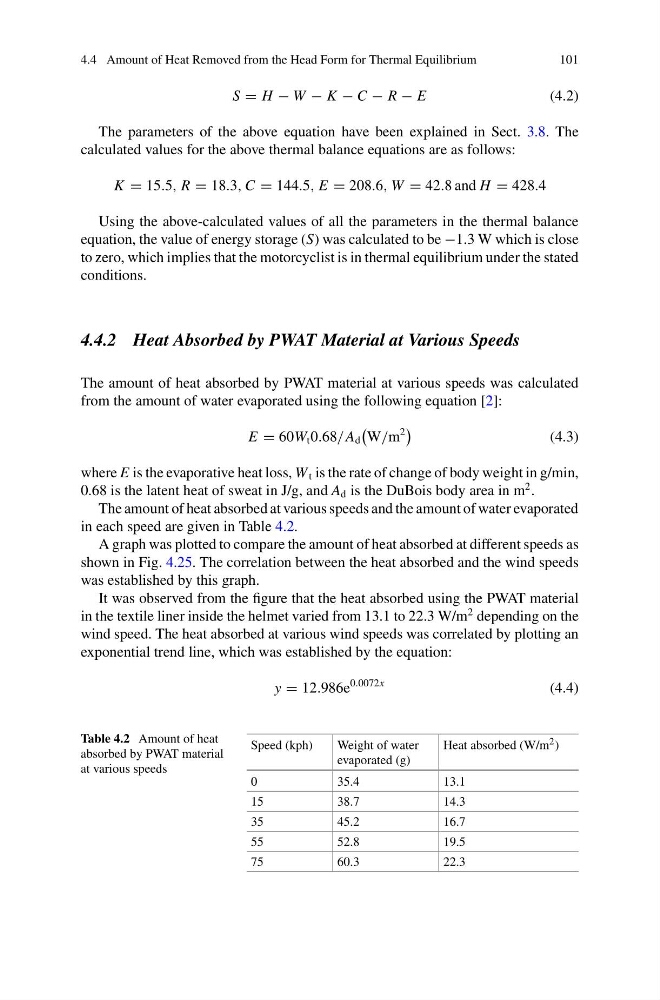
The amount of heat absorbed at various speeds and the amount of water evaporated
in each speed are given in Table 4.2.
A graph was plotted to compare the amount of heat absorbed at different speeds as
shown in Fig. 4.25. The correlation between the heat absorbed and the wind speeds
was established by this graph.
It was observed from the figure that the heat absorbed using the PWAT material
in the textile liner inside the helmet varied from 13.1 to 22.3 W/m
2 depending on the
wind speed. The heat absorbed at various wind speeds was correlated by plotting an
exponential trend line, which was established by the equation:
y = 12.986e
0.0072x
(4.4)
Table 4.2 Amount of heat
absorbed by PWAT material
at various speeds
Speed (kph)
Weight of water
evaporated (g)
Heat absorbed (W/m 2 )
0
35.4
13.1
15
38.7
14.3
35
45.2
16.7
55
52.8
19.5
75
60.3
22.3
101
S = H − W − K − C − R − E
(4.2)
The parameters of the above equation have been explained in Sect. 3.8. The
calculated values for the above thermal balance equations are as follows:
K = 15.5, R = 18.3, C = 144.5, E = 208.6, W = 42.8 and H = 428.4
Using the above-calculated values of all the parameters in the thermal balance
equation, the value of energy storage (S) was calculated to be −1.3 W which is close
to zero, which implies that the motorcyclist is in thermal equilibrium under the stated
conditions.
4.4.2 Heat Absorbed by PWAT Material at Various Speeds
The amount of heat absorbed by PWAT material at various speeds was calculated
from the amount of water evaporated using the following equation [2]:
E = 60W t 0.68/A d
W/m
2
(4.3)
where E is the evaporative heat loss, W t is the rate of change of body weight in g/min,
0.68 is the latent heat of sweat in J/g, and A d is the DuBois body area in m
2 .
The amount of heat absorbed at various speeds and the amount of water evaporated
in each speed are given in Table 4.2.
A graph was plotted to compare the amount of heat absorbed at different speeds as
shown in Fig. 4.25. The correlation between the heat absorbed and the wind speeds
was established by this graph.
It was observed from the figure that the heat absorbed using the PWAT material
in the textile liner inside the helmet varied from 13.1 to 22.3 W/m
2 depending on the
wind speed. The heat absorbed at various wind speeds was correlated by plotting an
exponential trend line, which was established by the equation:
y = 12.986e
0.0072x
(4.4)
Table 4.2 Amount of heat
absorbed by PWAT material
at various speeds
Speed (kph)
Weight of water
evaporated (g)
Heat absorbed (W/m 2 )
0
35.4
13.1
15
38.7
14.3
35
45.2
16.7
55
52.8
19.5
75
60.3
22.3