

In other words, the efficiency of the fault-tolerant system declines when the used
redundancy exceeds 100%.
If we introduce just defined success function in Eq. 4.9, we get the following
equation for a:
a ¼ 1 À cx
b 1Àx
ð
Þ
ð4:10Þ
It is worth to point out that recovery might be achieved with less than 100%
redundancy used, as it is shown in Fig. 4.6.
The well-known Hamming code, for example, provides recovery from a single
fault with redundancy 12–13%—depending on which logic schemes and technology were used for implementation. ERRIC (Evolving Recoverable Reduced
Instruction Computer [13] is fully recoverable from malfunctions in arithmetic and
logic units with 11.8–12.5% of hardware redundancy involved.
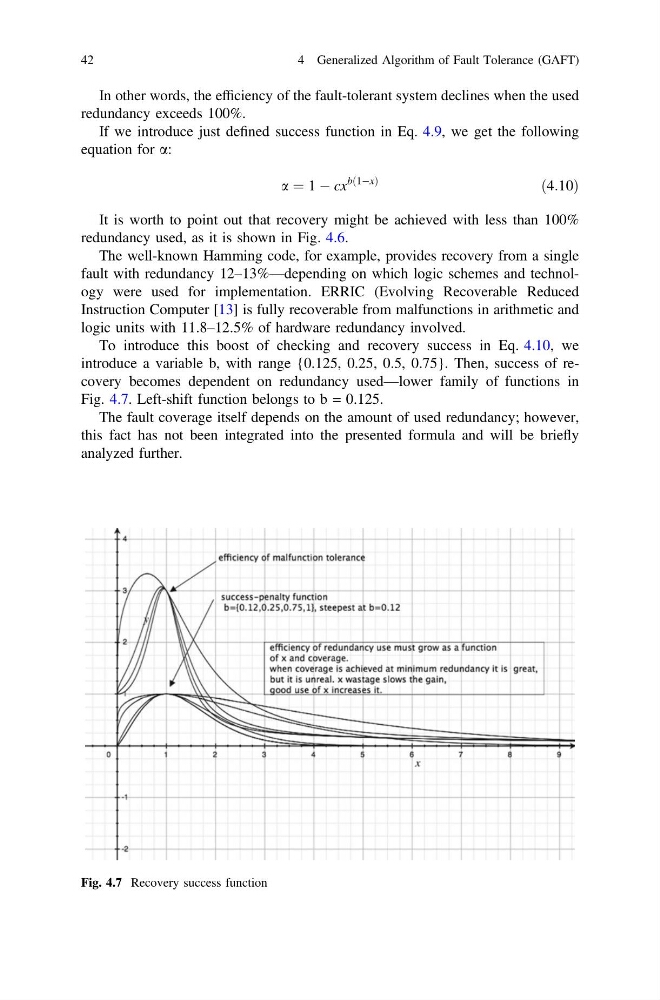
To introduce this boost of checking and recovery success in Eq. 4.10, we
introduce a variable b, with range {0.125, 0.25, 0.5, 0.75}. Then, success of recovery becomes dependent on redundancy used—lower family of functions in
Fig. 4.7. Left-shift function belongs to b = 0.125.
The fault coverage itself depends on the amount of used redundancy; however,
this fact has not been integrated into the presented formula and will be briefly
analyzed further.
Fig. 4.7 Recovery success function
42
4 Generalized Algorithm of Fault Tolerance (GAFT)
redundancy exceeds 100%.
If we introduce just defined success function in Eq. 4.9, we get the following
equation for a:
a ¼ 1 À cx
b 1Àx
ð
Þ
ð4:10Þ
It is worth to point out that recovery might be achieved with less than 100%
redundancy used, as it is shown in Fig. 4.6.
The well-known Hamming code, for example, provides recovery from a single
fault with redundancy 12–13%—depending on which logic schemes and technology were used for implementation. ERRIC (Evolving Recoverable Reduced
Instruction Computer [13] is fully recoverable from malfunctions in arithmetic and
logic units with 11.8–12.5% of hardware redundancy involved.
To introduce this boost of checking and recovery success in Eq. 4.10, we
introduce a variable b, with range {0.125, 0.25, 0.5, 0.75}. Then, success of recovery becomes dependent on redundancy used—lower family of functions in
Fig. 4.7. Left-shift function belongs to b = 0.125.
The fault coverage itself depends on the amount of used redundancy; however,
this fact has not been integrated into the presented formula and will be briefly
analyzed further.
Fig. 4.7 Recovery success function
42
4 Generalized Algorithm of Fault Tolerance (GAFT)