

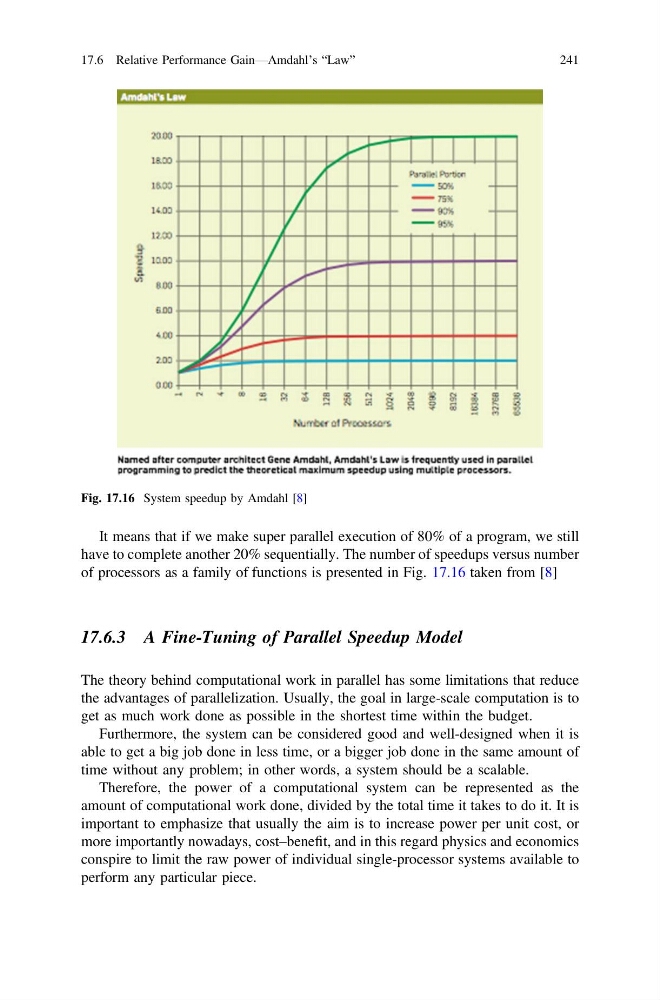
It means that if we make super parallel execution of 80% of a program, we still
have to complete another 20% sequentially. The number of speedups versus number
of processors as a family of functions is presented in Fig. 17.16 taken from [8]
17.6.3 A Fine-Tuning of Parallel Speedup Model
The theory behind computational work in parallel has some limitations that reduce
the advantages of parallelization. Usually, the goal in large-scale computation is to
get as much work done as possible in the shortest time within the budget.
Furthermore, the system can be considered good and well-designed when it is
able to get a big job done in less time, or a bigger job done in the same amount of
time without any problem; in other words, a system should be a scalable.
Therefore, the power of a computational system can be represented as the
amount of computational work done, divided by the total time it takes to do it. It is
important to emphasize that usually the aim is to increase power per unit cost, or
more importantly nowadays, cost–benefit, and in this regard physics and economics
conspire to limit the raw power of individual single-processor systems available to
perform any particular piece.
Fig. 17.16 System speedup by Amdahl [8]
17.6 Relative Performance Gain—Amdahl’s “Law”
241
have to complete another 20% sequentially. The number of speedups versus number
of processors as a family of functions is presented in Fig. 17.16 taken from [8]
17.6.3 A Fine-Tuning of Parallel Speedup Model
The theory behind computational work in parallel has some limitations that reduce
the advantages of parallelization. Usually, the goal in large-scale computation is to
get as much work done as possible in the shortest time within the budget.
Furthermore, the system can be considered good and well-designed when it is
able to get a big job done in less time, or a bigger job done in the same amount of
time without any problem; in other words, a system should be a scalable.
Therefore, the power of a computational system can be represented as the
amount of computational work done, divided by the total time it takes to do it. It is
important to emphasize that usually the aim is to increase power per unit cost, or
more importantly nowadays, cost–benefit, and in this regard physics and economics
conspire to limit the raw power of individual single-processor systems available to
perform any particular piece.
Fig. 17.16 System speedup by Amdahl [8]
17.6 Relative Performance Gain—Amdahl’s “Law”
241