

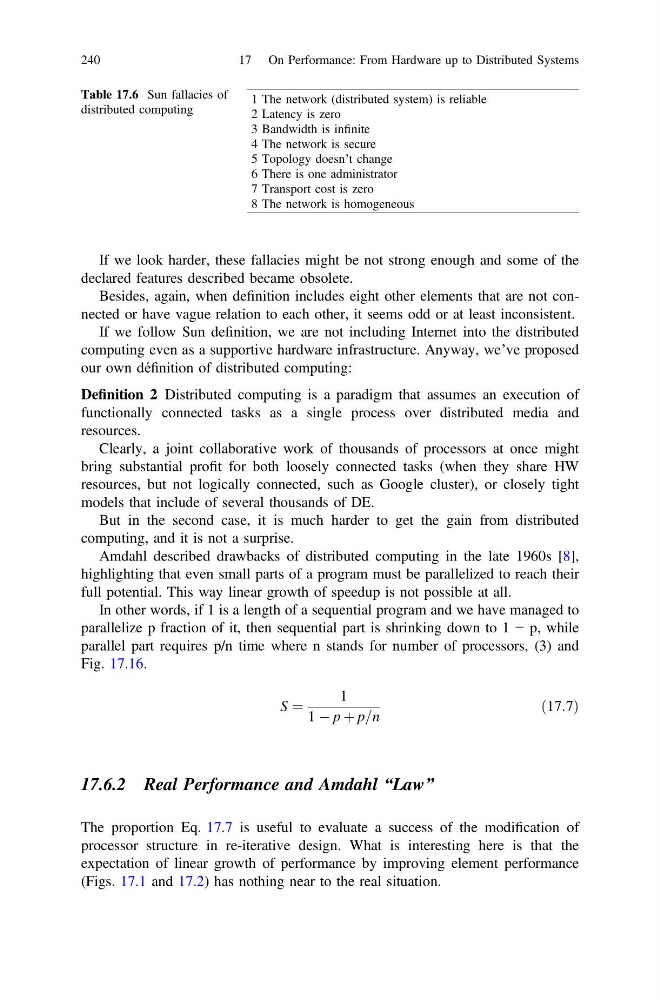
If we look harder, these fallacies might be not strong enough and some of the
declared features described became obsolete.
Besides, again, when definition includes eight other elements that are not connected or have vague relation to each other, it seems odd or at least inconsistent.
If we follow Sun definition, we are not including Internet into the distributed
computing even as a supportive hardware infrastructure. Anyway, we’ve proposed
our own définition of distributed computing:
Definition 2 Distributed computing is a paradigm that assumes an execution of
functionally connected tasks as a single process over distributed media and
resources.
Clearly, a joint collaborative work of thousands of processors at once might
bring substantial profit for both loosely connected tasks (when they share HW
resources, but not logically connected, such as Google cluster), or closely tight
models that include of several thousands of DE.
But in the second case, it is much harder to get the gain from distributed
computing, and it is not a surprise.
Amdahl described drawbacks of distributed computing in the late 1960s [8],
highlighting that even small parts of a program must be parallelized to reach their
full potential. This way linear growth of speedup is not possible at all.
In other words, if 1 is a length of a sequential program and we have managed to
parallelize p fraction of it, then sequential part is shrinking down to 1 − p, while
parallel part requires p/n time where n stands for number of processors, (3) and
Fig. 17.16.
S ¼
1
1 À p þ p=n
ð17:7Þ
17.6.2 Real Performance and Amdahl “Law”
The proportion Eq. 17.7 is useful to evaluate a success of the modification of
processor structure in re-iterative design. What is interesting here is that the
expectation of linear growth of performance by improving element performance
(Figs. 17.1 and 17.2) has nothing near to the real situation.
Table 17.6 Sun fallacies of
distributed computing
1 The network (distributed system) is reliable
2 Latency is zero
3 Bandwidth is infinite
4 The network is secure
5 Topology doesn’t change
6 There is one administrator
7 Transport cost is zero
8 The network is homogeneous
240
17 On Performance: From Hardware up to Distributed Systems
declared features described became obsolete.
Besides, again, when definition includes eight other elements that are not connected or have vague relation to each other, it seems odd or at least inconsistent.
If we follow Sun definition, we are not including Internet into the distributed
computing even as a supportive hardware infrastructure. Anyway, we’ve proposed
our own définition of distributed computing:
Definition 2 Distributed computing is a paradigm that assumes an execution of
functionally connected tasks as a single process over distributed media and
resources.
Clearly, a joint collaborative work of thousands of processors at once might
bring substantial profit for both loosely connected tasks (when they share HW
resources, but not logically connected, such as Google cluster), or closely tight
models that include of several thousands of DE.
But in the second case, it is much harder to get the gain from distributed
computing, and it is not a surprise.
Amdahl described drawbacks of distributed computing in the late 1960s [8],
highlighting that even small parts of a program must be parallelized to reach their
full potential. This way linear growth of speedup is not possible at all.
In other words, if 1 is a length of a sequential program and we have managed to
parallelize p fraction of it, then sequential part is shrinking down to 1 − p, while
parallel part requires p/n time where n stands for number of processors, (3) and
Fig. 17.16.
S ¼
1
1 À p þ p=n
ð17:7Þ
17.6.2 Real Performance and Amdahl “Law”
The proportion Eq. 17.7 is useful to evaluate a success of the modification of
processor structure in re-iterative design. What is interesting here is that the
expectation of linear growth of performance by improving element performance
(Figs. 17.1 and 17.2) has nothing near to the real situation.
Table 17.6 Sun fallacies of
distributed computing
1 The network (distributed system) is reliable
2 Latency is zero
3 Bandwidth is infinite
4 The network is secure
5 Topology doesn’t change
6 There is one administrator
7 Transport cost is zero
8 The network is homogeneous
240
17 On Performance: From Hardware up to Distributed Systems