

17.6 Relative Performance Gain—Amdahl’s “Law”
Relative gain in performance usually called “Amdahl’s law”. Well, law in terms of
science, not society, is “a regularity in the material world” (Shorter Oxford English
Dictionary, 6e, Vol 1). Thus, naming simple proportion of performance after
improvement P ai with performance before improvement P bi is, to put it politely, too
ambitious.
Speedup ¼
P ai
P bi
ð17:6Þ
But this proportion is useful to evaluate success of the modification of processor
structure after re-iterative design. What is interesting here is that arithmetic
expectation of linear growth of performance by improving element performance
(Figs. 17.1 and 17.2) has nothing near to the real situation.
17.6.1 Distributed Computing
In the late 1960s, an idea for the parallelization of computer program using distributed computing paradigm instead of single-processor scheme was proposed [8].
It was declared that parallelization of tasks and programs and use of available
distributed hardware for support of parallel execution is the most feasible way to
boost system performance.
Later, Sun [9] introduced “system fallacies” of distributed computing
(Table 17.6). Omitting topologic factors and paying attention to Fallacy 2, 3, and 7,
we discover that these fallacies fit into the area of parallel, closely connected
computers with multiprocessors—in fact, all modern computers.
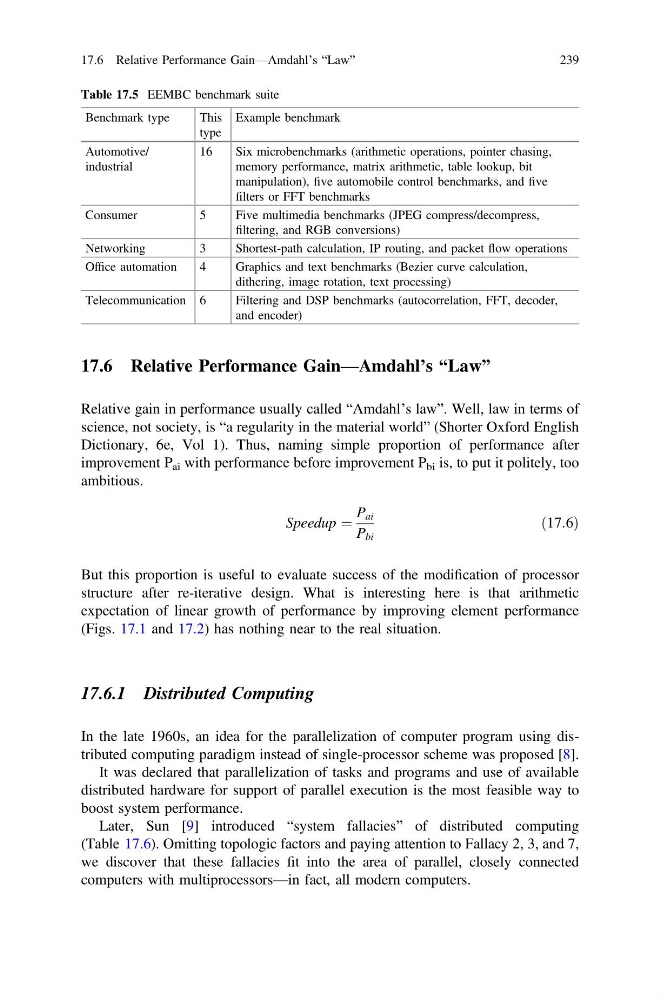
Table 17.5 EEMBC benchmark suite
Benchmark type
This
type
Example benchmark
Automotive/
industrial
16
Six microbenchmarks (arithmetic operations, pointer chasing,
memory performance, matrix arithmetic, table lookup, bit
manipulation), five automobile control benchmarks, and five
filters or FFT benchmarks
Consumer
5
Five multimedia benchmarks (JPEG compress/decompress,
filtering, and RGB conversions)
Networking
3
Shortest-path calculation, IP routing, and packet flow operations
Office automation
4
Graphics and text benchmarks (Bezier curve calculation,
dithering, image rotation, text processing)
Telecommunication 6
Filtering and DSP benchmarks (autocorrelation, FFT, decoder,
and encoder)
17.6 Relative Performance Gain—Amdahl’s “Law”
239
Relative gain in performance usually called “Amdahl’s law”. Well, law in terms of
science, not society, is “a regularity in the material world” (Shorter Oxford English
Dictionary, 6e, Vol 1). Thus, naming simple proportion of performance after
improvement P ai with performance before improvement P bi is, to put it politely, too
ambitious.
Speedup ¼
P ai
P bi
ð17:6Þ
But this proportion is useful to evaluate success of the modification of processor
structure after re-iterative design. What is interesting here is that arithmetic
expectation of linear growth of performance by improving element performance
(Figs. 17.1 and 17.2) has nothing near to the real situation.
17.6.1 Distributed Computing
In the late 1960s, an idea for the parallelization of computer program using distributed computing paradigm instead of single-processor scheme was proposed [8].
It was declared that parallelization of tasks and programs and use of available
distributed hardware for support of parallel execution is the most feasible way to
boost system performance.
Later, Sun [9] introduced “system fallacies” of distributed computing
(Table 17.6). Omitting topologic factors and paying attention to Fallacy 2, 3, and 7,
we discover that these fallacies fit into the area of parallel, closely connected
computers with multiprocessors—in fact, all modern computers.
Table 17.5 EEMBC benchmark suite
Benchmark type
This
type
Example benchmark
Automotive/
industrial
16
Six microbenchmarks (arithmetic operations, pointer chasing,
memory performance, matrix arithmetic, table lookup, bit
manipulation), five automobile control benchmarks, and five
filters or FFT benchmarks
Consumer
5
Five multimedia benchmarks (JPEG compress/decompress,
filtering, and RGB conversions)
Networking
3
Shortest-path calculation, IP routing, and packet flow operations
Office automation
4
Graphics and text benchmarks (Bezier curve calculation,
dithering, image rotation, text processing)
Telecommunication 6
Filtering and DSP benchmarks (autocorrelation, FFT, decoder,
and encoder)
17.6 Relative Performance Gain—Amdahl’s “Law”
239