

6.3 Signals and Patterns
89
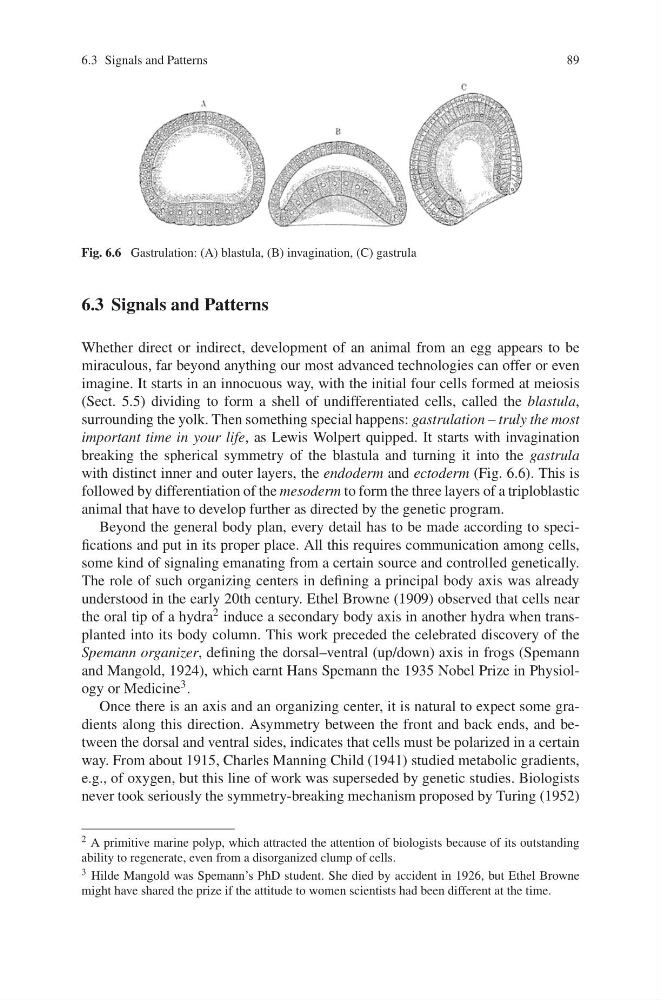
Fig. 6.6 Gastrulation: (A) blastula, (B) invagination, (C) gastrula
6.3 Signals and Patterns
Whether direct or indirect, development of an animal from an egg appears to be
miraculous, far beyond anything our most advanced technologies can offer or even
imagine. It starts in an innocuous way, with the initial four cells formed at meiosis
(Sect. 5.5) dividing to form a shell of undifferentiated cells, called the blastula,
surrounding the yolk. Then something special happens: gastrulation – truly the most
important time in your life, as Lewis Wolpert quipped. It starts with invagination
breaking the spherical symmetry of the blastula and turning it into the gastrula
with distinct inner and outer layers, the endoderm and ectoderm (Fig. 6.6). This is
followed by differentiation of the mesoderm to form the three layers of a triploblastic
animal that have to develop further as directed by the genetic program.
Beyond the general body plan, every detail has to be made according to specifications and put in its proper place. All this requires communication among cells,
some kind of signaling emanating from a certain source and controlled genetically.
The role of such organizing centers in defining a principal body axis was already
understood in the early 20th century. Ethel Browne (1909) observed that cells near
the oral tip of a hydra 2 induce a secondary body axis in another hydra when transplanted into its body column. This work preceded the celebrated discovery of the
Spemann organizer, defining the dorsal–ventral (up/down) axis in frogs (Spemann
and Mangold, 1924), which earnt Hans Spemann the 1935 Nobel Prize in Physiology or Medicine 3 .
Once there is an axis and an organizing center, it is natural to expect some gradients along this direction. Asymmetry between the front and back ends, and between the dorsal and ventral sides, indicates that cells must be polarized in a certain
way. From about 1915, Charles Manning Child (1941) studied metabolic gradients,
e.g., of oxygen, but this line of work was superseded by genetic studies. Biologists
never took seriously the symmetry-breaking mechanism proposed by Turing (1952)
2 A primitive marine polyp, which attracted the attention of biologists because of its outstanding
ability to regenerate, even from a disorganized clump of cells.
3 Hilde Mangold was Spemann’s PhD student. She died by accident in 1926, but Ethel Browne
might have shared the prize if the attitude to women scientists had been different at the time.
89
Fig. 6.6 Gastrulation: (A) blastula, (B) invagination, (C) gastrula
6.3 Signals and Patterns
Whether direct or indirect, development of an animal from an egg appears to be
miraculous, far beyond anything our most advanced technologies can offer or even
imagine. It starts in an innocuous way, with the initial four cells formed at meiosis
(Sect. 5.5) dividing to form a shell of undifferentiated cells, called the blastula,
surrounding the yolk. Then something special happens: gastrulation – truly the most
important time in your life, as Lewis Wolpert quipped. It starts with invagination
breaking the spherical symmetry of the blastula and turning it into the gastrula
with distinct inner and outer layers, the endoderm and ectoderm (Fig. 6.6). This is
followed by differentiation of the mesoderm to form the three layers of a triploblastic
animal that have to develop further as directed by the genetic program.
Beyond the general body plan, every detail has to be made according to specifications and put in its proper place. All this requires communication among cells,
some kind of signaling emanating from a certain source and controlled genetically.
The role of such organizing centers in defining a principal body axis was already
understood in the early 20th century. Ethel Browne (1909) observed that cells near
the oral tip of a hydra 2 induce a secondary body axis in another hydra when transplanted into its body column. This work preceded the celebrated discovery of the
Spemann organizer, defining the dorsal–ventral (up/down) axis in frogs (Spemann
and Mangold, 1924), which earnt Hans Spemann the 1935 Nobel Prize in Physiology or Medicine 3 .
Once there is an axis and an organizing center, it is natural to expect some gradients along this direction. Asymmetry between the front and back ends, and between the dorsal and ventral sides, indicates that cells must be polarized in a certain
way. From about 1915, Charles Manning Child (1941) studied metabolic gradients,
e.g., of oxygen, but this line of work was superseded by genetic studies. Biologists
never took seriously the symmetry-breaking mechanism proposed by Turing (1952)
2 A primitive marine polyp, which attracted the attention of biologists because of its outstanding
ability to regenerate, even from a disorganized clump of cells.
3 Hilde Mangold was Spemann’s PhD student. She died by accident in 1926, but Ethel Browne
might have shared the prize if the attitude to women scientists had been different at the time.