

88
6 Cells United
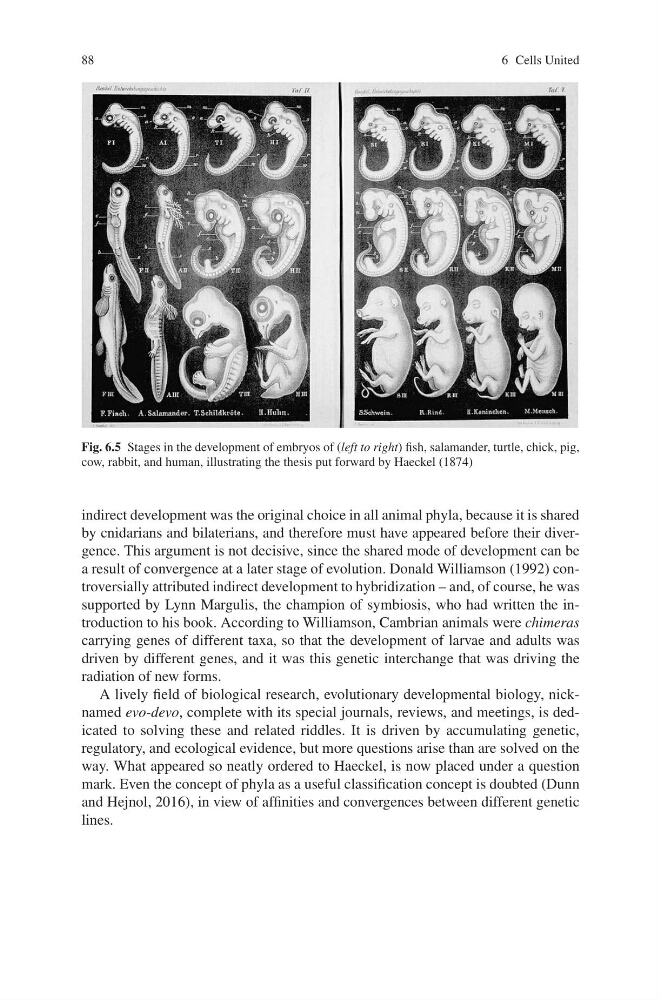
Fig. 6.5 Stages in the development of embryos of (left to right) fish, salamander, turtle, chick, pig,
cow, rabbit, and human, illustrating the thesis put forward by Haeckel (1874)
indirect development was the original choice in all animal phyla, because it is shared
by cnidarians and bilaterians, and therefore must have appeared before their divergence. This argument is not decisive, since the shared mode of development can be
a result of convergence at a later stage of evolution. Donald Williamson (1992) controversially attributed indirect development to hybridization – and, of course, he was
supported by Lynn Margulis, the champion of symbiosis, who had written the introduction to his book. According to Williamson, Cambrian animals were chimeras
carrying genes of different taxa, so that the development of larvae and adults was
driven by different genes, and it was this genetic interchange that was driving the
radiation of new forms.
A lively field of biological research, evolutionary developmental biology, nicknamed evo-devo, complete with its special journals, reviews, and meetings, is dedicated to solving these and related riddles. It is driven by accumulating genetic,
regulatory, and ecological evidence, but more questions arise than are solved on the
way. What appeared so neatly ordered to Haeckel, is now placed under a question
mark. Even the concept of phyla as a useful classification concept is doubted (Dunn
and Hejnol, 2016), in view of affinities and convergences between different genetic
lines.
6 Cells United
Fig. 6.5 Stages in the development of embryos of (left to right) fish, salamander, turtle, chick, pig,
cow, rabbit, and human, illustrating the thesis put forward by Haeckel (1874)
indirect development was the original choice in all animal phyla, because it is shared
by cnidarians and bilaterians, and therefore must have appeared before their divergence. This argument is not decisive, since the shared mode of development can be
a result of convergence at a later stage of evolution. Donald Williamson (1992) controversially attributed indirect development to hybridization – and, of course, he was
supported by Lynn Margulis, the champion of symbiosis, who had written the introduction to his book. According to Williamson, Cambrian animals were chimeras
carrying genes of different taxa, so that the development of larvae and adults was
driven by different genes, and it was this genetic interchange that was driving the
radiation of new forms.
A lively field of biological research, evolutionary developmental biology, nicknamed evo-devo, complete with its special journals, reviews, and meetings, is dedicated to solving these and related riddles. It is driven by accumulating genetic,
regulatory, and ecological evidence, but more questions arise than are solved on the
way. What appeared so neatly ordered to Haeckel, is now placed under a question
mark. Even the concept of phyla as a useful classification concept is doubted (Dunn
and Hejnol, 2016), in view of affinities and convergences between different genetic
lines.