

6.1 Why Develop?
85
aristocrat turned anarchist, juxtaposing capitalist competition with a utopian society
of “mutual aid”.
Symbiosis is ubiquitous in all walks of life, including consortia of flagellated and
phototrophic bacteria (think of an airplane as a union of a motor and wings); lichen,
a composite of algae or cyanobacteria incorporated in fungal tissues; and deep-water
fish carrying luminous bacteria. It does not necessarily benefit both symbionts and
does not necessarily lead them to join up into a single organism. A multitude of bacteria, far more numerous than our own cells, are our symbionts, helping us in many
tasks, but this does not mean that our ego is partly human and partly bacterial (although Margulis might have said it is). The formation of chimeras combining cells
with different genomes might have played a role in the emergence of multicellular
organisms.
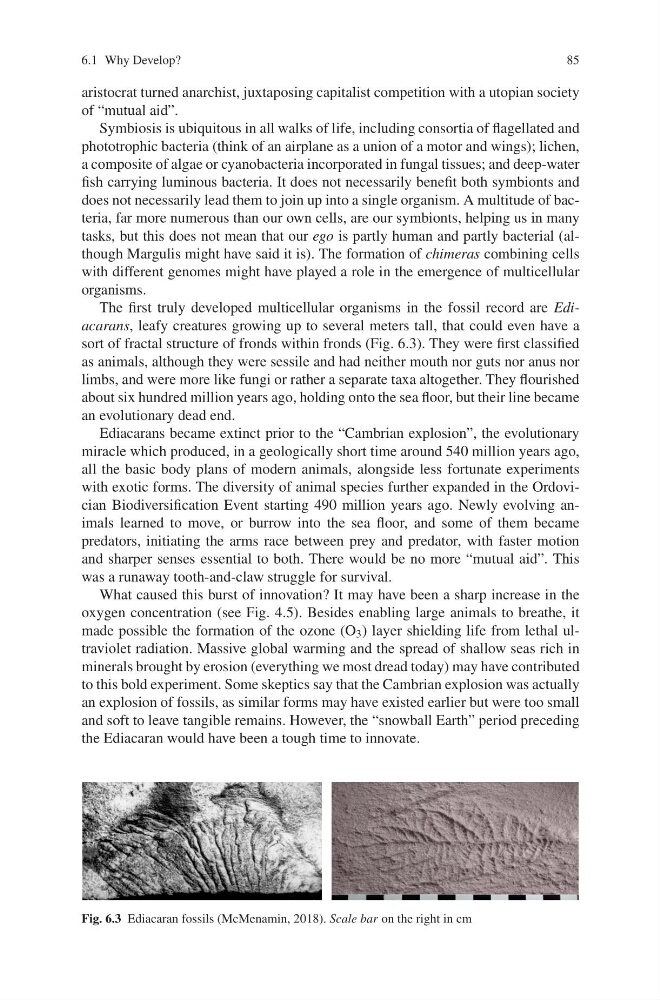
The first truly developed multicellular organisms in the fossil record are Ediacarans, leafy creatures growing up to several meters tall, that could even have a
sort of fractal structure of fronds within fronds (Fig. 6.3). They were first classified
as animals, although they were sessile and had neither mouth nor guts nor anus nor
limbs, and were more like fungi or rather a separate taxa altogether. They flourished
about six hundred million years ago, holding onto the sea floor, but their line became
an evolutionary dead end.
Ediacarans became extinct prior to the “Cambrian explosion”, the evolutionary
miracle which produced, in a geologically short time around 540 million years ago,
all the basic body plans of modern animals, alongside less fortunate experiments
with exotic forms. The diversity of animal species further expanded in the Ordovician Biodiversification Event starting 490 million years ago. Newly evolving animals learned to move, or burrow into the sea floor, and some of them became
predators, initiating the arms race between prey and predator, with faster motion
and sharper senses essential to both. There would be no more “mutual aid”. This
was a runaway tooth-and-claw struggle for survival.
What caused this burst of innovation? It may have been a sharp increase in the
oxygen concentration (see Fig. 4.5). Besides enabling large animals to breathe, it
made possible the formation of the ozone (O 3 ) layer shielding life from lethal ultraviolet radiation. Massive global warming and the spread of shallow seas rich in
minerals brought by erosion (everything we most dread today) may have contributed
to this bold experiment. Some skeptics say that the Cambrian explosion was actually
an explosion of fossils, as similar forms may have existed earlier but were too small
and soft to leave tangible remains. However, the “snowball Earth” period preceding
the Ediacaran would have been a tough time to innovate.
Fig. 6.3 Ediacaran fossils (McMenamin, 2018). Scale bar on the right in cm
85
aristocrat turned anarchist, juxtaposing capitalist competition with a utopian society
of “mutual aid”.
Symbiosis is ubiquitous in all walks of life, including consortia of flagellated and
phototrophic bacteria (think of an airplane as a union of a motor and wings); lichen,
a composite of algae or cyanobacteria incorporated in fungal tissues; and deep-water
fish carrying luminous bacteria. It does not necessarily benefit both symbionts and
does not necessarily lead them to join up into a single organism. A multitude of bacteria, far more numerous than our own cells, are our symbionts, helping us in many
tasks, but this does not mean that our ego is partly human and partly bacterial (although Margulis might have said it is). The formation of chimeras combining cells
with different genomes might have played a role in the emergence of multicellular
organisms.
The first truly developed multicellular organisms in the fossil record are Ediacarans, leafy creatures growing up to several meters tall, that could even have a
sort of fractal structure of fronds within fronds (Fig. 6.3). They were first classified
as animals, although they were sessile and had neither mouth nor guts nor anus nor
limbs, and were more like fungi or rather a separate taxa altogether. They flourished
about six hundred million years ago, holding onto the sea floor, but their line became
an evolutionary dead end.
Ediacarans became extinct prior to the “Cambrian explosion”, the evolutionary
miracle which produced, in a geologically short time around 540 million years ago,
all the basic body plans of modern animals, alongside less fortunate experiments
with exotic forms. The diversity of animal species further expanded in the Ordovician Biodiversification Event starting 490 million years ago. Newly evolving animals learned to move, or burrow into the sea floor, and some of them became
predators, initiating the arms race between prey and predator, with faster motion
and sharper senses essential to both. There would be no more “mutual aid”. This
was a runaway tooth-and-claw struggle for survival.
What caused this burst of innovation? It may have been a sharp increase in the
oxygen concentration (see Fig. 4.5). Besides enabling large animals to breathe, it
made possible the formation of the ozone (O 3 ) layer shielding life from lethal ultraviolet radiation. Massive global warming and the spread of shallow seas rich in
minerals brought by erosion (everything we most dread today) may have contributed
to this bold experiment. Some skeptics say that the Cambrian explosion was actually
an explosion of fossils, as similar forms may have existed earlier but were too small
and soft to leave tangible remains. However, the “snowball Earth” period preceding
the Ediacaran would have been a tough time to innovate.
Fig. 6.3 Ediacaran fossils (McMenamin, 2018). Scale bar on the right in cm