

86
6 Cells United
6.2 Body Plan
The emergence of animals with elaborate body plans was the crucial result of the
Cambrian explosion. The main structural features were bilateral symmetry and layering of tissues, common to phyla 1 emerging in the Cambrian explosion. Brainless Cnidaria, including jellyfish, corals, and polyps, having a different, centrally
symmetric arrangement without layering, as well as still more primitive sponges,
probably existed before the Cambrian, though this has not yet been verified by an
undisputed fossil record. The most successful phyla with the novel body plan were
arthropods (including insects, spiders, and crustaceans), molluscs (including not
just snails but the highly intelligent octopuses and squid), and chordates (ranging
from extinct creatures with a stiff rod of cartilage inside and no skull through fish
to humans). The grading here is done according to the registered number of species,
with the “highest” chordates, supported by an internal skeleton, just in third place,
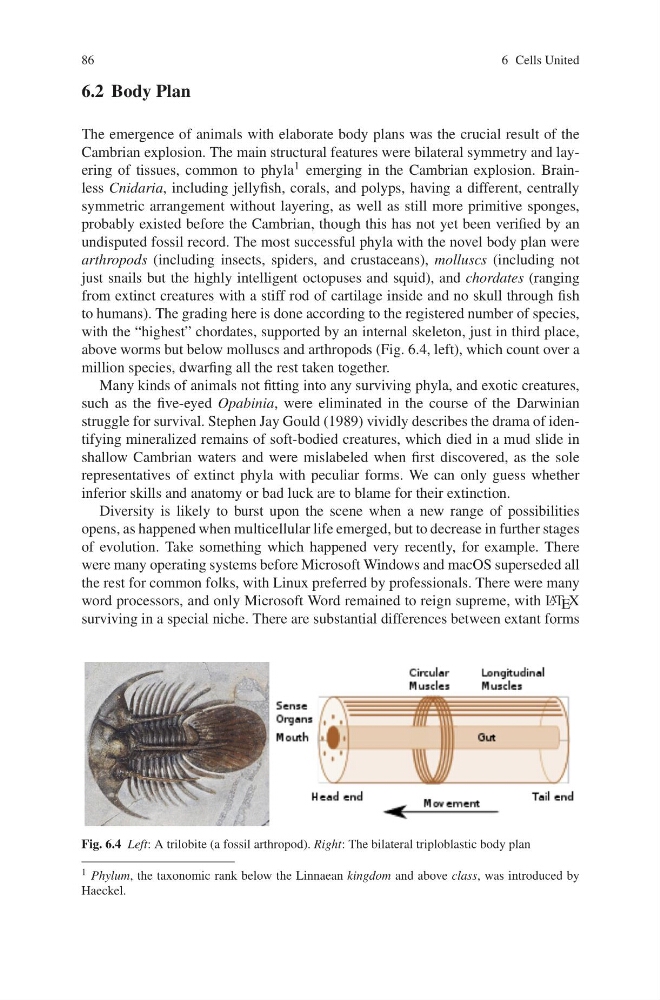
above worms but below molluscs and arthropods (Fig. 6.4, left), which count over a
million species, dwarfing all the rest taken together.
Many kinds of animals not fitting into any surviving phyla, and exotic creatures,
such as the five-eyed Opabinia, were eliminated in the course of the Darwinian
struggle for survival. Stephen Jay Gould (1989) vividly describes the drama of identifying mineralized remains of soft-bodied creatures, which died in a mud slide in
shallow Cambrian waters and were mislabeled when first discovered, as the sole
representatives of extinct phyla with peculiar forms. We can only guess whether
inferior skills and anatomy or bad luck are to blame for their extinction.
Diversity is likely to burst upon the scene when a new range of possibilities
opens, as happened when multicellular life emerged, but to decrease in further stages
of evolution. Take something which happened very recently, for example. There
were many operating systems before Microsoft Windows and macOS superseded all
the rest for common folks, with Linux preferred by professionals. There were many
word processors, and only Microsoft Word remained to reign supreme, with L A T E X
surviving in a special niche. There are substantial differences between extant forms
Fig. 6.4 Left: A trilobite (a fossil arthropod). Right: The bilateral triploblastic body plan
1 Phylum, the taxonomic rank below the Linnaean kingdom and above class, was introduced by
Haeckel.
6 Cells United
6.2 Body Plan
The emergence of animals with elaborate body plans was the crucial result of the
Cambrian explosion. The main structural features were bilateral symmetry and layering of tissues, common to phyla 1 emerging in the Cambrian explosion. Brainless Cnidaria, including jellyfish, corals, and polyps, having a different, centrally
symmetric arrangement without layering, as well as still more primitive sponges,
probably existed before the Cambrian, though this has not yet been verified by an
undisputed fossil record. The most successful phyla with the novel body plan were
arthropods (including insects, spiders, and crustaceans), molluscs (including not
just snails but the highly intelligent octopuses and squid), and chordates (ranging
from extinct creatures with a stiff rod of cartilage inside and no skull through fish
to humans). The grading here is done according to the registered number of species,
with the “highest” chordates, supported by an internal skeleton, just in third place,
above worms but below molluscs and arthropods (Fig. 6.4, left), which count over a
million species, dwarfing all the rest taken together.
Many kinds of animals not fitting into any surviving phyla, and exotic creatures,
such as the five-eyed Opabinia, were eliminated in the course of the Darwinian
struggle for survival. Stephen Jay Gould (1989) vividly describes the drama of identifying mineralized remains of soft-bodied creatures, which died in a mud slide in
shallow Cambrian waters and were mislabeled when first discovered, as the sole
representatives of extinct phyla with peculiar forms. We can only guess whether
inferior skills and anatomy or bad luck are to blame for their extinction.
Diversity is likely to burst upon the scene when a new range of possibilities
opens, as happened when multicellular life emerged, but to decrease in further stages
of evolution. Take something which happened very recently, for example. There
were many operating systems before Microsoft Windows and macOS superseded all
the rest for common folks, with Linux preferred by professionals. There were many
word processors, and only Microsoft Word remained to reign supreme, with L A T E X
surviving in a special niche. There are substantial differences between extant forms
Fig. 6.4 Left: A trilobite (a fossil arthropod). Right: The bilateral triploblastic body plan
1 Phylum, the taxonomic rank below the Linnaean kingdom and above class, was introduced by
Haeckel.