

84
6 Cells United
abilities of slime mold were tested in a harder task: designing a railroad network in
the Tokyo metropolitan area (Tero et al, 2010).
Cellular slime mold gathers in colonies with sophisticated shapes and starts moving as a single body when food is in short supply. It is a natural step from there to a
tentative diversification of the roles played by different cells and the emergence of
specialists expressing and employing different kinds of proteins. Slime molds take
the first step in this direction: when the colony is starving, some cells become infertile, forming a stalk supporting the remaining cells, most of which can bring viable
spores. This kind of division of labor came to its extreme in extant, truly multicellular organisms: somatic cells do all the hard work to sustain gametes, which alone
pass their genes to future generations.
Evolution to multicellularity by cells gathering together or the development of
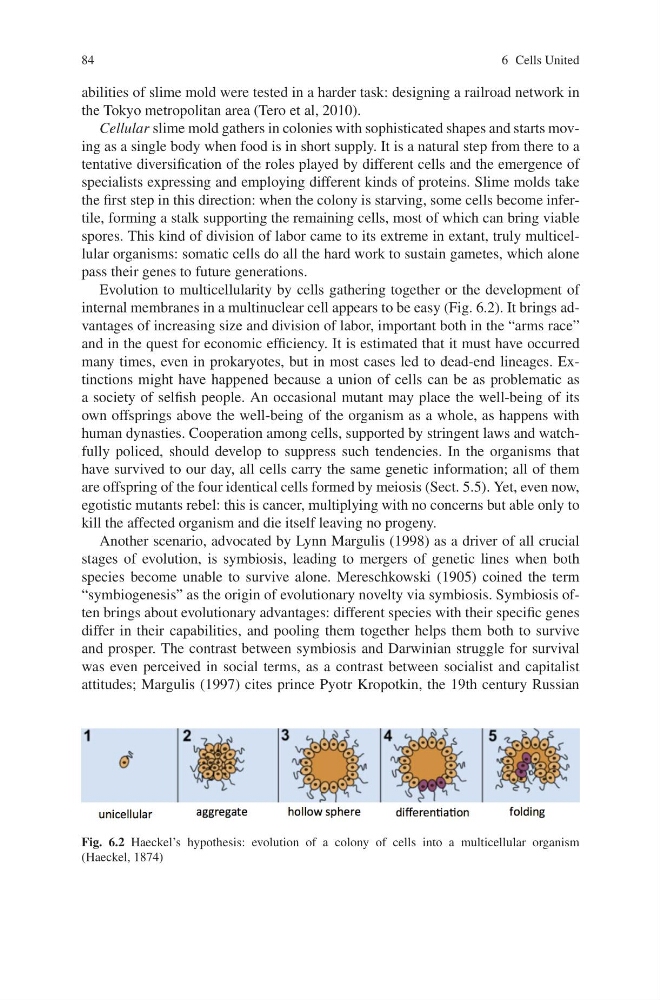
internal membranes in a multinuclear cell appears to be easy (Fig. 6.2). It brings advantages of increasing size and division of labor, important both in the “arms race”
and in the quest for economic efficiency. It is estimated that it must have occurred
many times, even in prokaryotes, but in most cases led to dead-end lineages. Extinctions might have happened because a union of cells can be as problematic as
a society of selfish people. An occasional mutant may place the well-being of its
own offsprings above the well-being of the organism as a whole, as happens with
human dynasties. Cooperation among cells, supported by stringent laws and watchfully policed, should develop to suppress such tendencies. In the organisms that
have survived to our day, all cells carry the same genetic information; all of them
are offspring of the four identical cells formed by meiosis (Sect. 5.5). Yet, even now,
egotistic mutants rebel: this is cancer, multiplying with no concerns but able only to
kill the affected organism and die itself leaving no progeny.
Another scenario, advocated by Lynn Margulis (1998) as a driver of all crucial
stages of evolution, is symbiosis, leading to mergers of genetic lines when both
species become unable to survive alone. Mereschkowski (1905) coined the term
“symbiogenesis” as the origin of evolutionary novelty via symbiosis. Symbiosis often brings about evolutionary advantages: different species with their specific genes
differ in their capabilities, and pooling them together helps them both to survive
and prosper. The contrast between symbiosis and Darwinian struggle for survival
was even perceived in social terms, as a contrast between socialist and capitalist
attitudes; Margulis (1997) cites prince Pyotr Kropotkin, the 19th century Russian
Fig. 6.2 Haeckel’s hypothesis: evolution of a colony of cells into a multicellular organism
(Haeckel, 1874)
6 Cells United
abilities of slime mold were tested in a harder task: designing a railroad network in
the Tokyo metropolitan area (Tero et al, 2010).
Cellular slime mold gathers in colonies with sophisticated shapes and starts moving as a single body when food is in short supply. It is a natural step from there to a
tentative diversification of the roles played by different cells and the emergence of
specialists expressing and employing different kinds of proteins. Slime molds take
the first step in this direction: when the colony is starving, some cells become infertile, forming a stalk supporting the remaining cells, most of which can bring viable
spores. This kind of division of labor came to its extreme in extant, truly multicellular organisms: somatic cells do all the hard work to sustain gametes, which alone
pass their genes to future generations.
Evolution to multicellularity by cells gathering together or the development of
internal membranes in a multinuclear cell appears to be easy (Fig. 6.2). It brings advantages of increasing size and division of labor, important both in the “arms race”
and in the quest for economic efficiency. It is estimated that it must have occurred
many times, even in prokaryotes, but in most cases led to dead-end lineages. Extinctions might have happened because a union of cells can be as problematic as
a society of selfish people. An occasional mutant may place the well-being of its
own offsprings above the well-being of the organism as a whole, as happens with
human dynasties. Cooperation among cells, supported by stringent laws and watchfully policed, should develop to suppress such tendencies. In the organisms that
have survived to our day, all cells carry the same genetic information; all of them
are offspring of the four identical cells formed by meiosis (Sect. 5.5). Yet, even now,
egotistic mutants rebel: this is cancer, multiplying with no concerns but able only to
kill the affected organism and die itself leaving no progeny.
Another scenario, advocated by Lynn Margulis (1998) as a driver of all crucial
stages of evolution, is symbiosis, leading to mergers of genetic lines when both
species become unable to survive alone. Mereschkowski (1905) coined the term
“symbiogenesis” as the origin of evolutionary novelty via symbiosis. Symbiosis often brings about evolutionary advantages: different species with their specific genes
differ in their capabilities, and pooling them together helps them both to survive
and prosper. The contrast between symbiosis and Darwinian struggle for survival
was even perceived in social terms, as a contrast between socialist and capitalist
attitudes; Margulis (1997) cites prince Pyotr Kropotkin, the 19th century Russian
Fig. 6.2 Haeckel’s hypothesis: evolution of a colony of cells into a multicellular organism
(Haeckel, 1874)