

Chapter 6
Cells United
6.1 Why Develop?
Why should multicellular organisms exist at all? Life managed without them for
three eons. Lynn Margulis (1997) rated most highly bacteria that “can do everything
but talk”, and with apparent approval quotes Nietzsche: “the Earth is a beautiful
place, but it has a pox called man”. There is a sort of self-hatred tendency among
radical intellectuals: they blame everything on the tribe they belong to, be it, on
different levels of discussion, animals, the species Homo, or the West.
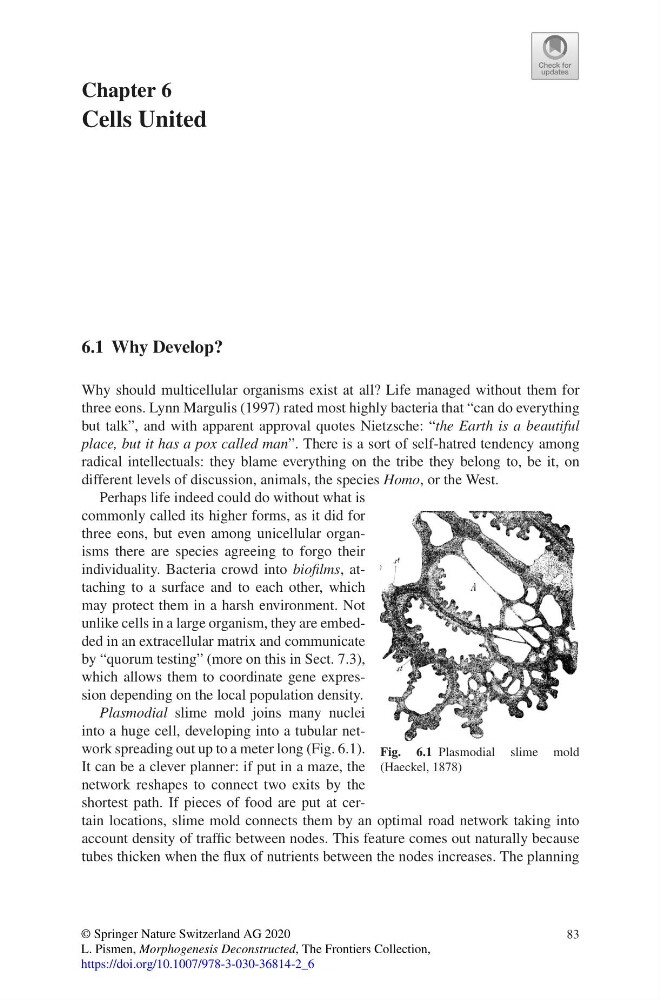
Fig. 6.1 Plasmodial slime mold
(Haeckel, 1878)
Perhaps life indeed could do without what is
commonly called its higher forms, as it did for
three eons, but even among unicellular organisms there are species agreeing to forgo their
individuality. Bacteria crowd into biofilms, attaching to a surface and to each other, which
may protect them in a harsh environment. Not
unlike cells in a large organism, they are embedded in an extracellular matrix and communicate
by “quorum testing” (more on this in Sect. 7.3),
which allows them to coordinate gene expression depending on the local population density.
Plasmodial slime mold joins many nuclei
into a huge cell, developing into a tubular network spreading out up to a meter long (Fig. 6.1).
It can be a clever planner: if put in a maze, the
network reshapes to connect two exits by the
shortest path. If pieces of food are put at certain locations, slime mold connects them by an optimal road network taking into
account density of traffic between nodes. This feature comes out naturally because
tubes thicken when the flux of nutrients between the nodes increases. The planning
83
© Springer Nature Switzerland AG 2020
L. Pismen, Morphogenesis Deconstructed, The Frontiers Collection,
https://doi.org/10.1007/978-3-030-36814-2_6
Cells United
6.1 Why Develop?
Why should multicellular organisms exist at all? Life managed without them for
three eons. Lynn Margulis (1997) rated most highly bacteria that “can do everything
but talk”, and with apparent approval quotes Nietzsche: “the Earth is a beautiful
place, but it has a pox called man”. There is a sort of self-hatred tendency among
radical intellectuals: they blame everything on the tribe they belong to, be it, on
different levels of discussion, animals, the species Homo, or the West.
Fig. 6.1 Plasmodial slime mold
(Haeckel, 1878)
Perhaps life indeed could do without what is
commonly called its higher forms, as it did for
three eons, but even among unicellular organisms there are species agreeing to forgo their
individuality. Bacteria crowd into biofilms, attaching to a surface and to each other, which
may protect them in a harsh environment. Not
unlike cells in a large organism, they are embedded in an extracellular matrix and communicate
by “quorum testing” (more on this in Sect. 7.3),
which allows them to coordinate gene expression depending on the local population density.
Plasmodial slime mold joins many nuclei
into a huge cell, developing into a tubular network spreading out up to a meter long (Fig. 6.1).
It can be a clever planner: if put in a maze, the
network reshapes to connect two exits by the
shortest path. If pieces of food are put at certain locations, slime mold connects them by an optimal road network taking into
account density of traffic between nodes. This feature comes out naturally because
tubes thicken when the flux of nutrients between the nodes increases. The planning
83
© Springer Nature Switzerland AG 2020
L. Pismen, Morphogenesis Deconstructed, The Frontiers Collection,
https://doi.org/10.1007/978-3-030-36814-2_6