

5.6 Crawling and Swimming
77
otic division, which, unlike mitosis, does not involve duplicating the genome. The
daughter cells keep each parent’s homologous pair, and genetic material exchanges
between them through crossing over (Sect. 4.2). The last meiotic division directs
each chromosome from homologous pairs to a separate daughter cell, leaving four
cells with the standard set of chromosomes.
5.6 Crawling and Swimming
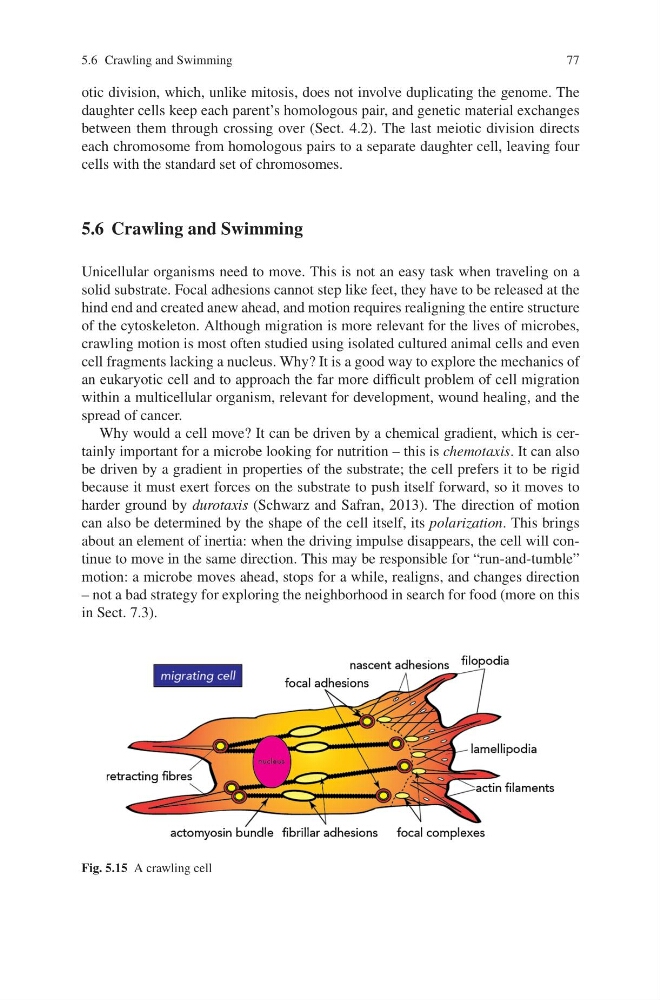
Unicellular organisms need to move. This is not an easy task when traveling on a
solid substrate. Focal adhesions cannot step like feet, they have to be released at the
hind end and created anew ahead, and motion requires realigning the entire structure
of the cytoskeleton. Although migration is more relevant for the lives of microbes,
crawling motion is most often studied using isolated cultured animal cells and even
cell fragments lacking a nucleus. Why? It is a good way to explore the mechanics of
an eukaryotic cell and to approach the far more difficult problem of cell migration
within a multicellular organism, relevant for development, wound healing, and the
spread of cancer.
Why would a cell move? It can be driven by a chemical gradient, which is certainly important for a microbe looking for nutrition – this is chemotaxis. It can also
be driven by a gradient in properties of the substrate; the cell prefers it to be rigid
because it must exert forces on the substrate to push itself forward, so it moves to
harder ground by durotaxis (Schwarz and Safran, 2013). The direction of motion
can also be determined by the shape of the cell itself, its polarization. This brings
about an element of inertia: when the driving impulse disappears, the cell will continue to move in the same direction. This may be responsible for “run-and-tumble”
motion: a microbe moves ahead, stops for a while, realigns, and changes direction
– not a bad strategy for exploring the neighborhood in search for food (more on this
in Sect. 7.3).
Fig. 5.15 A crawling cell
77
otic division, which, unlike mitosis, does not involve duplicating the genome. The
daughter cells keep each parent’s homologous pair, and genetic material exchanges
between them through crossing over (Sect. 4.2). The last meiotic division directs
each chromosome from homologous pairs to a separate daughter cell, leaving four
cells with the standard set of chromosomes.
5.6 Crawling and Swimming
Unicellular organisms need to move. This is not an easy task when traveling on a
solid substrate. Focal adhesions cannot step like feet, they have to be released at the
hind end and created anew ahead, and motion requires realigning the entire structure
of the cytoskeleton. Although migration is more relevant for the lives of microbes,
crawling motion is most often studied using isolated cultured animal cells and even
cell fragments lacking a nucleus. Why? It is a good way to explore the mechanics of
an eukaryotic cell and to approach the far more difficult problem of cell migration
within a multicellular organism, relevant for development, wound healing, and the
spread of cancer.
Why would a cell move? It can be driven by a chemical gradient, which is certainly important for a microbe looking for nutrition – this is chemotaxis. It can also
be driven by a gradient in properties of the substrate; the cell prefers it to be rigid
because it must exert forces on the substrate to push itself forward, so it moves to
harder ground by durotaxis (Schwarz and Safran, 2013). The direction of motion
can also be determined by the shape of the cell itself, its polarization. This brings
about an element of inertia: when the driving impulse disappears, the cell will continue to move in the same direction. This may be responsible for “run-and-tumble”
motion: a microbe moves ahead, stops for a while, realigns, and changes direction
– not a bad strategy for exploring the neighborhood in search for food (more on this
in Sect. 7.3).
Fig. 5.15 A crawling cell