

74
5 Cells in Motion
Actin
+TIP
Microtubule
Crosslinker
+
Plasma
membrane
Microtubule
stabilizing
complex
+
+
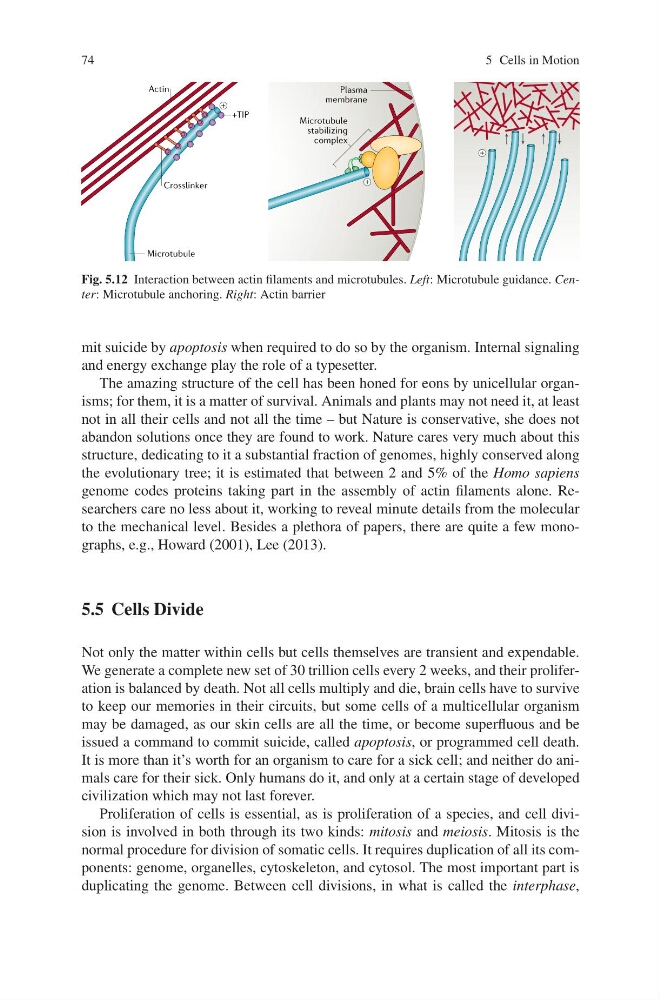
Fig. 5.12 Interaction between actin filaments and microtubules. Left: Microtubule guidance. Center: Microtubule anchoring. Right: Actin barrier
mit suicide by apoptosis when required to do so by the organism. Internal signaling
and energy exchange play the role of a typesetter.
The amazing structure of the cell has been honed for eons by unicellular organisms; for them, it is a matter of survival. Animals and plants may not need it, at least
not in all their cells and not all the time – but Nature is conservative, she does not
abandon solutions once they are found to work. Nature cares very much about this
structure, dedicating to it a substantial fraction of genomes, highly conserved along
the evolutionary tree; it is estimated that between 2 and 5% of the Homo sapiens
genome codes proteins taking part in the assembly of actin filaments alone. Researchers care no less about it, working to reveal minute details from the molecular
to the mechanical level. Besides a plethora of papers, there are quite a few monographs, e.g., Howard (2001), Lee (2013).
5.5 Cells Divide
Not only the matter within cells but cells themselves are transient and expendable.
We generate a complete new set of 30 trillion cells every 2 weeks, and their proliferation is balanced by death. Not all cells multiply and die, brain cells have to survive
to keep our memories in their circuits, but some cells of a multicellular organism
may be damaged, as our skin cells are all the time, or become superfluous and be
issued a command to commit suicide, called apoptosis, or programmed cell death.
It is more than it’s worth for an organism to care for a sick cell; and neither do animals care for their sick. Only humans do it, and only at a certain stage of developed
civilization which may not last forever.
Proliferation of cells is essential, as is proliferation of a species, and cell division is involved in both through its two kinds: mitosis and meiosis. Mitosis is the
normal procedure for division of somatic cells. It requires duplication of all its components: genome, organelles, cytoskeleton, and cytosol. The most important part is
duplicating the genome. Between cell divisions, in what is called the interphase,
5 Cells in Motion
Actin
+TIP
Microtubule
Crosslinker
+
Plasma
membrane
Microtubule
stabilizing
complex
+
+
Fig. 5.12 Interaction between actin filaments and microtubules. Left: Microtubule guidance. Center: Microtubule anchoring. Right: Actin barrier
mit suicide by apoptosis when required to do so by the organism. Internal signaling
and energy exchange play the role of a typesetter.
The amazing structure of the cell has been honed for eons by unicellular organisms; for them, it is a matter of survival. Animals and plants may not need it, at least
not in all their cells and not all the time – but Nature is conservative, she does not
abandon solutions once they are found to work. Nature cares very much about this
structure, dedicating to it a substantial fraction of genomes, highly conserved along
the evolutionary tree; it is estimated that between 2 and 5% of the Homo sapiens
genome codes proteins taking part in the assembly of actin filaments alone. Researchers care no less about it, working to reveal minute details from the molecular
to the mechanical level. Besides a plethora of papers, there are quite a few monographs, e.g., Howard (2001), Lee (2013).
5.5 Cells Divide
Not only the matter within cells but cells themselves are transient and expendable.
We generate a complete new set of 30 trillion cells every 2 weeks, and their proliferation is balanced by death. Not all cells multiply and die, brain cells have to survive
to keep our memories in their circuits, but some cells of a multicellular organism
may be damaged, as our skin cells are all the time, or become superfluous and be
issued a command to commit suicide, called apoptosis, or programmed cell death.
It is more than it’s worth for an organism to care for a sick cell; and neither do animals care for their sick. Only humans do it, and only at a certain stage of developed
civilization which may not last forever.
Proliferation of cells is essential, as is proliferation of a species, and cell division is involved in both through its two kinds: mitosis and meiosis. Mitosis is the
normal procedure for division of somatic cells. It requires duplication of all its components: genome, organelles, cytoskeleton, and cytosol. The most important part is
duplicating the genome. Between cell divisions, in what is called the interphase,