

5.4 Cytoskeleton
73
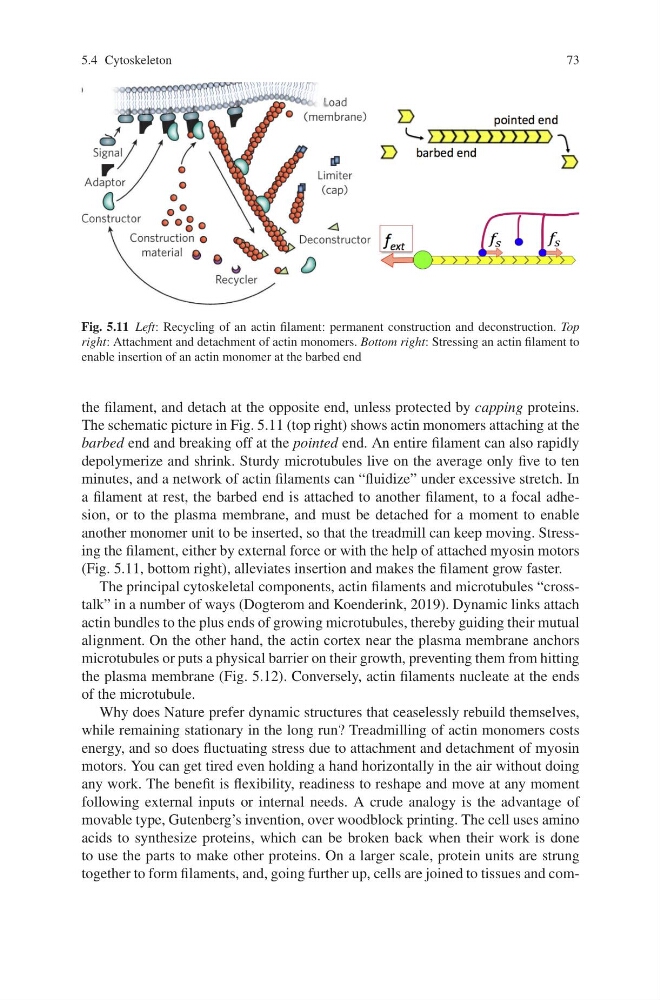
Fig. 5.11 Left: Recycling of an actin filament: permanent construction and deconstruction. Top
right: Attachment and detachment of actin monomers. Bottom right: Stressing an actin filament to
enable insertion of an actin monomer at the barbed end
the filament, and detach at the opposite end, unless protected by capping proteins.
The schematic picture in Fig. 5.11 (top right) shows actin monomers attaching at the
barbed end and breaking off at the pointed end. An entire filament can also rapidly
depolymerize and shrink. Sturdy microtubules live on the average only five to ten
minutes, and a network of actin filaments can “fluidize” under excessive stretch. In
a filament at rest, the barbed end is attached to another filament, to a focal adhesion, or to the plasma membrane, and must be detached for a moment to enable
another monomer unit to be inserted, so that the treadmill can keep moving. Stressing the filament, either by external force or with the help of attached myosin motors
(Fig. 5.11, bottom right), alleviates insertion and makes the filament grow faster.
The principal cytoskeletal components, actin filaments and microtubules “crosstalk” in a number of ways (Dogterom and Koenderink, 2019). Dynamic links attach
actin bundles to the plus ends of growing microtubules, thereby guiding their mutual
alignment. On the other hand, the actin cortex near the plasma membrane anchors
microtubules or puts a physical barrier on their growth, preventing them from hitting
the plasma membrane (Fig. 5.12). Conversely, actin filaments nucleate at the ends
of the microtubule.
Why does Nature prefer dynamic structures that ceaselessly rebuild themselves,
while remaining stationary in the long run? Treadmilling of actin monomers costs
energy, and so does fluctuating stress due to attachment and detachment of myosin
motors. You can get tired even holding a hand horizontally in the air without doing
any work. The benefit is flexibility, readiness to reshape and move at any moment
following external inputs or internal needs. A crude analogy is the advantage of
movable type, Gutenberg’s invention, over woodblock printing. The cell uses amino
acids to synthesize proteins, which can be broken back when their work is done
to use the parts to make other proteins. On a larger scale, protein units are strung
together to form filaments, and, going further up, cells are joined to tissues and com-
73
Fig. 5.11 Left: Recycling of an actin filament: permanent construction and deconstruction. Top
right: Attachment and detachment of actin monomers. Bottom right: Stressing an actin filament to
enable insertion of an actin monomer at the barbed end
the filament, and detach at the opposite end, unless protected by capping proteins.
The schematic picture in Fig. 5.11 (top right) shows actin monomers attaching at the
barbed end and breaking off at the pointed end. An entire filament can also rapidly
depolymerize and shrink. Sturdy microtubules live on the average only five to ten
minutes, and a network of actin filaments can “fluidize” under excessive stretch. In
a filament at rest, the barbed end is attached to another filament, to a focal adhesion, or to the plasma membrane, and must be detached for a moment to enable
another monomer unit to be inserted, so that the treadmill can keep moving. Stressing the filament, either by external force or with the help of attached myosin motors
(Fig. 5.11, bottom right), alleviates insertion and makes the filament grow faster.
The principal cytoskeletal components, actin filaments and microtubules “crosstalk” in a number of ways (Dogterom and Koenderink, 2019). Dynamic links attach
actin bundles to the plus ends of growing microtubules, thereby guiding their mutual
alignment. On the other hand, the actin cortex near the plasma membrane anchors
microtubules or puts a physical barrier on their growth, preventing them from hitting
the plasma membrane (Fig. 5.12). Conversely, actin filaments nucleate at the ends
of the microtubule.
Why does Nature prefer dynamic structures that ceaselessly rebuild themselves,
while remaining stationary in the long run? Treadmilling of actin monomers costs
energy, and so does fluctuating stress due to attachment and detachment of myosin
motors. You can get tired even holding a hand horizontally in the air without doing
any work. The benefit is flexibility, readiness to reshape and move at any moment
following external inputs or internal needs. A crude analogy is the advantage of
movable type, Gutenberg’s invention, over woodblock printing. The cell uses amino
acids to synthesize proteins, which can be broken back when their work is done
to use the parts to make other proteins. On a larger scale, protein units are strung
together to form filaments, and, going further up, cells are joined to tissues and com-