

70
5 Cells in Motion
Transport of ions through membrane channels depends both on their concentration and the voltage difference, combined in an electrochemical potential. Thus, to
maintain equilibrium, the inside should be positively charged. But neither the bacterium nor its descendant follow this rule: they abhor equilibrium, because they need
energy that is released when positive ions rush in, being driven by both concentration and voltage gradient. This energy is used by a molecular machine called ATP
synthase to attach a third phosphorous group back on the ADP.
ATP can be used, among other things, to facilitate transport of ions through the
plasma membrane. An important task, in particular, for nerve cells, is to maintain
the balance between positive potassium K + and sodium Na + ions. Potassium ions,
free to pass through their dedicated channels, are in equilibrium, which means that
the concentration gradient driving them outside should be compensated by negative charge in the cytosol (Fig. 5.6, right). But then sodium ions Na + are driven
inside both by their concentration gradient and voltage difference, in the same way
as hydrogen ions rush through the mitochondrial membrane, and release energy.
The protein called sodium/potassium ATPase located in the plasma membrane uses
the energy stored in ATP to drive Na + ions back and maintain their lower concentration in the cytosol. The entire energy conversion circuit, from the Krebs cycle to
maintaining the sodium/potassium balance, is sketched in Fig. 5.5.
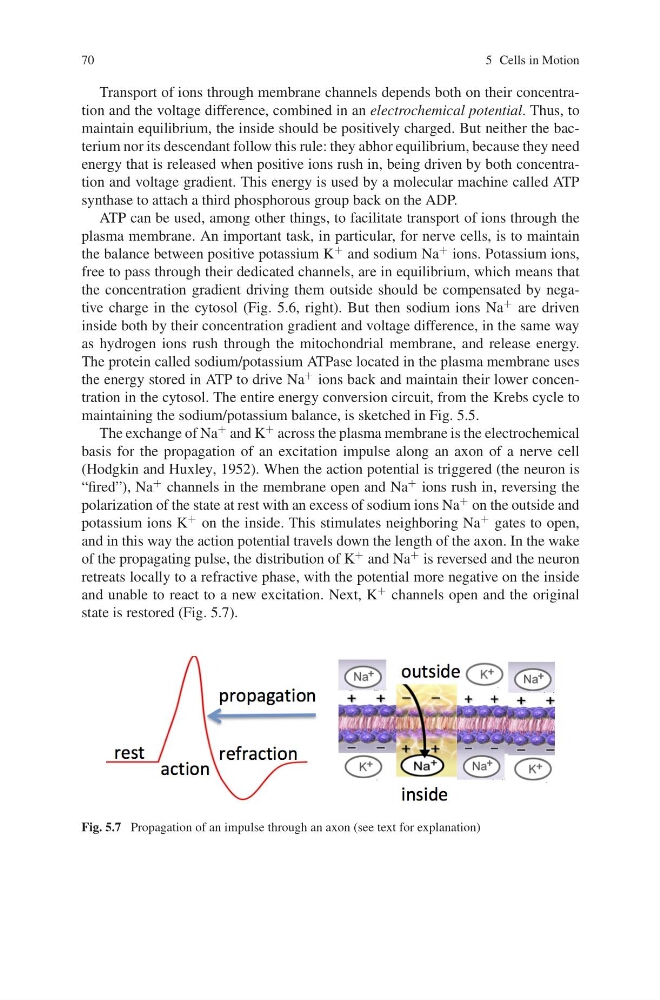
The exchange of Na + and K + across the plasma membrane is the electrochemical
basis for the propagation of an excitation impulse along an axon of a nerve cell
(Hodgkin and Huxley, 1952). When the action potential is triggered (the neuron is
“fired”), Na + channels in the membrane open and Na + ions rush in, reversing the
polarization of the state at rest with an excess of sodium ions Na + on the outside and
potassium ions K + on the inside. This stimulates neighboring Na + gates to open,
and in this way the action potential travels down the length of the axon. In the wake
of the propagating pulse, the distribution of K + and Na + is reversed and the neuron
retreats locally to a refractive phase, with the potential more negative on the inside
and unable to react to a new excitation. Next, K + channels open and the original
state is restored (Fig. 5.7).
Fig. 5.7 Propagation of an impulse through an axon (see text for explanation)
5 Cells in Motion
Transport of ions through membrane channels depends both on their concentration and the voltage difference, combined in an electrochemical potential. Thus, to
maintain equilibrium, the inside should be positively charged. But neither the bacterium nor its descendant follow this rule: they abhor equilibrium, because they need
energy that is released when positive ions rush in, being driven by both concentration and voltage gradient. This energy is used by a molecular machine called ATP
synthase to attach a third phosphorous group back on the ADP.
ATP can be used, among other things, to facilitate transport of ions through the
plasma membrane. An important task, in particular, for nerve cells, is to maintain
the balance between positive potassium K + and sodium Na + ions. Potassium ions,
free to pass through their dedicated channels, are in equilibrium, which means that
the concentration gradient driving them outside should be compensated by negative charge in the cytosol (Fig. 5.6, right). But then sodium ions Na + are driven
inside both by their concentration gradient and voltage difference, in the same way
as hydrogen ions rush through the mitochondrial membrane, and release energy.
The protein called sodium/potassium ATPase located in the plasma membrane uses
the energy stored in ATP to drive Na + ions back and maintain their lower concentration in the cytosol. The entire energy conversion circuit, from the Krebs cycle to
maintaining the sodium/potassium balance, is sketched in Fig. 5.5.
The exchange of Na + and K + across the plasma membrane is the electrochemical
basis for the propagation of an excitation impulse along an axon of a nerve cell
(Hodgkin and Huxley, 1952). When the action potential is triggered (the neuron is
“fired”), Na + channels in the membrane open and Na + ions rush in, reversing the
polarization of the state at rest with an excess of sodium ions Na + on the outside and
potassium ions K + on the inside. This stimulates neighboring Na + gates to open,
and in this way the action potential travels down the length of the axon. In the wake
of the propagating pulse, the distribution of K + and Na + is reversed and the neuron
retreats locally to a refractive phase, with the potential more negative on the inside
and unable to react to a new excitation. Next, K + channels open and the original
state is restored (Fig. 5.7).
Fig. 5.7 Propagation of an impulse through an axon (see text for explanation)