

5.3 Energetics and Electrochemistry
69
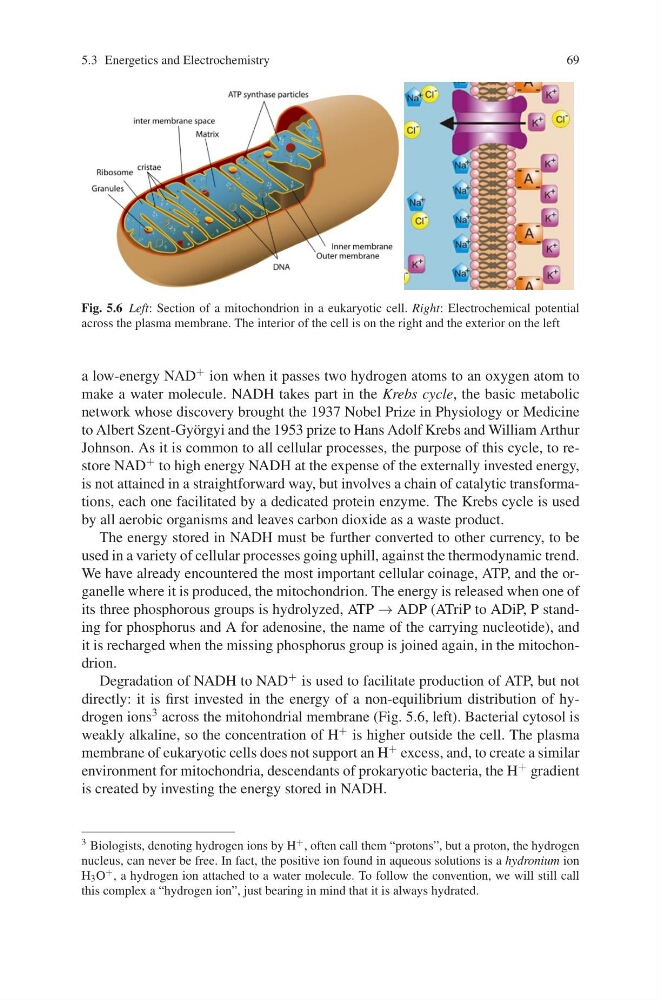
Fig. 5.6 Left: Section of a mitochondrion in a eukaryotic cell. Right: Electrochemical potential
across the plasma membrane. The interior of the cell is on the right and the exterior on the left
a low-energy NAD + ion when it passes two hydrogen atoms to an oxygen atom to
make a water molecule. NADH takes part in the Krebs cycle, the basic metabolic
network whose discovery brought the 1937 Nobel Prize in Physiology or Medicine
to Albert Szent-Gy¨ orgyi and the 1953 prize to Hans Adolf Krebs and William Arthur
Johnson. As it is common to all cellular processes, the purpose of this cycle, to restore NAD + to high energy NADH at the expense of the externally invested energy,
is not attained in a straightforward way, but involves a chain of catalytic transformations, each one facilitated by a dedicated protein enzyme. The Krebs cycle is used
by all aerobic organisms and leaves carbon dioxide as a waste product.
The energy stored in NADH must be further converted to other currency, to be
used in a variety of cellular processes going uphill, against the thermodynamic trend.
We have already encountered the most important cellular coinage, ATP, and the organelle where it is produced, the mitochondrion. The energy is released when one of
its three phosphorous groups is hydrolyzed, ATP → ADP (ATriP to ADiP, P standing for phosphorus and A for adenosine, the name of the carrying nucleotide), and
it is recharged when the missing phosphorus group is joined again, in the mitochondrion.
Degradation of NADH to NAD + is used to facilitate production of ATP, but not
directly: it is first invested in the energy of a non-equilibrium distribution of hydrogen ions 3 across the mitohondrial membrane (Fig. 5.6, left). Bacterial cytosol is
weakly alkaline, so the concentration of H + is higher outside the cell. The plasma
membrane of eukaryotic cells does not support an H + excess, and, to create a similar
environment for mitochondria, descendants of prokaryotic bacteria, the H + gradient
is created by investing the energy stored in NADH.
3 Biologists, denoting hydrogen ions by H + , often call them “protons”, but a proton, the hydrogen
nucleus, can never be free. In fact, the positive ion found in aqueous solutions is a hydronium ion
H 3 O + , a hydrogen ion attached to a water molecule. To follow the convention, we will still call
this complex a “hydrogen ion”, just bearing in mind that it is always hydrated.
69
Fig. 5.6 Left: Section of a mitochondrion in a eukaryotic cell. Right: Electrochemical potential
across the plasma membrane. The interior of the cell is on the right and the exterior on the left
a low-energy NAD + ion when it passes two hydrogen atoms to an oxygen atom to
make a water molecule. NADH takes part in the Krebs cycle, the basic metabolic
network whose discovery brought the 1937 Nobel Prize in Physiology or Medicine
to Albert Szent-Gy¨ orgyi and the 1953 prize to Hans Adolf Krebs and William Arthur
Johnson. As it is common to all cellular processes, the purpose of this cycle, to restore NAD + to high energy NADH at the expense of the externally invested energy,
is not attained in a straightforward way, but involves a chain of catalytic transformations, each one facilitated by a dedicated protein enzyme. The Krebs cycle is used
by all aerobic organisms and leaves carbon dioxide as a waste product.
The energy stored in NADH must be further converted to other currency, to be
used in a variety of cellular processes going uphill, against the thermodynamic trend.
We have already encountered the most important cellular coinage, ATP, and the organelle where it is produced, the mitochondrion. The energy is released when one of
its three phosphorous groups is hydrolyzed, ATP → ADP (ATriP to ADiP, P standing for phosphorus and A for adenosine, the name of the carrying nucleotide), and
it is recharged when the missing phosphorus group is joined again, in the mitochondrion.
Degradation of NADH to NAD + is used to facilitate production of ATP, but not
directly: it is first invested in the energy of a non-equilibrium distribution of hydrogen ions 3 across the mitohondrial membrane (Fig. 5.6, left). Bacterial cytosol is
weakly alkaline, so the concentration of H + is higher outside the cell. The plasma
membrane of eukaryotic cells does not support an H + excess, and, to create a similar
environment for mitochondria, descendants of prokaryotic bacteria, the H + gradient
is created by investing the energy stored in NADH.
3 Biologists, denoting hydrogen ions by H + , often call them “protons”, but a proton, the hydrogen
nucleus, can never be free. In fact, the positive ion found in aqueous solutions is a hydronium ion
H 3 O + , a hydrogen ion attached to a water molecule. To follow the convention, we will still call
this complex a “hydrogen ion”, just bearing in mind that it is always hydrated.