

66
5 Cells in Motion
5.2 Protein Traffic
The principal function of any cell is protein synthesis. In most advanced eukaryotic
cells, proteins are produced on ribosomes which nestle in the maze of rough endoplasmic reticulum adjacent to the nucleus, wherefrom instructions are delivered by
messenger RNA. A ribosome is a sophisticated molecular machine containing its
own ribosomal RNA and enzymes. It scans messenger RNA molecules copied on
DNA in the nucleus and carried through the cytoplasm, and assembles amino acids
coded by their nucleotide sequences. RNA strands are too unstable to travel safely
at elevated temperatures, which explains why there are no thermophiles among eukaryotes. The assembled proteins are packaged and distributed by Golgi apparatus
(Fig. 5.2). The way things work is better seen in the scheme on the right than in
the actual micrograph on the left, where the nucleus in the lower left corner and
rough endoplasmic reticulum are easily recognizable, but further detail has to be
deciphered by those in the know. Smooth endoplasmic reticulum is the site of less
sophisticated synthesis of lipids and other chemicals.
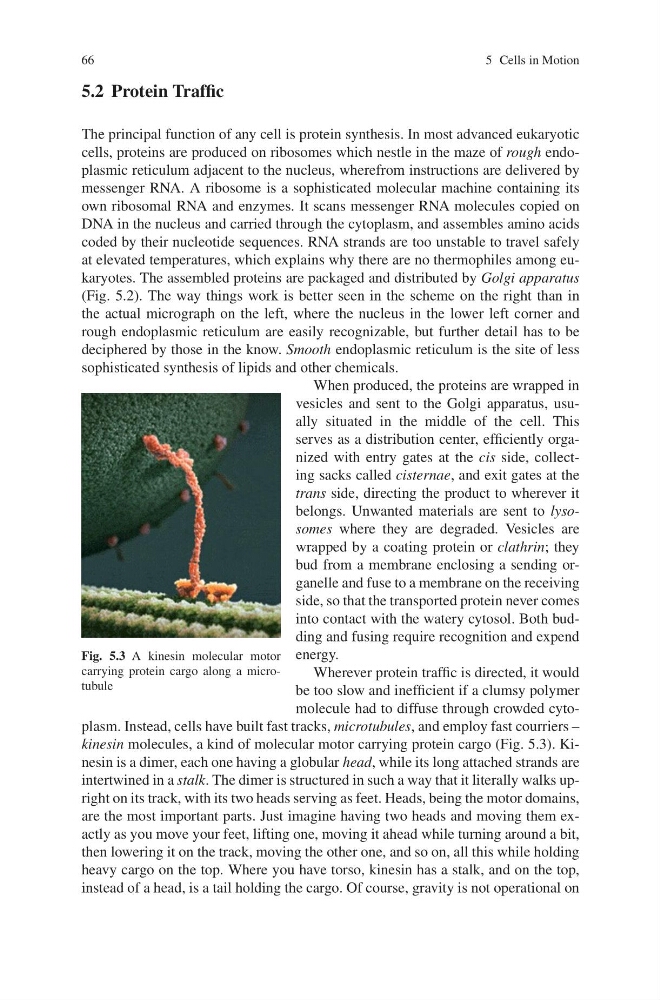
Fig. 5.3 A kinesin molecular motor
carrying protein cargo along a microtubule
When produced, the proteins are wrapped in
vesicles and sent to the Golgi apparatus, usually situated in the middle of the cell. This
serves as a distribution center, efficiently organized with entry gates at the cis side, collecting sacks called cisternae, and exit gates at the
trans side, directing the product to wherever it
belongs. Unwanted materials are sent to lysosomes where they are degraded. Vesicles are
wrapped by a coating protein or clathrin; they
bud from a membrane enclosing a sending organelle and fuse to a membrane on the receiving
side, so that the transported protein never comes
into contact with the watery cytosol. Both budding and fusing require recognition and expend
energy.
Wherever protein traffic is directed, it would
be too slow and inefficient if a clumsy polymer
molecule had to diffuse through crowded cytoplasm. Instead, cells have built fast tracks, microtubules, and employ fast courriers –
kinesin molecules, a kind of molecular motor carrying protein cargo (Fig. 5.3). Kinesin is a dimer, each one having a globular head, while its long attached strands are
intertwined in a stalk. The dimer is structured in such a way that it literally walks upright on its track, with its two heads serving as feet. Heads, being the motor domains,
are the most important parts. Just imagine having two heads and moving them exactly as you move your feet, lifting one, moving it ahead while turning around a bit,
then lowering it on the track, moving the other one, and so on, all this while holding
heavy cargo on the top. Where you have torso, kinesin has a stalk, and on the top,
instead of a head, is a tail holding the cargo. Of course, gravity is not operational on
5 Cells in Motion
5.2 Protein Traffic
The principal function of any cell is protein synthesis. In most advanced eukaryotic
cells, proteins are produced on ribosomes which nestle in the maze of rough endoplasmic reticulum adjacent to the nucleus, wherefrom instructions are delivered by
messenger RNA. A ribosome is a sophisticated molecular machine containing its
own ribosomal RNA and enzymes. It scans messenger RNA molecules copied on
DNA in the nucleus and carried through the cytoplasm, and assembles amino acids
coded by their nucleotide sequences. RNA strands are too unstable to travel safely
at elevated temperatures, which explains why there are no thermophiles among eukaryotes. The assembled proteins are packaged and distributed by Golgi apparatus
(Fig. 5.2). The way things work is better seen in the scheme on the right than in
the actual micrograph on the left, where the nucleus in the lower left corner and
rough endoplasmic reticulum are easily recognizable, but further detail has to be
deciphered by those in the know. Smooth endoplasmic reticulum is the site of less
sophisticated synthesis of lipids and other chemicals.
Fig. 5.3 A kinesin molecular motor
carrying protein cargo along a microtubule
When produced, the proteins are wrapped in
vesicles and sent to the Golgi apparatus, usually situated in the middle of the cell. This
serves as a distribution center, efficiently organized with entry gates at the cis side, collecting sacks called cisternae, and exit gates at the
trans side, directing the product to wherever it
belongs. Unwanted materials are sent to lysosomes where they are degraded. Vesicles are
wrapped by a coating protein or clathrin; they
bud from a membrane enclosing a sending organelle and fuse to a membrane on the receiving
side, so that the transported protein never comes
into contact with the watery cytosol. Both budding and fusing require recognition and expend
energy.
Wherever protein traffic is directed, it would
be too slow and inefficient if a clumsy polymer
molecule had to diffuse through crowded cytoplasm. Instead, cells have built fast tracks, microtubules, and employ fast courriers –
kinesin molecules, a kind of molecular motor carrying protein cargo (Fig. 5.3). Kinesin is a dimer, each one having a globular head, while its long attached strands are
intertwined in a stalk. The dimer is structured in such a way that it literally walks upright on its track, with its two heads serving as feet. Heads, being the motor domains,
are the most important parts. Just imagine having two heads and moving them exactly as you move your feet, lifting one, moving it ahead while turning around a bit,
then lowering it on the track, moving the other one, and so on, all this while holding
heavy cargo on the top. Where you have torso, kinesin has a stalk, and on the top,
instead of a head, is a tail holding the cargo. Of course, gravity is not operational on