

5.1 Why Such a Tangle?
65
pass through a nuclear pore, like entering a code at a safeguarded door. The small
circles in Fig. 4.8 show ribosomes where protein synthesis is carried out.
The cytosol, filling a prokaryotic cell or the cytoplasm of a eukaryotic cell outside the nucleus, is basically just salty water – but it is heavily laced with polymers
that render it viscoelastic. The interior of a cell may look like a chaotic mess of proteins moving in all directors, sometimes carried on the shoulders of motor proteins
running along “scaffolds” – actin filaments that form the cytoskeleton supporting
the cell’s mechanical integrity. Yet somehow, among all this hustle, things are getting done, and even more efficiently than they are done in a well-designed chemical
factory or in a busy city. Cells are always in motion, even when they remain in
place. Uri Alon (2007) expresses it poetically: Cells are matter that dances. Structures spontaneously assemble, perform elaborate biochemical functions, and vanish
effortlessly when their work is done.
So why is the cell so complicated? You acquire complexity by a lifetime of learning, and the cell has had eons to learn, since it first began as a bag of chemicals enclosed by a lipid sheath. The complexity and efficiency of cells defies any social or
industrial analogies. We still have to go a long way to bring social interactions and
technologies to the level of sophistication of a bacterial cell. We can describe the
way a city functions without understanding the lives of its inhabitants, busy in their
various occupations. In the same way, we can try to understand how a cell works
without delving into its deep intrinsic chemical mechanisms.
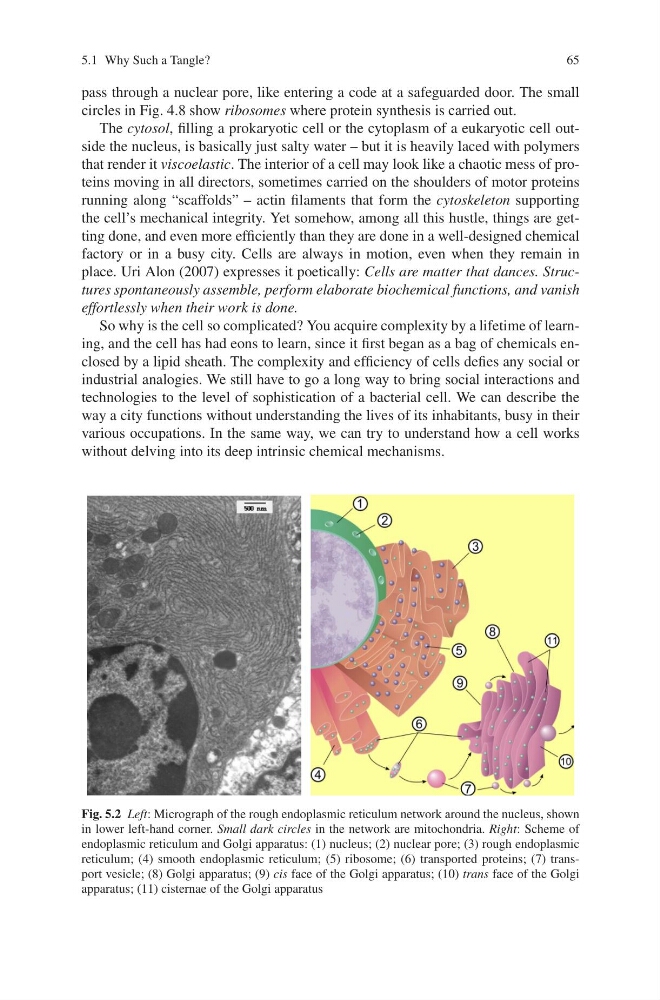
Fig. 5.2 Left: Micrograph of the rough endoplasmic reticulum network around the nucleus, shown
in lower left-hand corner. Small dark circles in the network are mitochondria. Right: Scheme of
endoplasmic reticulum and Golgi apparatus: (1) nucleus; (2) nuclear pore; (3) rough endoplasmic
reticulum; (4) smooth endoplasmic reticulum; (5) ribosome; (6) transported proteins; (7) transport vesicle; (8) Golgi apparatus; (9) cis face of the Golgi apparatus; (10) trans face of the Golgi
apparatus; (11) cisternae of the Golgi apparatus
65
pass through a nuclear pore, like entering a code at a safeguarded door. The small
circles in Fig. 4.8 show ribosomes where protein synthesis is carried out.
The cytosol, filling a prokaryotic cell or the cytoplasm of a eukaryotic cell outside the nucleus, is basically just salty water – but it is heavily laced with polymers
that render it viscoelastic. The interior of a cell may look like a chaotic mess of proteins moving in all directors, sometimes carried on the shoulders of motor proteins
running along “scaffolds” – actin filaments that form the cytoskeleton supporting
the cell’s mechanical integrity. Yet somehow, among all this hustle, things are getting done, and even more efficiently than they are done in a well-designed chemical
factory or in a busy city. Cells are always in motion, even when they remain in
place. Uri Alon (2007) expresses it poetically: Cells are matter that dances. Structures spontaneously assemble, perform elaborate biochemical functions, and vanish
effortlessly when their work is done.
So why is the cell so complicated? You acquire complexity by a lifetime of learning, and the cell has had eons to learn, since it first began as a bag of chemicals enclosed by a lipid sheath. The complexity and efficiency of cells defies any social or
industrial analogies. We still have to go a long way to bring social interactions and
technologies to the level of sophistication of a bacterial cell. We can describe the
way a city functions without understanding the lives of its inhabitants, busy in their
various occupations. In the same way, we can try to understand how a cell works
without delving into its deep intrinsic chemical mechanisms.
Fig. 5.2 Left: Micrograph of the rough endoplasmic reticulum network around the nucleus, shown
in lower left-hand corner. Small dark circles in the network are mitochondria. Right: Scheme of
endoplasmic reticulum and Golgi apparatus: (1) nucleus; (2) nuclear pore; (3) rough endoplasmic
reticulum; (4) smooth endoplasmic reticulum; (5) ribosome; (6) transported proteins; (7) transport vesicle; (8) Golgi apparatus; (9) cis face of the Golgi apparatus; (10) trans face of the Golgi
apparatus; (11) cisternae of the Golgi apparatus