

5.2 Protein Traffic
67
this scale, and there is no difference between up and down, so you really can walk
on your heads, provided you have at least two.
Each head has an attachment site which glues it to the track and is detached
when the head is lifted. The bond between the kinesin and the microtubule must
be physical rather than covalent, to facilitate attachment and detachment. Another
attachment site on the tail binds it to the cargo. Whether walking on feet or on heads,
you need energy. This comes from the common cellular currency – ATP. Each step
involves a change of conformation, and requires one ATP molecule to be released.
The cargo should be carried in a certain direction rather than wander back and forth.
This is ensured by making the tracks unidirectional: the microtubules are polarized,
so that most kinesin molecules walk towards their “positive” end, although some are
able to switch directionality.
Some proteins are carried to the plasma membrane bounding the cell, to be either expelled as waste or sent out as agents of trade and communication with other
cells; other proteins may come from outside as signals, nutrients, or invaders. The
plasma membrane of a eukaryotic cell is organized with a sophistication matching
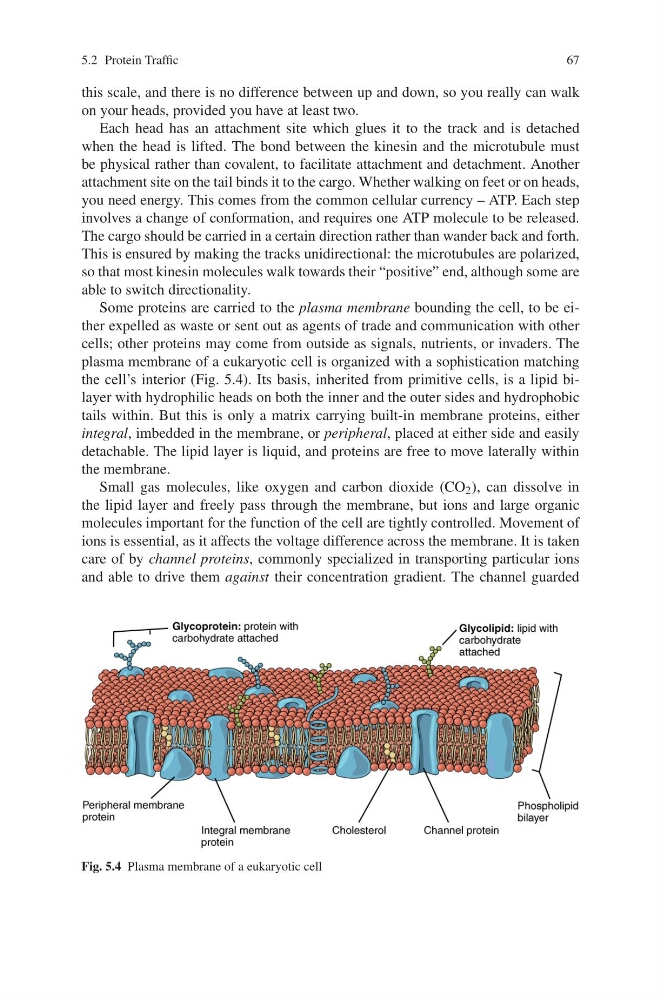
the cell’s interior (Fig. 5.4). Its basis, inherited from primitive cells, is a lipid bilayer with hydrophilic heads on both the inner and the outer sides and hydrophobic
tails within. But this is only a matrix carrying built-in membrane proteins, either
integral, imbedded in the membrane, or peripheral, placed at either side and easily
detachable. The lipid layer is liquid, and proteins are free to move laterally within
the membrane.
Small gas molecules, like oxygen and carbon dioxide (CO 2 ), can dissolve in
the lipid layer and freely pass through the membrane, but ions and large organic
molecules important for the function of the cell are tightly controlled. Movement of
ions is essential, as it affects the voltage difference across the membrane. It is taken
care of by channel proteins, commonly specialized in transporting particular ions
and able to drive them against their concentration gradient. The channel guarded
Fig. 5.4 Plasma membrane of a eukaryotic cell
67
this scale, and there is no difference between up and down, so you really can walk
on your heads, provided you have at least two.
Each head has an attachment site which glues it to the track and is detached
when the head is lifted. The bond between the kinesin and the microtubule must
be physical rather than covalent, to facilitate attachment and detachment. Another
attachment site on the tail binds it to the cargo. Whether walking on feet or on heads,
you need energy. This comes from the common cellular currency – ATP. Each step
involves a change of conformation, and requires one ATP molecule to be released.
The cargo should be carried in a certain direction rather than wander back and forth.
This is ensured by making the tracks unidirectional: the microtubules are polarized,
so that most kinesin molecules walk towards their “positive” end, although some are
able to switch directionality.
Some proteins are carried to the plasma membrane bounding the cell, to be either expelled as waste or sent out as agents of trade and communication with other
cells; other proteins may come from outside as signals, nutrients, or invaders. The
plasma membrane of a eukaryotic cell is organized with a sophistication matching
the cell’s interior (Fig. 5.4). Its basis, inherited from primitive cells, is a lipid bilayer with hydrophilic heads on both the inner and the outer sides and hydrophobic
tails within. But this is only a matrix carrying built-in membrane proteins, either
integral, imbedded in the membrane, or peripheral, placed at either side and easily
detachable. The lipid layer is liquid, and proteins are free to move laterally within
the membrane.
Small gas molecules, like oxygen and carbon dioxide (CO 2 ), can dissolve in
the lipid layer and freely pass through the membrane, but ions and large organic
molecules important for the function of the cell are tightly controlled. Movement of
ions is essential, as it affects the voltage difference across the membrane. It is taken
care of by channel proteins, commonly specialized in transporting particular ions
and able to drive them against their concentration gradient. The channel guarded
Fig. 5.4 Plasma membrane of a eukaryotic cell