

8.4 Nanotechnology
127
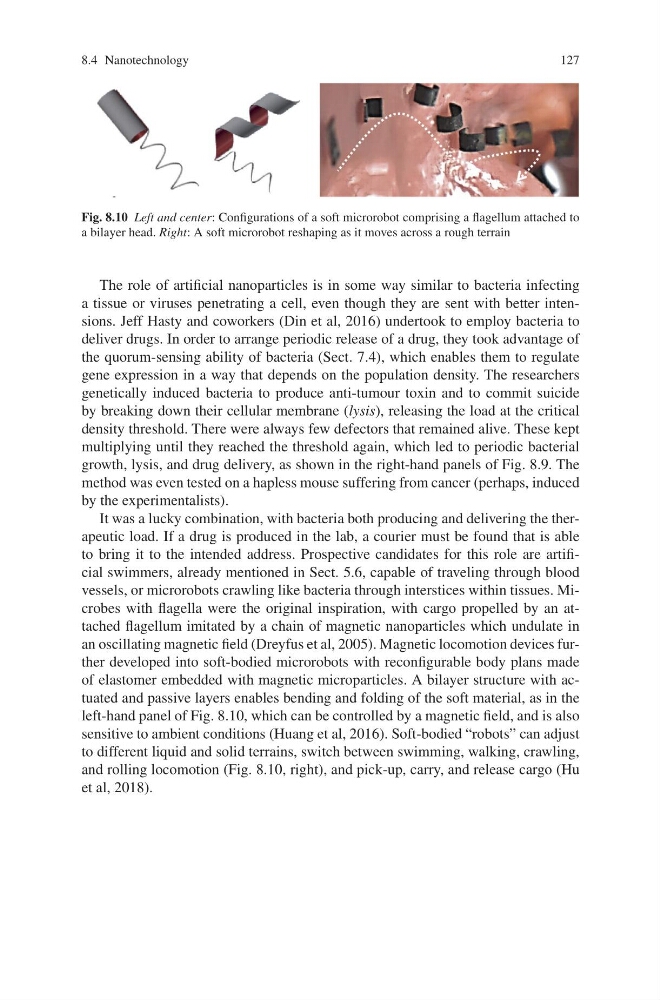
Fig. 8.10 Left and center: Configurations of a soft microrobot comprising a flagellum attached to
a bilayer head. Right: A soft microrobot reshaping as it moves across a rough terrain
The role of artificial nanoparticles is in some way similar to bacteria infecting
a tissue or viruses penetrating a cell, even though they are sent with better intensions. Jeff Hasty and coworkers (Din et al, 2016) undertook to employ bacteria to
deliver drugs. In order to arrange periodic release of a drug, they took advantage of
the quorum-sensing ability of bacteria (Sect. 7.4), which enables them to regulate
gene expression in a way that depends on the population density. The researchers
genetically induced bacteria to produce anti-tumour toxin and to commit suicide
by breaking down their cellular membrane (lysis), releasing the load at the critical
density threshold. There were always few defectors that remained alive. These kept
multiplying until they reached the threshold again, which led to periodic bacterial
growth, lysis, and drug delivery, as shown in the right-hand panels of Fig. 8.9. The
method was even tested on a hapless mouse suffering from cancer (perhaps, induced
by the experimentalists).
It was a lucky combination, with bacteria both producing and delivering the therapeutic load. If a drug is produced in the lab, a courier must be found that is able
to bring it to the intended address. Prospective candidates for this role are artificial swimmers, already mentioned in Sect. 5.6, capable of traveling through blood
vessels, or microrobots crawling like bacteria through interstices within tissues. Microbes with flagella were the original inspiration, with cargo propelled by an attached flagellum imitated by a chain of magnetic nanoparticles which undulate in
an oscillating magnetic field (Dreyfus et al, 2005). Magnetic locomotion devices further developed into soft-bodied microrobots with reconfigurable body plans made
of elastomer embedded with magnetic microparticles. A bilayer structure with actuated and passive layers enables bending and folding of the soft material, as in the
left-hand panel of Fig. 8.10, which can be controlled by a magnetic field, and is also
sensitive to ambient conditions (Huang et al, 2016). Soft-bodied “robots” can adjust
to different liquid and solid terrains, switch between swimming, walking, crawling,
and rolling locomotion (Fig. 8.10, right), and pick-up, carry, and release cargo (Hu
et al, 2018).
127
Fig. 8.10 Left and center: Configurations of a soft microrobot comprising a flagellum attached to
a bilayer head. Right: A soft microrobot reshaping as it moves across a rough terrain
The role of artificial nanoparticles is in some way similar to bacteria infecting
a tissue or viruses penetrating a cell, even though they are sent with better intensions. Jeff Hasty and coworkers (Din et al, 2016) undertook to employ bacteria to
deliver drugs. In order to arrange periodic release of a drug, they took advantage of
the quorum-sensing ability of bacteria (Sect. 7.4), which enables them to regulate
gene expression in a way that depends on the population density. The researchers
genetically induced bacteria to produce anti-tumour toxin and to commit suicide
by breaking down their cellular membrane (lysis), releasing the load at the critical
density threshold. There were always few defectors that remained alive. These kept
multiplying until they reached the threshold again, which led to periodic bacterial
growth, lysis, and drug delivery, as shown in the right-hand panels of Fig. 8.9. The
method was even tested on a hapless mouse suffering from cancer (perhaps, induced
by the experimentalists).
It was a lucky combination, with bacteria both producing and delivering the therapeutic load. If a drug is produced in the lab, a courier must be found that is able
to bring it to the intended address. Prospective candidates for this role are artificial swimmers, already mentioned in Sect. 5.6, capable of traveling through blood
vessels, or microrobots crawling like bacteria through interstices within tissues. Microbes with flagella were the original inspiration, with cargo propelled by an attached flagellum imitated by a chain of magnetic nanoparticles which undulate in
an oscillating magnetic field (Dreyfus et al, 2005). Magnetic locomotion devices further developed into soft-bodied microrobots with reconfigurable body plans made
of elastomer embedded with magnetic microparticles. A bilayer structure with actuated and passive layers enables bending and folding of the soft material, as in the
left-hand panel of Fig. 8.10, which can be controlled by a magnetic field, and is also
sensitive to ambient conditions (Huang et al, 2016). Soft-bodied “robots” can adjust
to different liquid and solid terrains, switch between swimming, walking, crawling,
and rolling locomotion (Fig. 8.10, right), and pick-up, carry, and release cargo (Hu
et al, 2018).