

128
8 Biomorphic Technologies
8.5 Tinkering with Nature
A chance discovery by Jozef Schell and Marc van Montagu’s group (Zaenen et
al, 1974) that the Agrobacterium tumefaciens microbe induces cancer in plants by
inserting detrimental code sequences into the cell’s genome was redirected to beneficial use, adding desirable genes in a cheap and easy way, say, to make plants
disease-resistant. This led to the development of an entire industry producing genetically modified organisms (GMO), referred to by its detractors as “Frankenfood”,
forbidden in some countries, although its ill effects are not evident. This opens both
heavenly and abysmal prospects, from eliminating genetic diseases to producing
designer babies to creating half-human hybrids to releasing deadly viruses into the
environment. Of course, abhorrent applications of genetic engineering will be or already are legally forbidden, but this will not deter curious clandestine researchers,
still less plain criminals.
The next step – perhaps from earthly to alien life – was the synthesis of unnatural DNA containing “letters” different from the four present in the natural genome.
Floyd Romesberg and coworkers (Zhang et al, 2017) inserted a synthetic base pair
into the genome of E. coli, the favorite microbe of researchers. The alien form was
healthy and able to store the information carried by the six-letter alphabet, transcribing the unnatural nucleotides into the codons of messenger RNA and using them to
produce proteins containing unconventional amino acids. It didn’t stop here. Steve
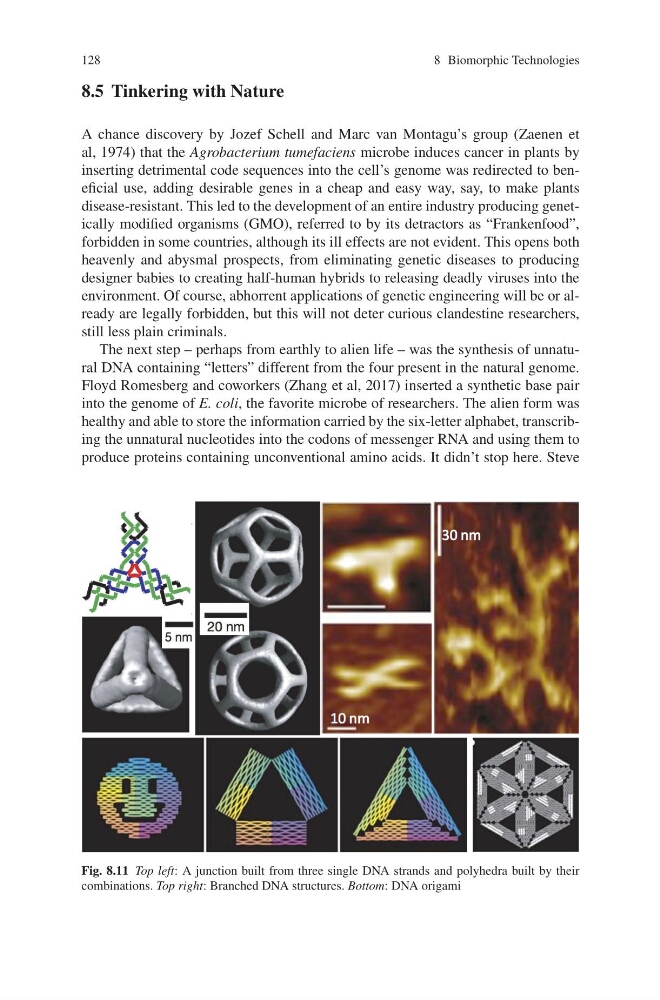
Fig. 8.11 Top left: A junction built from three single DNA strands and polyhedra built by their
combinations. Top right: Branched DNA structures. Bottom: DNA origami
8 Biomorphic Technologies
8.5 Tinkering with Nature
A chance discovery by Jozef Schell and Marc van Montagu’s group (Zaenen et
al, 1974) that the Agrobacterium tumefaciens microbe induces cancer in plants by
inserting detrimental code sequences into the cell’s genome was redirected to beneficial use, adding desirable genes in a cheap and easy way, say, to make plants
disease-resistant. This led to the development of an entire industry producing genetically modified organisms (GMO), referred to by its detractors as “Frankenfood”,
forbidden in some countries, although its ill effects are not evident. This opens both
heavenly and abysmal prospects, from eliminating genetic diseases to producing
designer babies to creating half-human hybrids to releasing deadly viruses into the
environment. Of course, abhorrent applications of genetic engineering will be or already are legally forbidden, but this will not deter curious clandestine researchers,
still less plain criminals.
The next step – perhaps from earthly to alien life – was the synthesis of unnatural DNA containing “letters” different from the four present in the natural genome.
Floyd Romesberg and coworkers (Zhang et al, 2017) inserted a synthetic base pair
into the genome of E. coli, the favorite microbe of researchers. The alien form was
healthy and able to store the information carried by the six-letter alphabet, transcribing the unnatural nucleotides into the codons of messenger RNA and using them to
produce proteins containing unconventional amino acids. It didn’t stop here. Steve
Fig. 8.11 Top left: A junction built from three single DNA strands and polyhedra built by their
combinations. Top right: Branched DNA structures. Bottom: DNA origami