

7.3 The Bacterial Alternative
111
that a run is going in the wrong direction it tumbles with a higher probability, and
the other way around.
It is quite comfortable to devise and implement models where “walkers” representing either bacteria or abstract “active particles” move while interacting with
other particles through induced fields or just sensing them in the vicinity. Walkers may also possess geometric characteristics, most commonly, polarization. The
bacterium habitually used in experiments, E. coli, is oblong; thus, it can be characterized by a director aligned with its long axis (Sect. 3.3). Interaction between
polarized particles favoring their mutual alignment is also a feature of many models.
The direction of motion can also be viewed as a geometric characteristic, equivalent to vector polarization. The simplest model of collective motion (Vicsek et al,
1995) contains a single interaction mechanism: the velocity of each particle has to
align with that of its close neighbors. This model has become very popular, being
applied even to such animate assemblies as bird flocks and fish shoals. The advantage (or, depending on your point of view, disadvantage) of models of this kind is
that they may produce pictures bearing a superficial resemblance with observations
even when they do not reflect the actual way the system in question operates. Alignment of migrating birds and fish is motivated by hydrodynamics: in this way, they
save propulsion effort. Computing hydrodynamic interactions is a hard task. In the
case of microbes, interactions are carried by induced viscous flow (Sect. 5.6) and
can be computed, though not easily and not precisely, but in the case of fish and
birds, solving the hydrodynamic problem involving inertia and turbulence would be
hopeless. The Vicsek model avoids this trouble.
Models including chemotaxis have plenty of leeway, as there are a great many
ways to assign signaling species, their emission and sensing characteristics, and possibly also the manner in which polarization modifies the motion. But a resemblance
with experimental results, as I already mentioned, never proves a model’s validity.
Time (growth)
Signal concentration
Threshold concentration
Emitter
Responder
Signal
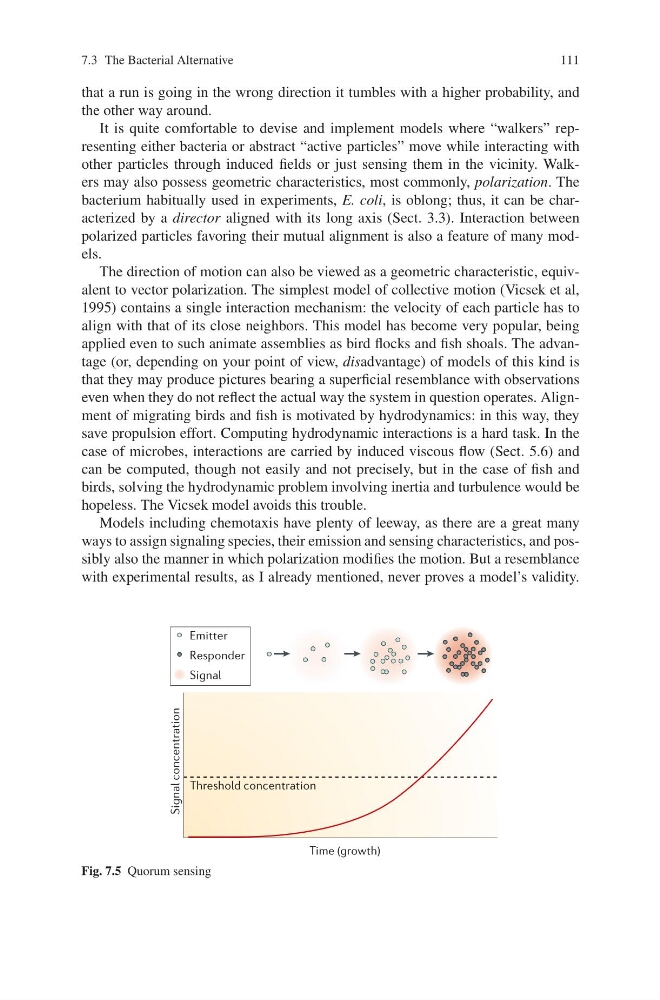
Fig. 7.5 Quorum sensing
111
that a run is going in the wrong direction it tumbles with a higher probability, and
the other way around.
It is quite comfortable to devise and implement models where “walkers” representing either bacteria or abstract “active particles” move while interacting with
other particles through induced fields or just sensing them in the vicinity. Walkers may also possess geometric characteristics, most commonly, polarization. The
bacterium habitually used in experiments, E. coli, is oblong; thus, it can be characterized by a director aligned with its long axis (Sect. 3.3). Interaction between
polarized particles favoring their mutual alignment is also a feature of many models.
The direction of motion can also be viewed as a geometric characteristic, equivalent to vector polarization. The simplest model of collective motion (Vicsek et al,
1995) contains a single interaction mechanism: the velocity of each particle has to
align with that of its close neighbors. This model has become very popular, being
applied even to such animate assemblies as bird flocks and fish shoals. The advantage (or, depending on your point of view, disadvantage) of models of this kind is
that they may produce pictures bearing a superficial resemblance with observations
even when they do not reflect the actual way the system in question operates. Alignment of migrating birds and fish is motivated by hydrodynamics: in this way, they
save propulsion effort. Computing hydrodynamic interactions is a hard task. In the
case of microbes, interactions are carried by induced viscous flow (Sect. 5.6) and
can be computed, though not easily and not precisely, but in the case of fish and
birds, solving the hydrodynamic problem involving inertia and turbulence would be
hopeless. The Vicsek model avoids this trouble.
Models including chemotaxis have plenty of leeway, as there are a great many
ways to assign signaling species, their emission and sensing characteristics, and possibly also the manner in which polarization modifies the motion. But a resemblance
with experimental results, as I already mentioned, never proves a model’s validity.
Time (growth)
Signal concentration
Threshold concentration
Emitter
Responder
Signal
Fig. 7.5 Quorum sensing