

110
7 Communication
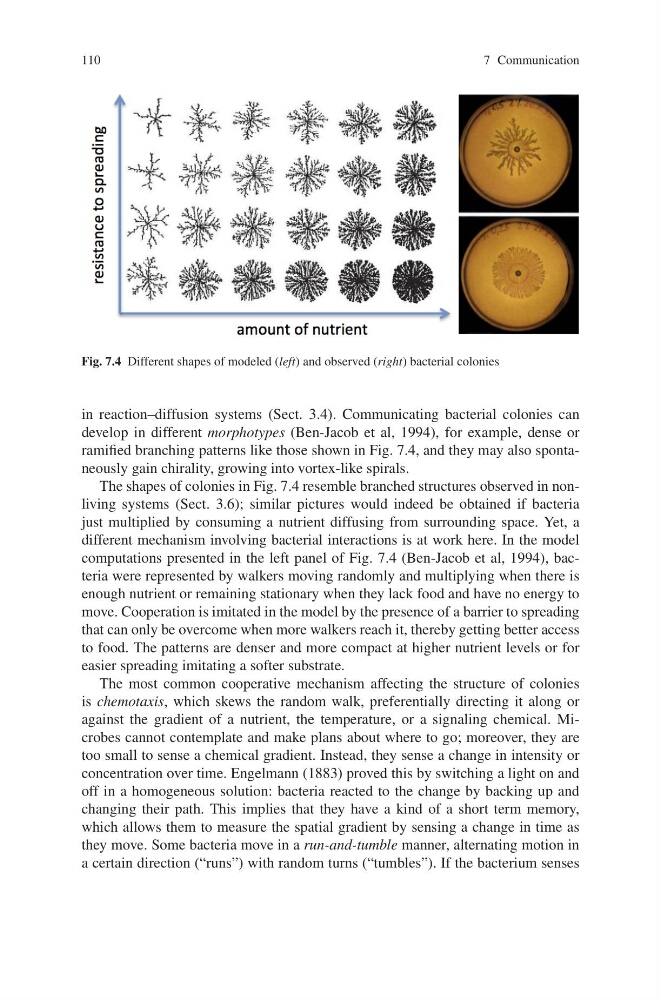
Fig. 7.4 Different shapes of modeled (left) and observed (right) bacterial colonies
in reaction–diffusion systems (Sect. 3.4). Communicating bacterial colonies can
develop in different morphotypes (Ben-Jacob et al, 1994), for example, dense or
ramified branching patterns like those shown in Fig. 7.4, and they may also spontaneously gain chirality, growing into vortex-like spirals.
The shapes of colonies in Fig. 7.4 resemble branched structures observed in nonliving systems (Sect. 3.6); similar pictures would indeed be obtained if bacteria
just multiplied by consuming a nutrient diffusing from surrounding space. Yet, a
different mechanism involving bacterial interactions is at work here. In the model
computations presented in the left panel of Fig. 7.4 (Ben-Jacob et al, 1994), bacteria were represented by walkers moving randomly and multiplying when there is
enough nutrient or remaining stationary when they lack food and have no energy to
move. Cooperation is imitated in the model by the presence of a barrier to spreading
that can only be overcome when more walkers reach it, thereby getting better access
to food. The patterns are denser and more compact at higher nutrient levels or for
easier spreading imitating a softer substrate.
The most common cooperative mechanism affecting the structure of colonies
is chemotaxis, which skews the random walk, preferentially directing it along or
against the gradient of a nutrient, the temperature, or a signaling chemical. Microbes cannot contemplate and make plans about where to go; moreover, they are
too small to sense a chemical gradient. Instead, they sense a change in intensity or
concentration over time. Engelmann (1883) proved this by switching a light on and
off in a homogeneous solution: bacteria reacted to the change by backing up and
changing their path. This implies that they have a kind of a short term memory,
which allows them to measure the spatial gradient by sensing a change in time as
they move. Some bacteria move in a run-and-tumble manner, alternating motion in
a certain direction (“runs”) with random turns (“tumbles”). If the bacterium senses
7 Communication
Fig. 7.4 Different shapes of modeled (left) and observed (right) bacterial colonies
in reaction–diffusion systems (Sect. 3.4). Communicating bacterial colonies can
develop in different morphotypes (Ben-Jacob et al, 1994), for example, dense or
ramified branching patterns like those shown in Fig. 7.4, and they may also spontaneously gain chirality, growing into vortex-like spirals.
The shapes of colonies in Fig. 7.4 resemble branched structures observed in nonliving systems (Sect. 3.6); similar pictures would indeed be obtained if bacteria
just multiplied by consuming a nutrient diffusing from surrounding space. Yet, a
different mechanism involving bacterial interactions is at work here. In the model
computations presented in the left panel of Fig. 7.4 (Ben-Jacob et al, 1994), bacteria were represented by walkers moving randomly and multiplying when there is
enough nutrient or remaining stationary when they lack food and have no energy to
move. Cooperation is imitated in the model by the presence of a barrier to spreading
that can only be overcome when more walkers reach it, thereby getting better access
to food. The patterns are denser and more compact at higher nutrient levels or for
easier spreading imitating a softer substrate.
The most common cooperative mechanism affecting the structure of colonies
is chemotaxis, which skews the random walk, preferentially directing it along or
against the gradient of a nutrient, the temperature, or a signaling chemical. Microbes cannot contemplate and make plans about where to go; moreover, they are
too small to sense a chemical gradient. Instead, they sense a change in intensity or
concentration over time. Engelmann (1883) proved this by switching a light on and
off in a homogeneous solution: bacteria reacted to the change by backing up and
changing their path. This implies that they have a kind of a short term memory,
which allows them to measure the spatial gradient by sensing a change in time as
they move. Some bacteria move in a run-and-tumble manner, alternating motion in
a certain direction (“runs”) with random turns (“tumbles”). If the bacterium senses