

6.4 Mechanics of Tissues
95
cells from surface tension – he could not know of myosin motors stressing the cell.
The changing shapes of an amoeba presented some problem, so he explained that
surface tension is different at different locations; not very persuasive, since it should
apparently be negative wherever the shape is concave. His transformations yielding
the shapes of various fish (Fig. 6.9) and the spirals of mollusc shells or ram horns
were also qualitative, devoid of actual chemical and physical mechanisms. Stephen
Wolfram (2002) found it particularly attractive, as it fits well with the digital games
of his “new kind of science”. Both D’Arcy Thompson and Wolfram are preoccupied
with outward features, like visible shapes, pigmentation patterns, or arrangements
of leaves, as their approach cannot penetrate deeper into the inner workings of life.
Of course, in D’Arcy Thompson’s day, there was no other choice.
It appears to be a straightforward task to apply the well-developed apparatus
of continuum mechanics to live tissues. The problem lies in complex and largely
unknown chemo-mechanical interactions in a jumbled environment of living tissues.
Therefore a cell-based discretized approach turns out to be more efficient than direct
application of continuous equations (which in any case would be discretized on an
arbitrary grid when computing). Deformations and motions of cells are too difficult
to observe and model in a three-dimensional setting, but two-dimensional tissues
are both common and convenient to handle.
The original blastula (Sect. 6.3) is a two-dimensional shell, and epithelial layers
of skin, guts, etc., play an important role in a grown organism. Cells densely fill
such layers, and their basic arrangement, as in generic two-dimensional patterns,
is a hexagonal grid (Sect. 3.4). Of course, the movement of cells, their growth and
division, will always distort the ideal regular pattern, but one of its features is robust:
the number of three-cell junctions, or vertices. On the average, each cell in a layer
has six neighbors and six vertices. A four-cell junction is non-generic and highly
improbable; even in such an artificial construction as the map of the US there is a
single “four-corner” point. A convenient way to study rearrangements of cellular
layers is to study the dynamics of vertices. Mechanical laws are introduced in such
models in an implicit way by assigning an energy function dependent on deviations
from certain optimal values of the area and the perimeter of the cell (Farhadifar et al,
2007). Changing the area will also imply changing the local thickness of the layer
if the volume is fixed, or an even more drastic rearrangement of the cell interior if
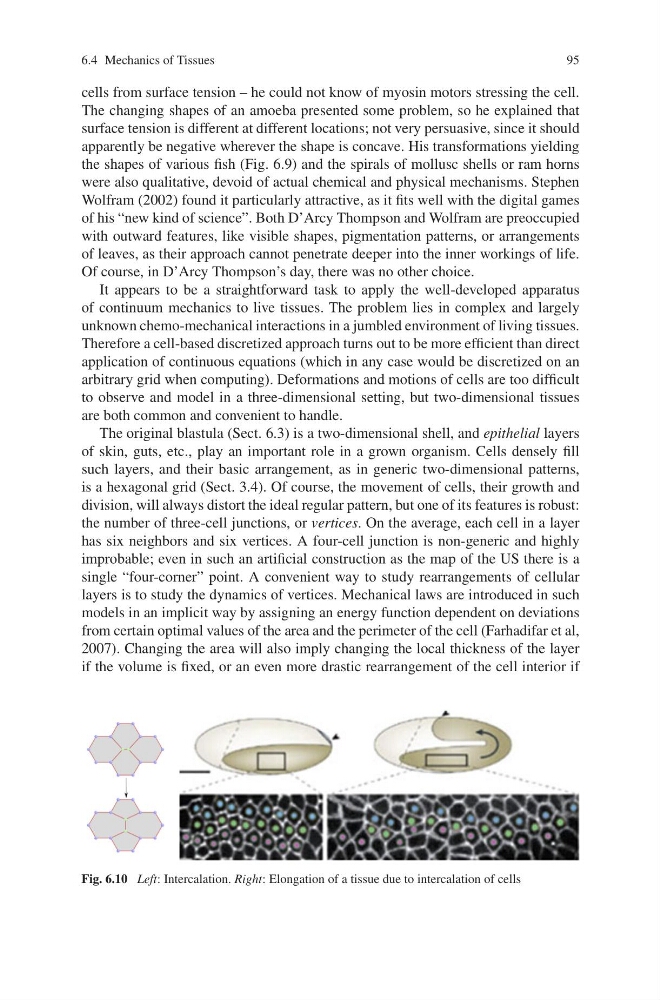
Fig. 6.10 Left: Intercalation. Right: Elongation of a tissue due to intercalation of cells
95
cells from surface tension – he could not know of myosin motors stressing the cell.
The changing shapes of an amoeba presented some problem, so he explained that
surface tension is different at different locations; not very persuasive, since it should
apparently be negative wherever the shape is concave. His transformations yielding
the shapes of various fish (Fig. 6.9) and the spirals of mollusc shells or ram horns
were also qualitative, devoid of actual chemical and physical mechanisms. Stephen
Wolfram (2002) found it particularly attractive, as it fits well with the digital games
of his “new kind of science”. Both D’Arcy Thompson and Wolfram are preoccupied
with outward features, like visible shapes, pigmentation patterns, or arrangements
of leaves, as their approach cannot penetrate deeper into the inner workings of life.
Of course, in D’Arcy Thompson’s day, there was no other choice.
It appears to be a straightforward task to apply the well-developed apparatus
of continuum mechanics to live tissues. The problem lies in complex and largely
unknown chemo-mechanical interactions in a jumbled environment of living tissues.
Therefore a cell-based discretized approach turns out to be more efficient than direct
application of continuous equations (which in any case would be discretized on an
arbitrary grid when computing). Deformations and motions of cells are too difficult
to observe and model in a three-dimensional setting, but two-dimensional tissues
are both common and convenient to handle.
The original blastula (Sect. 6.3) is a two-dimensional shell, and epithelial layers
of skin, guts, etc., play an important role in a grown organism. Cells densely fill
such layers, and their basic arrangement, as in generic two-dimensional patterns,
is a hexagonal grid (Sect. 3.4). Of course, the movement of cells, their growth and
division, will always distort the ideal regular pattern, but one of its features is robust:
the number of three-cell junctions, or vertices. On the average, each cell in a layer
has six neighbors and six vertices. A four-cell junction is non-generic and highly
improbable; even in such an artificial construction as the map of the US there is a
single “four-corner” point. A convenient way to study rearrangements of cellular
layers is to study the dynamics of vertices. Mechanical laws are introduced in such
models in an implicit way by assigning an energy function dependent on deviations
from certain optimal values of the area and the perimeter of the cell (Farhadifar et al,
2007). Changing the area will also imply changing the local thickness of the layer
if the volume is fixed, or an even more drastic rearrangement of the cell interior if
Fig. 6.10 Left: Intercalation. Right: Elongation of a tissue due to intercalation of cells