

94
6 Cells United
inhibition, involve different kinds of communication between cells (see Fig. 6.7).
Intricate mechanisms are guessed, disputed, and modeled for the various details of
Drosophila anatomy, as well as for other model animals, and the search is bound to
continue.
As Wolpert (2016) himself admits, we still do not know the molecular basis of
positional information [. . . ], nor do we have convincing evidence of how positional
values are specified or interpreted. The hope that particular mechanisms revealed
by studies of model animals might be generic is often justified, but it can never be
guaranteed that other creatures did not arrive at different patterning mechanisms.
The detailed view is frustratingly complex. It is essential when studying human
development and physiology, even at the price of sacrificing our mammal relatives
to save human lives. It may help to elucidate general principles as well, but it is too
often driven by the inertia of academic routine, convenience of experimentation, and
availability of funds.
6.4 Mechanics of Tissues
D’Arcy Thompson (1917) was the first to emphasize the roles of physical laws and
mechanics in development, rising against the attitude of biologists of his age who
were deeply reluctant to compare the living with the dead, or to explain by geometry or by dynamics the things which have their part in the mystery of life. It was
prophetic at his time to write: Cell and tissue, shell and bone, leaf and flower, are so
many portions of matter, and it is in obedience to the laws of physics that their particles have been moved, moulded and conformed. Although he is sometimes called
the founder of mathematical biology, his methods are far removed from those of
modern theories, and he himself admitted his weakness in mathematics.
There is nothing in life that needs more physics than was known in the early 20th
century and of which D’Arcy Thompson was aware, though not on a professional
level. You don’t need quantum mechanics to understand life; the level of quantumchemical computations lies too deep, and will never be practical for understanding
the properties of large molecules, let alone their interactions. But the proper tools
for deep study had not yet arrived by then. His was a qualitative approach with
clever estimates based on the physics he knew, for example, deducing shapes of
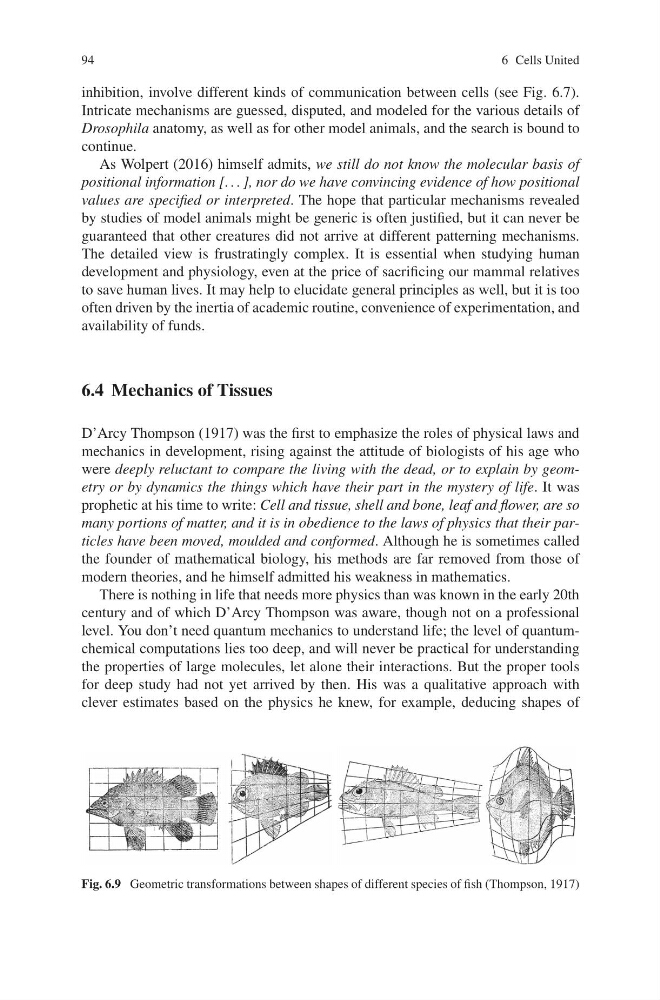
Fig. 6.9 Geometric transformations between shapes of different species of fish (Thompson, 1917)
6 Cells United
inhibition, involve different kinds of communication between cells (see Fig. 6.7).
Intricate mechanisms are guessed, disputed, and modeled for the various details of
Drosophila anatomy, as well as for other model animals, and the search is bound to
continue.
As Wolpert (2016) himself admits, we still do not know the molecular basis of
positional information [. . . ], nor do we have convincing evidence of how positional
values are specified or interpreted. The hope that particular mechanisms revealed
by studies of model animals might be generic is often justified, but it can never be
guaranteed that other creatures did not arrive at different patterning mechanisms.
The detailed view is frustratingly complex. It is essential when studying human
development and physiology, even at the price of sacrificing our mammal relatives
to save human lives. It may help to elucidate general principles as well, but it is too
often driven by the inertia of academic routine, convenience of experimentation, and
availability of funds.
6.4 Mechanics of Tissues
D’Arcy Thompson (1917) was the first to emphasize the roles of physical laws and
mechanics in development, rising against the attitude of biologists of his age who
were deeply reluctant to compare the living with the dead, or to explain by geometry or by dynamics the things which have their part in the mystery of life. It was
prophetic at his time to write: Cell and tissue, shell and bone, leaf and flower, are so
many portions of matter, and it is in obedience to the laws of physics that their particles have been moved, moulded and conformed. Although he is sometimes called
the founder of mathematical biology, his methods are far removed from those of
modern theories, and he himself admitted his weakness in mathematics.
There is nothing in life that needs more physics than was known in the early 20th
century and of which D’Arcy Thompson was aware, though not on a professional
level. You don’t need quantum mechanics to understand life; the level of quantumchemical computations lies too deep, and will never be practical for understanding
the properties of large molecules, let alone their interactions. But the proper tools
for deep study had not yet arrived by then. His was a qualitative approach with
clever estimates based on the physics he knew, for example, deducing shapes of
Fig. 6.9 Geometric transformations between shapes of different species of fish (Thompson, 1917)