

83
4
Homogeneous mixed organometallic catalysts found by Ziegler, Sloan and Lapporte (ZSL
catalysts) and further developed by Bernhard
Fell have a good chance of industrial application.
They are based on the metals nickel or cobalt and
are activated by aluminum alkyls.
Another possibility for the selective
hydrogenation of oleochemicals is the use of
special palladium nanocatalysts. They can be
produced relatively easily in situ from palladium dichloride by reduction with hydrogen
in the presence of a relatively polar solvent
such as propylene carbonate. Palladium colloids of only a few nanometers in size are
formed, which are long-term stabilized by the
coordinating solvent. Due to the large surface area of the nanoparticles, they are very
active, so that some selective hydrogenations
of oleochemicals are completed after only a
few minutes. At the same time, they lead very
selectively to the desired mono-unsaturated
oleochemicals. A further advantage of these
catalysts is their easy recyclability: The nanocatalyst remains completely dissolved in the
propylene carbonate phase, which can be
easily separated after the reaction has taken
place. For faster separation, only a few percent
of water is added to the propylene carbonate
phase (. Fig. 4.29).
4.2.3 Linkage of New C-H Bonds
New C–H bonds are formed in the catalytic
hydrogenation of unsaturated oleochemicals
with hydrogen. The first heterogeneous hydrogenation catalysts were discovered in 1897 by
Paul Sabatier and Jean Baptiste Senderens and
then applied to unsaturated fats in 1901 by
Wilhelm Normann. The use of heterogeneous
nickel catalysts is today an industrial standard
to improve the color and odor stability of oleochemicals or to convert (liquid) oils into (solid)
margarine. The latter reaction is also the reason
why hydrogenation in oleochemistry is often
referred to as “hardening”.
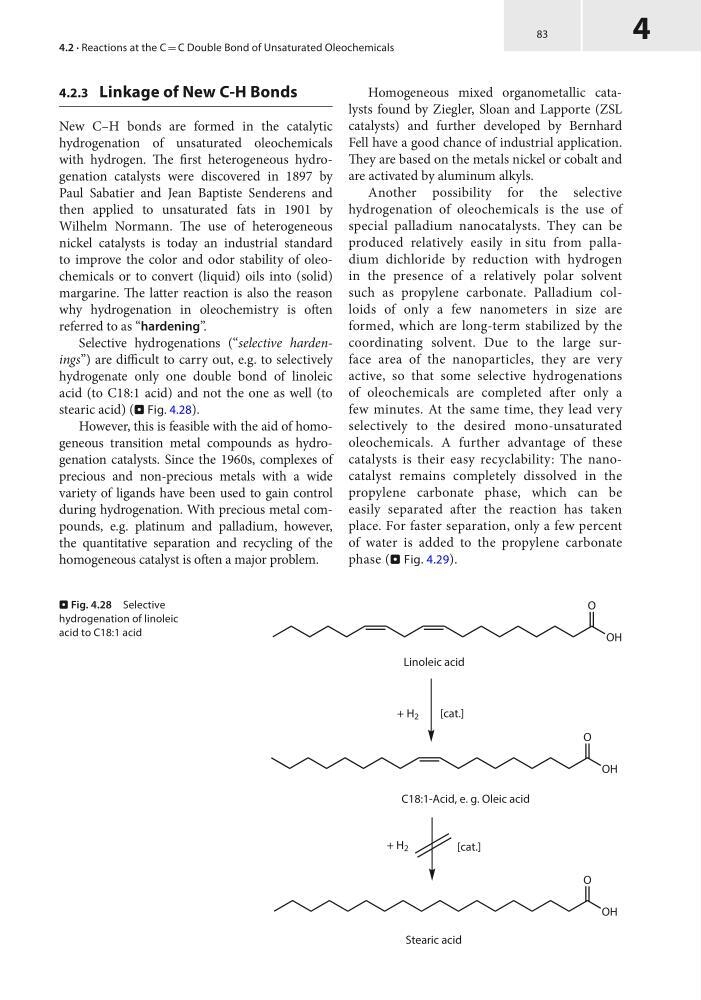
Selective hydrogenations (“selective hardenings”) are difficult to carry out, e.g. to selectively
hydrogenate only one double bond of linoleic
acid (to C18:1 acid) and not the one as well (to
stearic acid) (. Fig. 4.28).
However, this is feasible with the aid of homogeneous transition metal compounds as hydrogenation catalysts. Since the 1960s, complexes of
precious and non-precious metals with a wide
variety of ligands have been used to gain control
during hydrogenation. With precious metal compounds, e.g. platinum and palladium, however,
the quantitative separation and recycling of the
homogeneous catalyst is often a major problem.
. Fig. 4.28 Selective
hydrogenation of linoleic
acid to C18:1 acid
OH
O
+ H 2
OH
O
Linoleic acid
C18:1-Acid, e. g. Oleic acid
[cat.]
+ H 2
[cat.]
OH
O
Stearic acid
4.2 · Reactions at the C = C Double Bond of Unsaturated Oleochemicals
4
Homogeneous mixed organometallic catalysts found by Ziegler, Sloan and Lapporte (ZSL
catalysts) and further developed by Bernhard
Fell have a good chance of industrial application.
They are based on the metals nickel or cobalt and
are activated by aluminum alkyls.
Another possibility for the selective
hydrogenation of oleochemicals is the use of
special palladium nanocatalysts. They can be
produced relatively easily in situ from palladium dichloride by reduction with hydrogen
in the presence of a relatively polar solvent
such as propylene carbonate. Palladium colloids of only a few nanometers in size are
formed, which are long-term stabilized by the
coordinating solvent. Due to the large surface area of the nanoparticles, they are very
active, so that some selective hydrogenations
of oleochemicals are completed after only a
few minutes. At the same time, they lead very
selectively to the desired mono-unsaturated
oleochemicals. A further advantage of these
catalysts is their easy recyclability: The nanocatalyst remains completely dissolved in the
propylene carbonate phase, which can be
easily separated after the reaction has taken
place. For faster separation, only a few percent
of water is added to the propylene carbonate
phase (. Fig. 4.29).
4.2.3 Linkage of New C-H Bonds
New C–H bonds are formed in the catalytic
hydrogenation of unsaturated oleochemicals
with hydrogen. The first heterogeneous hydrogenation catalysts were discovered in 1897 by
Paul Sabatier and Jean Baptiste Senderens and
then applied to unsaturated fats in 1901 by
Wilhelm Normann. The use of heterogeneous
nickel catalysts is today an industrial standard
to improve the color and odor stability of oleochemicals or to convert (liquid) oils into (solid)
margarine. The latter reaction is also the reason
why hydrogenation in oleochemistry is often
referred to as “hardening”.
Selective hydrogenations (“selective hardenings”) are difficult to carry out, e.g. to selectively
hydrogenate only one double bond of linoleic
acid (to C18:1 acid) and not the one as well (to
stearic acid) (. Fig. 4.28).
However, this is feasible with the aid of homogeneous transition metal compounds as hydrogenation catalysts. Since the 1960s, complexes of
precious and non-precious metals with a wide
variety of ligands have been used to gain control
during hydrogenation. With precious metal compounds, e.g. platinum and palladium, however,
the quantitative separation and recycling of the
homogeneous catalyst is often a major problem.
. Fig. 4.28 Selective
hydrogenation of linoleic
acid to C18:1 acid
OH
O
+ H 2
OH
O
Linoleic acid
C18:1-Acid, e. g. Oleic acid
[cat.]
+ H 2
[cat.]
OH
O
Stearic acid
4.2 · Reactions at the C = C Double Bond of Unsaturated Oleochemicals