

82
Chapter 4 · There is More to Oleochemistry - Reactions at the Fatty Acid Alkyl Chain
4
converted into a polyester by cobalt-catalyzed
alkoxycarbonylation.
5 If the acid is only reduced to the level of
10-undecenal and then aldol condensation
is carried out, the result is again a molecule
with two terminal double bonds, which can
be polymerized again by ADMET.
A major disadvantage of ricinoleic acid is that
it occurs exclusively in castor oil, of which only
relatively small amounts are available. If one
compares the 10-undecenoic acid accessible from
castor oil with the 9-decenoic acid produced by
ethenolysis of methyl oleate, it becomes obvious
that there is a much broader raw material basis
for the latter.
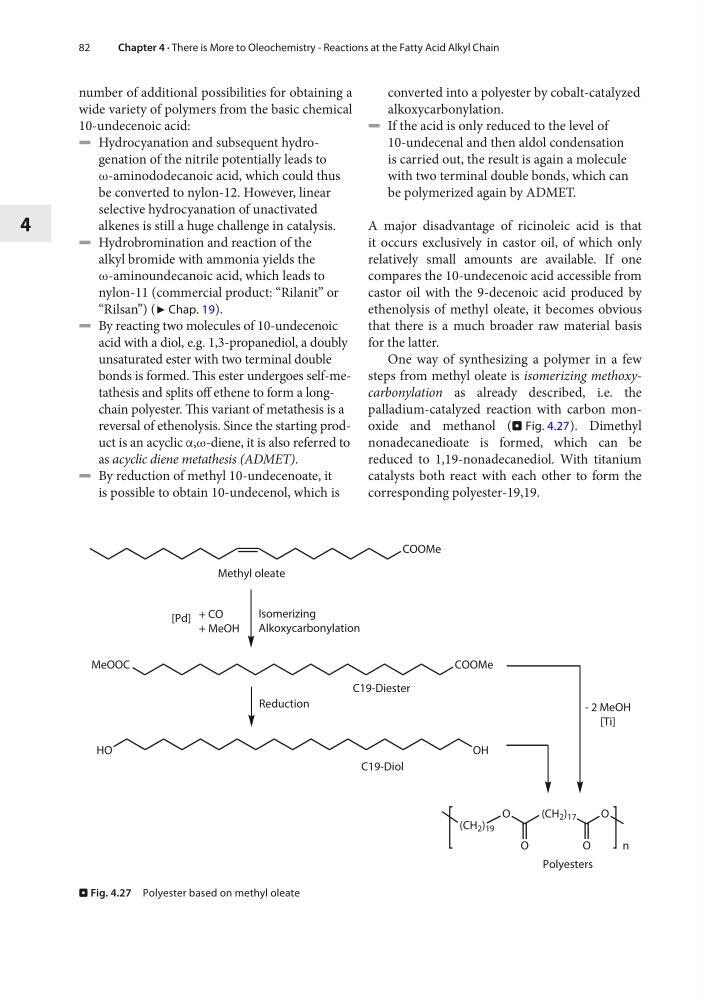
One way of synthesizing a polymer in a few
steps from methyl oleate is isomerizing methoxycarbonylation as already described, i.e. the
palladium-catalyzed reaction with carbon monoxide and methanol (. Fig. 4.27). Dimethyl
nonadecanedioate is formed, which can be
reduced to 1,19-nonadecanediol. With titanium
catalysts both react with each other to form the
corresponding polyester-19,19.
number of additional possibilities for obtaining a
wide variety of polymers from the basic chemical
10-undecenoic acid:
5 Hydrocyanation and subsequent hydrogenation of the nitrile potentially leads to
ω-aminododecanoic acid, which could thus
be converted to nylon-12. However, linear
selective hydrocyanation of unactivated
alkenes is still a huge challenge in catalysis.
5 Hydrobromination and reaction of the
alkyl bromide with ammonia yields the
ω-aminoundecanoic acid, which leads to
nylon-11 (commercial product: “Rilanit” or
“Rilsan”) (7 Chap. 19).
5 By reacting two molecules of 10-undecenoic
acid with a diol, e.g. 1,3-propanediol, a doubly
unsaturated ester with two terminal double
bonds is formed. This ester undergoes self-metathesis and splits off ethene to form a longchain polyester. This variant of metathesis is a
reversal of ethenolysis. Since the starting product is an acyclic α,ω-diene, it is also referred to
as acyclic diene metathesis (ADMET).
5 By reduction of methyl 10-undecenoate, it
is possible to obtain 10-undecenol, which is
COOMe
Methyl oleate
Isomerizing
Alkoxycarbonylation
+ CO
+ MeOH
[Pd]
MeOOC
COOMe
Reduction
HO
OH
- 2 MeOH
[Ti]
(CH 2 ) 19
O
(CH 2 ) 17
O
O
O
n
Polyesters
C19-Diester
C19-Diol
. Fig. 4.27 Polyester based on methyl oleate
Chapter 4 · There is More to Oleochemistry - Reactions at the Fatty Acid Alkyl Chain
4
converted into a polyester by cobalt-catalyzed
alkoxycarbonylation.
5 If the acid is only reduced to the level of
10-undecenal and then aldol condensation
is carried out, the result is again a molecule
with two terminal double bonds, which can
be polymerized again by ADMET.
A major disadvantage of ricinoleic acid is that
it occurs exclusively in castor oil, of which only
relatively small amounts are available. If one
compares the 10-undecenoic acid accessible from
castor oil with the 9-decenoic acid produced by
ethenolysis of methyl oleate, it becomes obvious
that there is a much broader raw material basis
for the latter.
One way of synthesizing a polymer in a few
steps from methyl oleate is isomerizing methoxycarbonylation as already described, i.e. the
palladium-catalyzed reaction with carbon monoxide and methanol (. Fig. 4.27). Dimethyl
nonadecanedioate is formed, which can be
reduced to 1,19-nonadecanediol. With titanium
catalysts both react with each other to form the
corresponding polyester-19,19.
number of additional possibilities for obtaining a
wide variety of polymers from the basic chemical
10-undecenoic acid:
5 Hydrocyanation and subsequent hydrogenation of the nitrile potentially leads to
ω-aminododecanoic acid, which could thus
be converted to nylon-12. However, linear
selective hydrocyanation of unactivated
alkenes is still a huge challenge in catalysis.
5 Hydrobromination and reaction of the
alkyl bromide with ammonia yields the
ω-aminoundecanoic acid, which leads to
nylon-11 (commercial product: “Rilanit” or
“Rilsan”) (7 Chap. 19).
5 By reacting two molecules of 10-undecenoic
acid with a diol, e.g. 1,3-propanediol, a doubly
unsaturated ester with two terminal double
bonds is formed. This ester undergoes self-metathesis and splits off ethene to form a longchain polyester. This variant of metathesis is a
reversal of ethenolysis. Since the starting product is an acyclic α,ω-diene, it is also referred to
as acyclic diene metathesis (ADMET).
5 By reduction of methyl 10-undecenoate, it
is possible to obtain 10-undecenol, which is
COOMe
Methyl oleate
Isomerizing
Alkoxycarbonylation
+ CO
+ MeOH
[Pd]
MeOOC
COOMe
Reduction
HO
OH
- 2 MeOH
[Ti]
(CH 2 ) 19
O
(CH 2 ) 17
O
O
O
n
Polyesters
C19-Diester
C19-Diol
. Fig. 4.27 Polyester based on methyl oleate