

84
Chapter 4 · There is More to Oleochemistry - Reactions at the Fatty Acid Alkyl Chain
4
are exclusively formed. Before addition to
zirconium, an internal double bond is always
isomerized to a terminal double bond.
Unfortunately, unsaturated fatty acids cannot
be used directly in this reaction: The carboxy
group must first be protected by a reaction
with amino alcohols as oxazoline group. This
reaction is also stoichiometric in relation to
zirconium and would first have to be converted into a catalytic reaction. Catalytic
hydrozirconation could be used to specifically
produce oleochemicals with terminal double
bonds, the advantages of which we have
already learned about.
5 The situation with hydroalumination is
quite analogous: Alkenes with internal double bonds also react exclusively to primary
aluminum alkylene. This reaction can be
carried out catalytically with titanium
catalysts. A transfer to oleochemicals is still
pending.
4.2.4 Further Additions
to the C=C Double Bonds
of Oleochemicals
This section briefly mentions some (more exotic)
additions to unsaturated fats that lead to unusual
products and could therefore become important:
5 Hydrosilylation of unsaturated fats with
silanes is one way of forming C-Si bonds and
thus producing special silicones with fatty
alkyl chains. Such products are being discussed for hydrophobizing building surfaces
or as specialty lubricants. One example is
the hydrosilylation of methyl linoleate with
dimethylchlorosilane shown in Eq. 4.2. The
Speier catalyst, hexachloroplatinic acid, is
used as catalyst.
5 Hydrozirconation of alkenes is important
because - independent of the position of the
double bond in the alkene - the corresponding primary zirconium organic compounds
Pd
Separator
C18:1-Acids
H2O/Propylene
carbonate
Pd- nanocatalyst
M
Linoleic
Acid
Hydrogen
Reactor
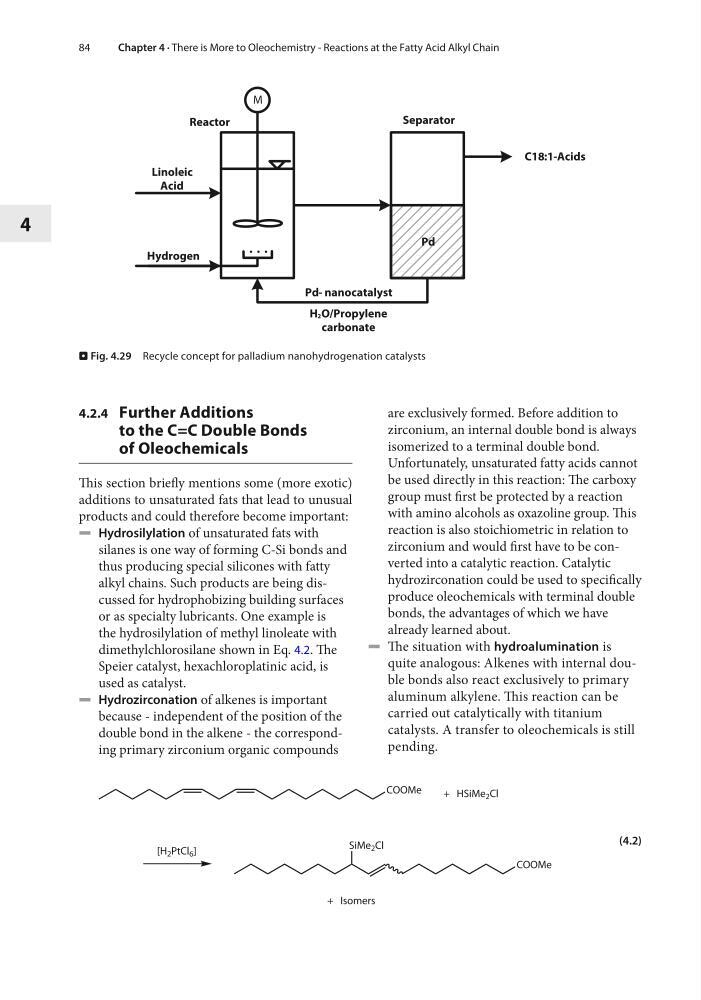
. Fig. 4.29 Recycle concept for palladium nanohydrogenation catalysts
(4.2)
Chapter 4 · There is More to Oleochemistry - Reactions at the Fatty Acid Alkyl Chain
4
are exclusively formed. Before addition to
zirconium, an internal double bond is always
isomerized to a terminal double bond.
Unfortunately, unsaturated fatty acids cannot
be used directly in this reaction: The carboxy
group must first be protected by a reaction
with amino alcohols as oxazoline group. This
reaction is also stoichiometric in relation to
zirconium and would first have to be converted into a catalytic reaction. Catalytic
hydrozirconation could be used to specifically
produce oleochemicals with terminal double
bonds, the advantages of which we have
already learned about.
5 The situation with hydroalumination is
quite analogous: Alkenes with internal double bonds also react exclusively to primary
aluminum alkylene. This reaction can be
carried out catalytically with titanium
catalysts. A transfer to oleochemicals is still
pending.
4.2.4 Further Additions
to the C=C Double Bonds
of Oleochemicals
This section briefly mentions some (more exotic)
additions to unsaturated fats that lead to unusual
products and could therefore become important:
5 Hydrosilylation of unsaturated fats with
silanes is one way of forming C-Si bonds and
thus producing special silicones with fatty
alkyl chains. Such products are being discussed for hydrophobizing building surfaces
or as specialty lubricants. One example is
the hydrosilylation of methyl linoleate with
dimethylchlorosilane shown in Eq. 4.2. The
Speier catalyst, hexachloroplatinic acid, is
used as catalyst.
5 Hydrozirconation of alkenes is important
because - independent of the position of the
double bond in the alkene - the corresponding primary zirconium organic compounds
Pd
Separator
C18:1-Acids
H2O/Propylene
carbonate
Pd- nanocatalyst
M
Linoleic
Acid
Hydrogen
Reactor
. Fig. 4.29 Recycle concept for palladium nanohydrogenation catalysts
(4.2)