

51
3
3.2 · Reactions at the Carboxy Group of Fatty Acids
from the Laurics (7 Sect. 2.1) of coconut or
palm kernel oil are used as fatty alkyl radicals.
Due to their linearity, they are also easily biodegradable.
Typical fields of application of the FAS are:
5 Powder or liquid laundry detergents for
household laundry,
5 Shampoos (see the box “A typical shampoo”),
5 Wetting agents in the textile industry,
5 Stabilizers during bleaching,
5 Dispersants and emulsifiers in cosmetics.
As the overview in . Fig. 3.14 shows,
another important conversion of fatty alcohols
is the reaction with chlorosulfonic acid or sulfur trioxide to fatty alcohol sulfates (FAS). Due
to their good water solubility and their low
sensitivity to water hardness (i.e. content of Ca
and Mg ions in water), they are also very good
surfactants. Their washing capacity is particularly high if the C 12 or C 14 chains obtained
Sulfation of Fatty Alcohols to Fatty
Alcohol Sulfates (FAS)
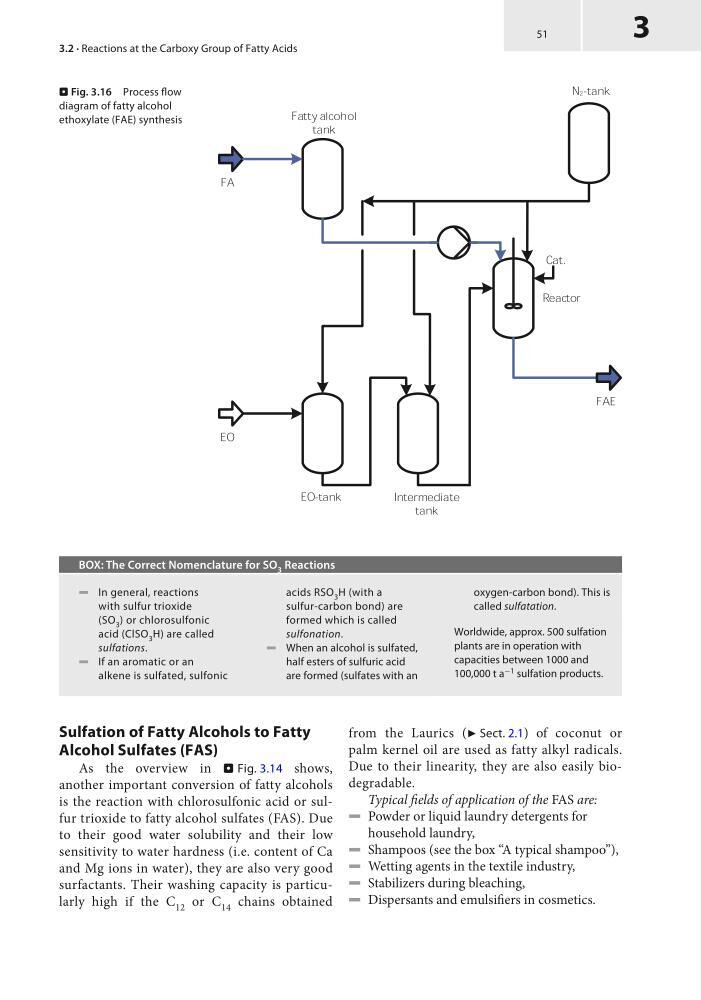
. Fig. 3.16 Process flow
diagram of fatty alcohol
ethoxylate (FAE) synthesis
BOX: The Correct Nomenclature for SO 3 Reactions
5 In general, reactions
with sulfur trioxide
(SO 3 ) or chlorosulfonic
acid (ClSO 3 H) are called
sulfations.
5 If an aromatic or an
alkene is sulfated, sulfonic
acids RSO 3 H (with a
sulfur-carbon bond) are
formed which is called
sulfonation.
5 When an alcohol is sulfated,
half esters of sulfuric acid
are formed (sulfates with an
oxygen-carbon bond). This is
called sulfatation.
Worldwide, approx. 500 sulfation
plants are in operation with
capacities between 1000 and
100,000 t a −1 sulfation products.
3
3.2 · Reactions at the Carboxy Group of Fatty Acids
from the Laurics (7 Sect. 2.1) of coconut or
palm kernel oil are used as fatty alkyl radicals.
Due to their linearity, they are also easily biodegradable.
Typical fields of application of the FAS are:
5 Powder or liquid laundry detergents for
household laundry,
5 Shampoos (see the box “A typical shampoo”),
5 Wetting agents in the textile industry,
5 Stabilizers during bleaching,
5 Dispersants and emulsifiers in cosmetics.
As the overview in . Fig. 3.14 shows,
another important conversion of fatty alcohols
is the reaction with chlorosulfonic acid or sulfur trioxide to fatty alcohol sulfates (FAS). Due
to their good water solubility and their low
sensitivity to water hardness (i.e. content of Ca
and Mg ions in water), they are also very good
surfactants. Their washing capacity is particularly high if the C 12 or C 14 chains obtained
Sulfation of Fatty Alcohols to Fatty
Alcohol Sulfates (FAS)
. Fig. 3.16 Process flow
diagram of fatty alcohol
ethoxylate (FAE) synthesis
BOX: The Correct Nomenclature for SO 3 Reactions
5 In general, reactions
with sulfur trioxide
(SO 3 ) or chlorosulfonic
acid (ClSO 3 H) are called
sulfations.
5 If an aromatic or an
alkene is sulfated, sulfonic
acids RSO 3 H (with a
sulfur-carbon bond) are
formed which is called
sulfonation.
5 When an alcohol is sulfated,
half esters of sulfuric acid
are formed (sulfates with an
oxygen-carbon bond). This is
called sulfatation.
Worldwide, approx. 500 sulfation
plants are in operation with
capacities between 1000 and
100,000 t a −1 sulfation products.