

50
Chapter 3 · The Basics of Oleochemistry - Basic Oleochemicals
3
(from the fatty alcohol) and on the right hand side
of an ether chain with numerous ether oxygen atoms
and a terminal hydroxyl group (from the ethylene
oxide molecules). The right part of the molecule consists of a hydrophilic and therefore very water-soluble
group. This combination hydrophobic/hydrophilic
is a feature for surfactants which are able to dissolve
dirt particles (e.g. a grease spot on the shirt) with
their hydrophobic end and at the same time transfer
the dirt into the aqueous washing liquor with their
hydrophilic end. The more uniform the distribution of EO on the fatty alcohol, the more uniform
the properties of the surfactant. FAE are excellent
low-foaming non-ionic surfactants with high washing and dispersing ability and good biodegradability.
However, working with ethylene oxide is
quite dangerous due to its high reactivity and
high flammability. The conversion in . Fig. 3.15
must therefore be carried out under strong precautions. The flow diagram in . Fig. 3.16 shows
how to proceed best: Using the inert gas nitrogen, ethylene oxide EO is pressed from its storage tank into an intermediate chamber and
further mixed with nitrogen. This very diluted
mixture is fed into the stirred reactor, into which
the fatty alcohol (FA) is also slowly and continuously pumped. The highly exothermic reaction
can thus be carried out very gently and safely.
3.2.2 Conversions of Fatty Alcohols
Ethoxylation of Fatty Alcohols
to Fatty Alcohol Ethoxylates (FAE)
In ethoxylation, fatty alcohols are reacted with
ethylene oxide (EO, oxirane). This results in
fatty alcohol ethoxylates (FAE), also known as
fatty alcohol polyglycol ethers or alkyl polyglycol
ethers. These are always mixtures with a different number of glycol units. The stoichiometry of
the reaction makes it possible to set an “average
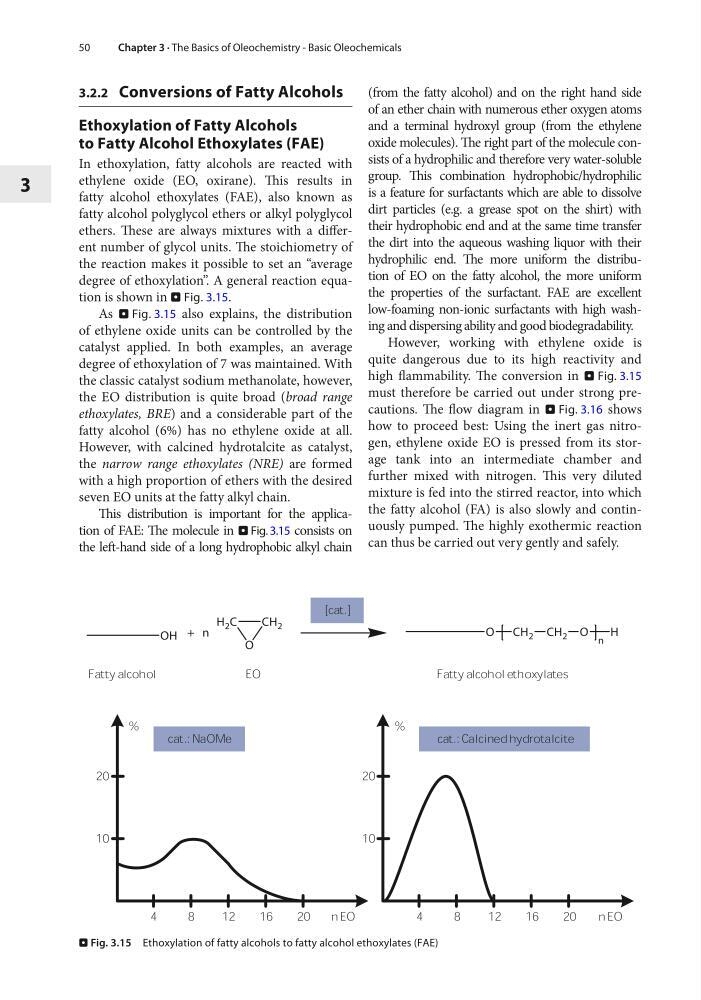
degree of ethoxylation”. A general reaction equation is shown in . Fig. 3.15.
As . Fig. 3.15 also explains, the distribution
of ethylene oxide units can be controlled by the
catalyst applied. In both examples, an average
degree of ethoxylation of 7 was maintained. With
the classic catalyst sodium methanolate, however,
the EO distribution is quite broad (broad range
ethoxylates, BRE) and a considerable part of the
fatty alcohol (6%) has no ethylene oxide at all.
However, with calcined hydrotalcite as catalyst,
the narrow range ethoxylates (NRE) are formed
with a high proportion of ethers with the desired
seven EO units at the fatty alkyl chain.
This distribution is important for the application of FAE: The molecule in . Fig. 3.15 consists on
the left-hand side of a long hydrophobic alkyl chain
. Fig. 3.15 Ethoxylation of fatty alcohols to fatty alcohol ethoxylates (FAE)
Chapter 3 · The Basics of Oleochemistry - Basic Oleochemicals
3
(from the fatty alcohol) and on the right hand side
of an ether chain with numerous ether oxygen atoms
and a terminal hydroxyl group (from the ethylene
oxide molecules). The right part of the molecule consists of a hydrophilic and therefore very water-soluble
group. This combination hydrophobic/hydrophilic
is a feature for surfactants which are able to dissolve
dirt particles (e.g. a grease spot on the shirt) with
their hydrophobic end and at the same time transfer
the dirt into the aqueous washing liquor with their
hydrophilic end. The more uniform the distribution of EO on the fatty alcohol, the more uniform
the properties of the surfactant. FAE are excellent
low-foaming non-ionic surfactants with high washing and dispersing ability and good biodegradability.
However, working with ethylene oxide is
quite dangerous due to its high reactivity and
high flammability. The conversion in . Fig. 3.15
must therefore be carried out under strong precautions. The flow diagram in . Fig. 3.16 shows
how to proceed best: Using the inert gas nitrogen, ethylene oxide EO is pressed from its storage tank into an intermediate chamber and
further mixed with nitrogen. This very diluted
mixture is fed into the stirred reactor, into which
the fatty alcohol (FA) is also slowly and continuously pumped. The highly exothermic reaction
can thus be carried out very gently and safely.
3.2.2 Conversions of Fatty Alcohols
Ethoxylation of Fatty Alcohols
to Fatty Alcohol Ethoxylates (FAE)
In ethoxylation, fatty alcohols are reacted with
ethylene oxide (EO, oxirane). This results in
fatty alcohol ethoxylates (FAE), also known as
fatty alcohol polyglycol ethers or alkyl polyglycol
ethers. These are always mixtures with a different number of glycol units. The stoichiometry of
the reaction makes it possible to set an “average
degree of ethoxylation”. A general reaction equation is shown in . Fig. 3.15.
As . Fig. 3.15 also explains, the distribution
of ethylene oxide units can be controlled by the
catalyst applied. In both examples, an average
degree of ethoxylation of 7 was maintained. With
the classic catalyst sodium methanolate, however,
the EO distribution is quite broad (broad range
ethoxylates, BRE) and a considerable part of the
fatty alcohol (6%) has no ethylene oxide at all.
However, with calcined hydrotalcite as catalyst,
the narrow range ethoxylates (NRE) are formed
with a high proportion of ethers with the desired
seven EO units at the fatty alkyl chain.
This distribution is important for the application of FAE: The molecule in . Fig. 3.15 consists on
the left-hand side of a long hydrophobic alkyl chain
. Fig. 3.15 Ethoxylation of fatty alcohols to fatty alcohol ethoxylates (FAE)