

52
Chapter 3 · The Basics of Oleochemistry - Basic Oleochemicals
3
BOX: A Typical Hair Shampoo
If a consumer selects a hair
shampoo from the huge
assortment in a supermarket,
he is usually influenced by
commercials and the smell.
Very few people are asking
which ingredients the shampoo
contains. But we want to know
more:
5 The main purpose of a
shampoo is the good
cleaning of the hair and
the head skin. One or
more surfactants are
needed for this: The
main surfactant (primary
surfactant) is usually an
anionic surfactant, e.g. the
fatty alcohol sulfates (FAS)
or the very skin-friendly
fatty alcohol ether sulfates
(FAES), both presented in
7 Sect. 3.2.2. The primary
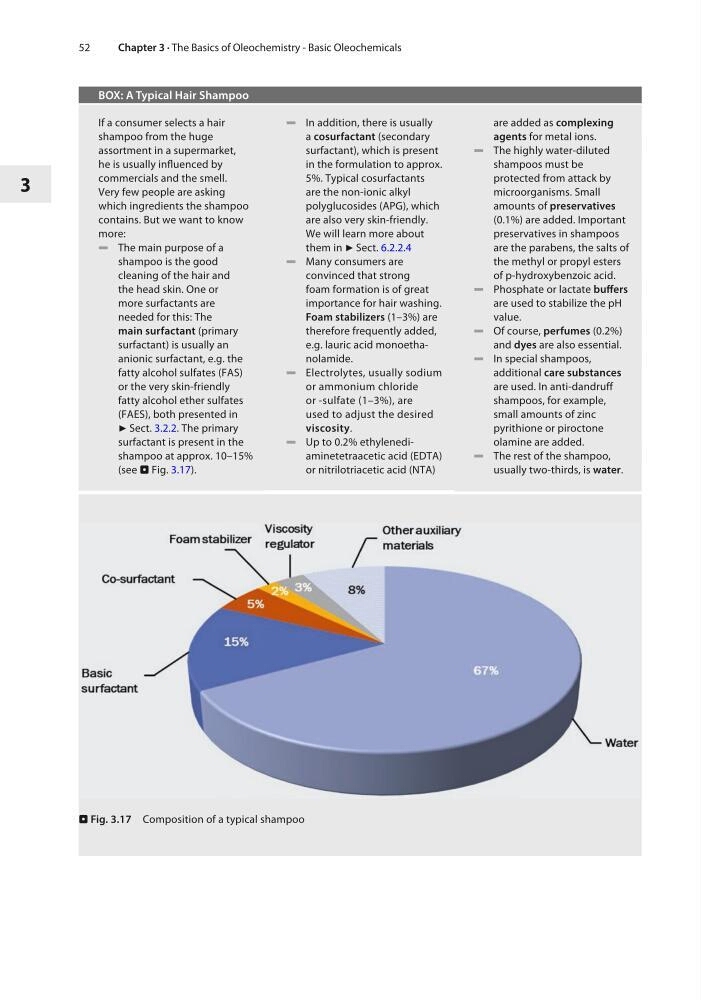
surfactant is present in the
shampoo at approx. 10–15%
(see . Fig. 3.17).
5 In addition, there is usually
a cosurfactant (secondary
surfactant), which is present
in the formulation to approx.
5%. Typical cosurfactants
are the non-ionic alkyl
polyglucosides (APG), which
are also very skin-friendly.
We will learn more about
them in 7 Sect. 6.2.2.4
5 Many consumers are
convinced that strong
foam formation is of great
importance for hair washing.
Foam stabilizers (1–3%) are
therefore frequently added,
e.g. lauric acid monoethanolamide.
5 Electrolytes, usually sodium
or ammonium chloride
or -sulfate (1–3%), are
used to adjust the desired
viscosity.
5 Up to 0.2% ethylenediaminetetraacetic acid (EDTA)
or nitrilotriacetic acid (NTA)
are added as complexing
agents for metal ions.
5 The highly water-diluted
shampoos must be
protected from attack by
microorganisms. Small
amounts of preservatives
(0.1%) are added. Important
preservatives in shampoos
are the parabens, the salts of
the methyl or propyl esters
of p-hydroxybenzoic acid.
5 Phosphate or lactate buffers
are used to stabilize the pH
value.
5 Of course, perfumes (0.2%)
and dyes are also essential.
5 In special shampoos,
additional care substances
are used. In anti-dandruff
shampoos, for example,
small amounts of zinc
pyrithione or piroctone
olamine are added.
5 The rest of the shampoo,
usually two-thirds, is water.
. Fig. 3.17 Composition of a typical shampoo
Chapter 3 · The Basics of Oleochemistry - Basic Oleochemicals
3
BOX: A Typical Hair Shampoo
If a consumer selects a hair
shampoo from the huge
assortment in a supermarket,
he is usually influenced by
commercials and the smell.
Very few people are asking
which ingredients the shampoo
contains. But we want to know
more:
5 The main purpose of a
shampoo is the good
cleaning of the hair and
the head skin. One or
more surfactants are
needed for this: The
main surfactant (primary
surfactant) is usually an
anionic surfactant, e.g. the
fatty alcohol sulfates (FAS)
or the very skin-friendly
fatty alcohol ether sulfates
(FAES), both presented in
7 Sect. 3.2.2. The primary
surfactant is present in the
shampoo at approx. 10–15%
(see . Fig. 3.17).
5 In addition, there is usually
a cosurfactant (secondary
surfactant), which is present
in the formulation to approx.
5%. Typical cosurfactants
are the non-ionic alkyl
polyglucosides (APG), which
are also very skin-friendly.
We will learn more about
them in 7 Sect. 6.2.2.4
5 Many consumers are
convinced that strong
foam formation is of great
importance for hair washing.
Foam stabilizers (1–3%) are
therefore frequently added,
e.g. lauric acid monoethanolamide.
5 Electrolytes, usually sodium
or ammonium chloride
or -sulfate (1–3%), are
used to adjust the desired
viscosity.
5 Up to 0.2% ethylenediaminetetraacetic acid (EDTA)
or nitrilotriacetic acid (NTA)
are added as complexing
agents for metal ions.
5 The highly water-diluted
shampoos must be
protected from attack by
microorganisms. Small
amounts of preservatives
(0.1%) are added. Important
preservatives in shampoos
are the parabens, the salts of
the methyl or propyl esters
of p-hydroxybenzoic acid.
5 Phosphate or lactate buffers
are used to stabilize the pH
value.
5 Of course, perfumes (0.2%)
and dyes are also essential.
5 In special shampoos,
additional care substances
are used. In anti-dandruff
shampoos, for example,
small amounts of zinc
pyrithione or piroctone
olamine are added.
5 The rest of the shampoo,
usually two-thirds, is water.
. Fig. 3.17 Composition of a typical shampoo