

21
2
comparison with animal fats, grease is also listed
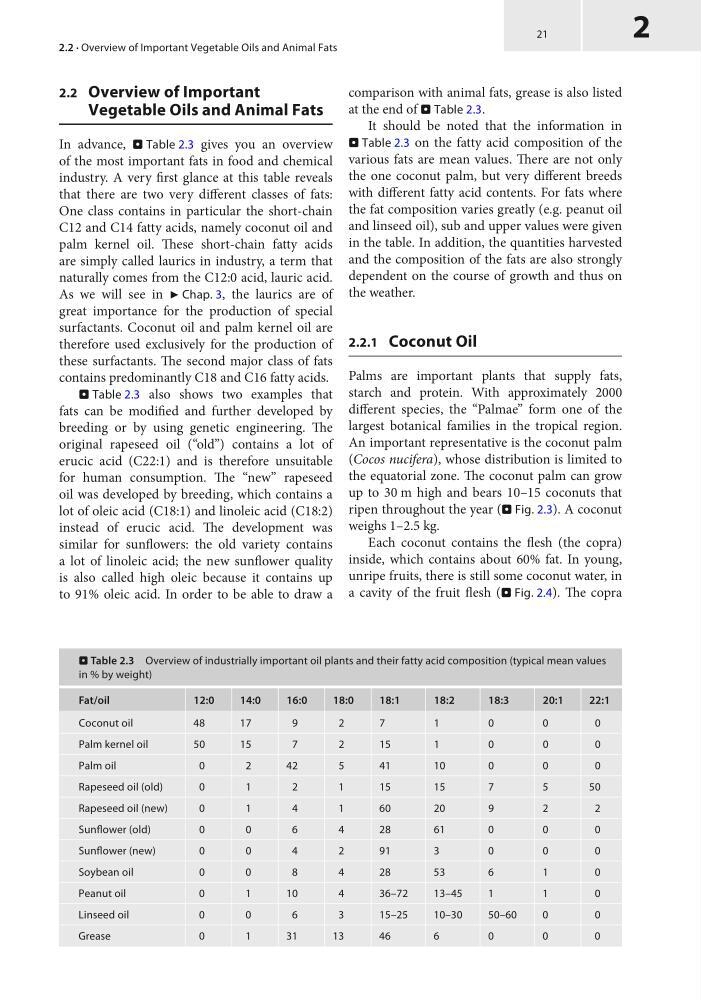
at the end of . Table 2.3.
It should be noted that the information in
. Table 2.3 on the fatty acid composition of the
various fats are mean values. There are not only
the one coconut palm, but very different breeds
with different fatty acid contents. For fats where
the fat composition varies greatly (e.g. peanut oil
and linseed oil), sub and upper values were given
in the table. In addition, the quantities harvested
and the composition of the fats are also strongly
dependent on the course of growth and thus on
the weather.
2.2.1 Coconut Oil
Palms are important plants that supply fats,
starch and protein. With approximately 2000
different species, the “Palmae” form one of the
largest botanical families in the tropical region.
An important representative is the coconut palm
(Cocos nucifera), whose distribution is limited to
the equatorial zone. The coconut palm can grow
up to 30 m high and bears 10–15 coconuts that
ripen throughout the year (. Fig. 2.3). A coconut
weighs 1–2.5 kg.
Each coconut contains the flesh (the copra)
inside, which contains about 60% fat. In young,
unripe fruits, there is still some coconut water, in
a cavity of the fruit flesh (. Fig. 2.4). The copra
2.2 Overview of Important
Vegetable Oils and Animal Fats
In advance, . Table 2.3 gives you an overview
of the most important fats in food and chemical
industry. A very first glance at this table reveals
that there are two very different classes of fats:
One class contains in particular the short-chain
C12 and C14 fatty acids, namely coconut oil and
palm kernel oil. These short-chain fatty acids
are simply called laurics in industry, a term that
naturally comes from the C12:0 acid, lauric acid.
As we will see in 7 Chap. 3, the laurics are of
great importance for the production of special
surfactants. Coconut oil and palm kernel oil are
therefore used exclusively for the production of
these surfactants. The second major class of fats
contains predominantly C18 and C16 fatty acids.
. Table 2.3 also shows two examples that
fats can be modified and further developed by
breeding or by using genetic engineering. The
original rapeseed oil (“old”) contains a lot of
erucic acid (C22:1) and is therefore unsuitable
for human consumption. The “new” rapeseed
oil was developed by breeding, which contains a
lot of oleic acid (C18:1) and linoleic acid (C18:2)
instead of erucic acid. The development was
similar for sunflowers: the old variety contains
a lot of linoleic acid; the new sunflower quality
is also called high oleic because it contains up
to 91% oleic acid. In order to be able to draw a
. Table 2.3 Overview of industrially important oil plants and their fatty acid composition (typical mean values
in % by weight)
Fat/oil
12:0
14:0
16:0
18:0
18:1
18:2
18:3
20:1
22:1
Coconut oil
48
17
9
2
7
1
0
0
0
Palm kernel oil
50
15
7
2
15
1
0
0
0
Palm oil
0
2
42
5
41
10
0
0
0
Rapeseed oil (old)
0
1
2
1
15
15
7
5
50
Rapeseed oil (new)
0
1
4
1
60
20
9
2
2
Sunflower (old)
0
0
6
4
28
61
0
0
0
Sunflower (new)
0
0
4
2
91
3
0
0
0
Soybean oil
0
0
8
4
28
53
6
1
0
Peanut oil
0
1
10
4
36–72
13–45
1
1
0
Linseed oil
0
0
6
3
15–25
10–30
50–60
0
0
Grease
0
1
31
13
46
6
0
0
0
2.2 · Overview of Important Vegetable Oils and Animal Fats
2
comparison with animal fats, grease is also listed
at the end of . Table 2.3.
It should be noted that the information in
. Table 2.3 on the fatty acid composition of the
various fats are mean values. There are not only
the one coconut palm, but very different breeds
with different fatty acid contents. For fats where
the fat composition varies greatly (e.g. peanut oil
and linseed oil), sub and upper values were given
in the table. In addition, the quantities harvested
and the composition of the fats are also strongly
dependent on the course of growth and thus on
the weather.
2.2.1 Coconut Oil
Palms are important plants that supply fats,
starch and protein. With approximately 2000
different species, the “Palmae” form one of the
largest botanical families in the tropical region.
An important representative is the coconut palm
(Cocos nucifera), whose distribution is limited to
the equatorial zone. The coconut palm can grow
up to 30 m high and bears 10–15 coconuts that
ripen throughout the year (. Fig. 2.3). A coconut
weighs 1–2.5 kg.
Each coconut contains the flesh (the copra)
inside, which contains about 60% fat. In young,
unripe fruits, there is still some coconut water, in
a cavity of the fruit flesh (. Fig. 2.4). The copra
2.2 Overview of Important
Vegetable Oils and Animal Fats
In advance, . Table 2.3 gives you an overview
of the most important fats in food and chemical
industry. A very first glance at this table reveals
that there are two very different classes of fats:
One class contains in particular the short-chain
C12 and C14 fatty acids, namely coconut oil and
palm kernel oil. These short-chain fatty acids
are simply called laurics in industry, a term that
naturally comes from the C12:0 acid, lauric acid.
As we will see in 7 Chap. 3, the laurics are of
great importance for the production of special
surfactants. Coconut oil and palm kernel oil are
therefore used exclusively for the production of
these surfactants. The second major class of fats
contains predominantly C18 and C16 fatty acids.
. Table 2.3 also shows two examples that
fats can be modified and further developed by
breeding or by using genetic engineering. The
original rapeseed oil (“old”) contains a lot of
erucic acid (C22:1) and is therefore unsuitable
for human consumption. The “new” rapeseed
oil was developed by breeding, which contains a
lot of oleic acid (C18:1) and linoleic acid (C18:2)
instead of erucic acid. The development was
similar for sunflowers: the old variety contains
a lot of linoleic acid; the new sunflower quality
is also called high oleic because it contains up
to 91% oleic acid. In order to be able to draw a
. Table 2.3 Overview of industrially important oil plants and their fatty acid composition (typical mean values
in % by weight)
Fat/oil
12:0
14:0
16:0
18:0
18:1
18:2
18:3
20:1
22:1
Coconut oil
48
17
9
2
7
1
0
0
0
Palm kernel oil
50
15
7
2
15
1
0
0
0
Palm oil
0
2
42
5
41
10
0
0
0
Rapeseed oil (old)
0
1
2
1
15
15
7
5
50
Rapeseed oil (new)
0
1
4
1
60
20
9
2
2
Sunflower (old)
0
0
6
4
28
61
0
0
0
Sunflower (new)
0
0
4
2
91
3
0
0
0
Soybean oil
0
0
8
4
28
53
6
1
0
Peanut oil
0
1
10
4
36–72
13–45
1
1
0
Linseed oil
0
0
6
3
15–25
10–30
50–60
0
0
Grease
0
1
31
13
46
6
0
0
0
2.2 · Overview of Important Vegetable Oils and Animal Fats