

22
Chapter 2 · The Raw Materials of Oleochemistry - Oil Plants
2
shorter stems. They are thus better able to withstand tropical storms, have increased resistance
to disease and are easier to harvest, e.g. with harvesting machines. Meanwhile, there are dwarf
mutants of the Cocos nucifera, which grow only
about 2 m high.
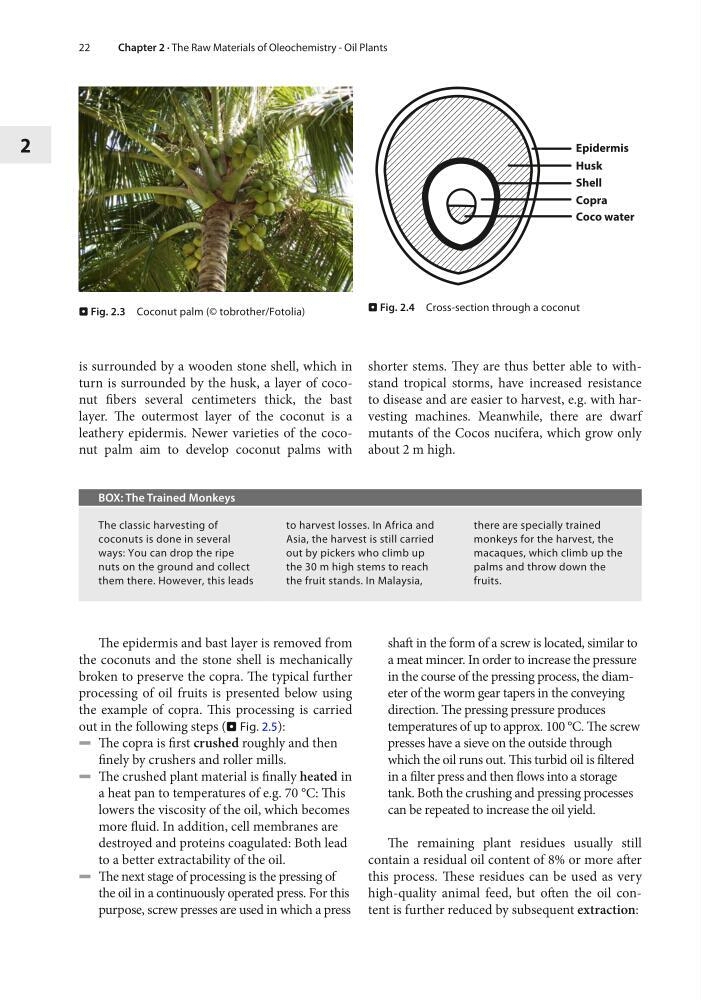
is surrounded by a wooden stone shell, which in
turn is surrounded by the husk, a layer of coconut fibers several centimeters thick, the bast
layer. The outermost layer of the coconut is a
leathery epidermis. Newer varieties of the coconut palm aim to develop coconut palms with
. Fig. 2.3 Coconut palm (© tobrother/Fotolia)
Epidermis
Husk
Shell
Copra
Coco water
. Fig. 2.4 Cross-section through a coconut
BOX: The Trained Monkeys
The classic harvesting of
coconuts is done in several
ways: You can drop the ripe
nuts on the ground and collect
them there. However, this leads
to harvest losses. In Africa and
Asia, the harvest is still carried
out by pickers who climb up
the 30 m high stems to reach
the fruit stands. In Malaysia,
there are specially trained
monkeys for the harvest, the
macaques, which climb up the
palms and throw down the
fruits.
The epidermis and bast layer is removed from
the coconuts and the stone shell is mechanically
broken to preserve the copra. The typical further
processing of oil fruits is presented below using
the example of copra. This processing is carried
out in the following steps (. Fig. 2.5):
5 The copra is first crushed roughly and then
finely by crushers and roller mills.
5 The crushed plant material is finally heated in
a heat pan to temperatures of e.g. 70 °C: This
lowers the viscosity of the oil, which becomes
more fluid. In addition, cell membranes are
destroyed and proteins coagulated: Both lead
to a better extractability of the oil.
5 The next stage of processing is the pressing of
the oil in a continuously operated press. For this
purpose, screw presses are used in which a press
shaft in the form of a screw is located, similar to
a meat mincer. In order to increase the pressure
in the course of the pressing process, the diameter of the worm gear tapers in the conveying
direction. The pressing pressure produces
temperatures of up to approx. 100 °C. The screw
presses have a sieve on the outside through
which the oil runs out. This turbid oil is filtered
in a filter press and then flows into a storage
tank. Both the crushing and pressing processes
can be repeated to increase the oil yield.
The remaining plant residues usually still
contain a residual oil content of 8% or more after
this process. These residues can be used as very
high-quality animal feed, but often the oil content is further reduced by subsequent extraction:
Chapter 2 · The Raw Materials of Oleochemistry - Oil Plants
2
shorter stems. They are thus better able to withstand tropical storms, have increased resistance
to disease and are easier to harvest, e.g. with harvesting machines. Meanwhile, there are dwarf
mutants of the Cocos nucifera, which grow only
about 2 m high.
is surrounded by a wooden stone shell, which in
turn is surrounded by the husk, a layer of coconut fibers several centimeters thick, the bast
layer. The outermost layer of the coconut is a
leathery epidermis. Newer varieties of the coconut palm aim to develop coconut palms with
. Fig. 2.3 Coconut palm (© tobrother/Fotolia)
Epidermis
Husk
Shell
Copra
Coco water
. Fig. 2.4 Cross-section through a coconut
BOX: The Trained Monkeys
The classic harvesting of
coconuts is done in several
ways: You can drop the ripe
nuts on the ground and collect
them there. However, this leads
to harvest losses. In Africa and
Asia, the harvest is still carried
out by pickers who climb up
the 30 m high stems to reach
the fruit stands. In Malaysia,
there are specially trained
monkeys for the harvest, the
macaques, which climb up the
palms and throw down the
fruits.
The epidermis and bast layer is removed from
the coconuts and the stone shell is mechanically
broken to preserve the copra. The typical further
processing of oil fruits is presented below using
the example of copra. This processing is carried
out in the following steps (. Fig. 2.5):
5 The copra is first crushed roughly and then
finely by crushers and roller mills.
5 The crushed plant material is finally heated in
a heat pan to temperatures of e.g. 70 °C: This
lowers the viscosity of the oil, which becomes
more fluid. In addition, cell membranes are
destroyed and proteins coagulated: Both lead
to a better extractability of the oil.
5 The next stage of processing is the pressing of
the oil in a continuously operated press. For this
purpose, screw presses are used in which a press
shaft in the form of a screw is located, similar to
a meat mincer. In order to increase the pressure
in the course of the pressing process, the diameter of the worm gear tapers in the conveying
direction. The pressing pressure produces
temperatures of up to approx. 100 °C. The screw
presses have a sieve on the outside through
which the oil runs out. This turbid oil is filtered
in a filter press and then flows into a storage
tank. Both the crushing and pressing processes
can be repeated to increase the oil yield.
The remaining plant residues usually still
contain a residual oil content of 8% or more after
this process. These residues can be used as very
high-quality animal feed, but often the oil content is further reduced by subsequent extraction: