

179
9
nature, it occurs mainly in two forms, which differ in the orientation of the chitin strands:
5 α-chitin, in which the chitin chains are
arranged antiparallel, i.e. in opposite directions,
5 β-chitin, in which the chains run parallel to
each other.
Here, α-chitin is the most common form in
nature and is found, for example, in the shells
of crustaceans or insects. The opposing orientation of the chitin molecules allows a particularly dense packing and is therefore particularly
stable. The molecular masses are typically in the
range of 10 6 Dalton.
The proportion of chitin in the various living
organisms can vary greatly and depends above all
on which part (wings, shell, entire living organism, etc.) is considered (. Table 9.1). The differences within a genus can also be very large.
BOX: The Difficult Discovery of Chitin
Chitin was first described in
1811 by the French botanist
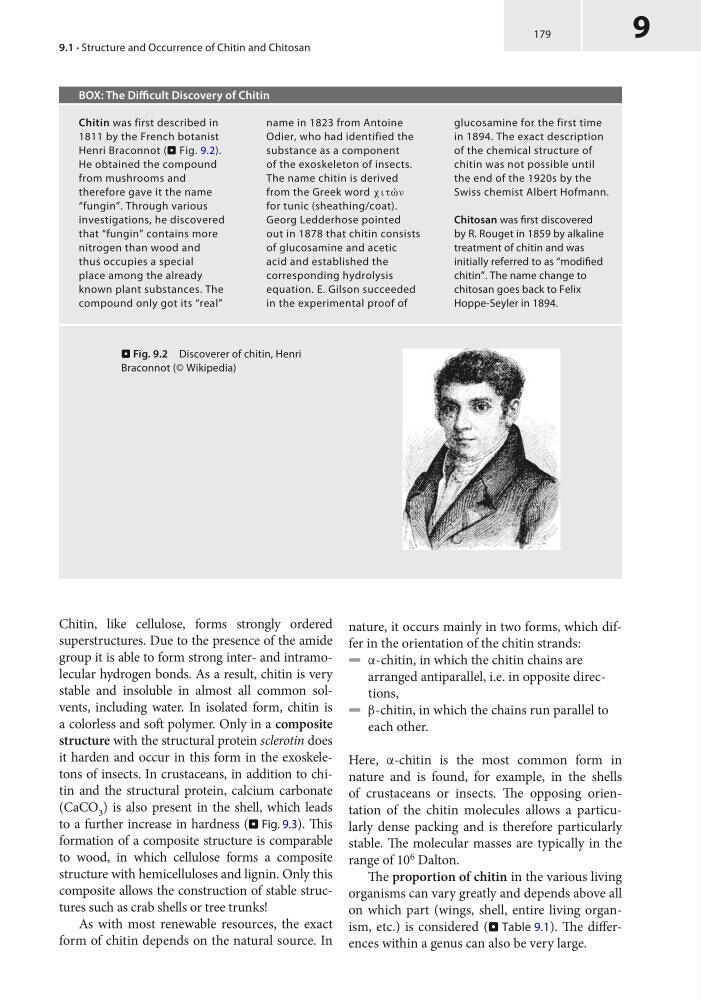
Henri Braconnot (. Fig. 9.2).
He obtained the compound
from mushrooms and
therefore gave it the name
“fungin”. Through various
investigations, he discovered
that “fungin” contains more
nitrogen than wood and
thus occupies a special
place among the already
known plant substances. The
compound only got its “real”
name in 1823 from Antoine
Odier, who had identified the
substance as a component
of the exoskeleton of insects.
The name chitin is derived
from the Greek word χιτών
for tunic (sheathing/coat).
Georg Ledderhose pointed
out in 1878 that chitin consists
of glucosamine and acetic
acid and established the
corresponding hydrolysis
equation. E. Gilson succeeded
in the experimental proof of
glucosamine for the first time
in 1894. The exact description
of the chemical structure of
chitin was not possible until
the end of the 1920s by the
Swiss chemist Albert Hofmann.
Chitosan was first discovered
by R. Rouget in 1859 by alkaline
treatment of chitin and was
initially referred to as “modified
chitin”. The name change to
chitosan goes back to Felix
Hoppe-Seyler in 1894.
. Fig. 9.2 Discoverer of chitin, Henri
Braconnot (© Wikipedia)
Chitin, like cellulose, forms strongly ordered
superstructures. Due to the presence of the amide
group it is able to form strong inter- and intramolecular hydrogen bonds. As a result, chitin is very
stable and insoluble in almost all common solvents, including water. In isolated form, chitin is
a colorless and soft polymer. Only in a composite
structure with the structural protein sclerotin does
it harden and occur in this form in the exoskeletons of insects. In crustaceans, in addition to chitin and the structural protein, calcium carbonate
(CaCO 3 ) is also present in the shell, which leads
to a further increase in hardness (. Fig. 9.3). This
formation of a composite structure is comparable
to wood, in which cellulose forms a composite
structure with hemicelluloses and lignin. Only this
composite allows the construction of stable structures such as crab shells or tree trunks!
As with most renewable resources, the exact
form of chitin depends on the natural source. In
9.1 · Structure and Occurrence of Chitin and Chitosan
9
nature, it occurs mainly in two forms, which differ in the orientation of the chitin strands:
5 α-chitin, in which the chitin chains are
arranged antiparallel, i.e. in opposite directions,
5 β-chitin, in which the chains run parallel to
each other.
Here, α-chitin is the most common form in
nature and is found, for example, in the shells
of crustaceans or insects. The opposing orientation of the chitin molecules allows a particularly dense packing and is therefore particularly
stable. The molecular masses are typically in the
range of 10 6 Dalton.
The proportion of chitin in the various living
organisms can vary greatly and depends above all
on which part (wings, shell, entire living organism, etc.) is considered (. Table 9.1). The differences within a genus can also be very large.
BOX: The Difficult Discovery of Chitin
Chitin was first described in
1811 by the French botanist
Henri Braconnot (. Fig. 9.2).
He obtained the compound
from mushrooms and
therefore gave it the name
“fungin”. Through various
investigations, he discovered
that “fungin” contains more
nitrogen than wood and
thus occupies a special
place among the already
known plant substances. The
compound only got its “real”
name in 1823 from Antoine
Odier, who had identified the
substance as a component
of the exoskeleton of insects.
The name chitin is derived
from the Greek word χιτών
for tunic (sheathing/coat).
Georg Ledderhose pointed
out in 1878 that chitin consists
of glucosamine and acetic
acid and established the
corresponding hydrolysis
equation. E. Gilson succeeded
in the experimental proof of
glucosamine for the first time
in 1894. The exact description
of the chemical structure of
chitin was not possible until
the end of the 1920s by the
Swiss chemist Albert Hofmann.
Chitosan was first discovered
by R. Rouget in 1859 by alkaline
treatment of chitin and was
initially referred to as “modified
chitin”. The name change to
chitosan goes back to Felix
Hoppe-Seyler in 1894.
. Fig. 9.2 Discoverer of chitin, Henri
Braconnot (© Wikipedia)
Chitin, like cellulose, forms strongly ordered
superstructures. Due to the presence of the amide
group it is able to form strong inter- and intramolecular hydrogen bonds. As a result, chitin is very
stable and insoluble in almost all common solvents, including water. In isolated form, chitin is
a colorless and soft polymer. Only in a composite
structure with the structural protein sclerotin does
it harden and occur in this form in the exoskeletons of insects. In crustaceans, in addition to chitin and the structural protein, calcium carbonate
(CaCO 3 ) is also present in the shell, which leads
to a further increase in hardness (. Fig. 9.3). This
formation of a composite structure is comparable
to wood, in which cellulose forms a composite
structure with hemicelluloses and lignin. Only this
composite allows the construction of stable structures such as crab shells or tree trunks!
As with most renewable resources, the exact
form of chitin depends on the natural source. In
9.1 · Structure and Occurrence of Chitin and Chitosan