

178
Chapter 9 · Carbohydrates from the Sea - Chitin, Chitosan and Algae
9
Structurally, there are some correlations with
cellulose (7 Chap. 7):
5 Chitin is also an unbranched polysaccharide
in which the monomer building blocks are
linked via a β-1,4-glycosidic bond.
5 Chitin also consists of only one monomer.
5 Chitin also forms ordered superstructures
(fibrillar structures) and is therefore very
stable and inert.
In contrast to cellulose, chitin does not have a
hydroxyl function at position C2 of the pyranose
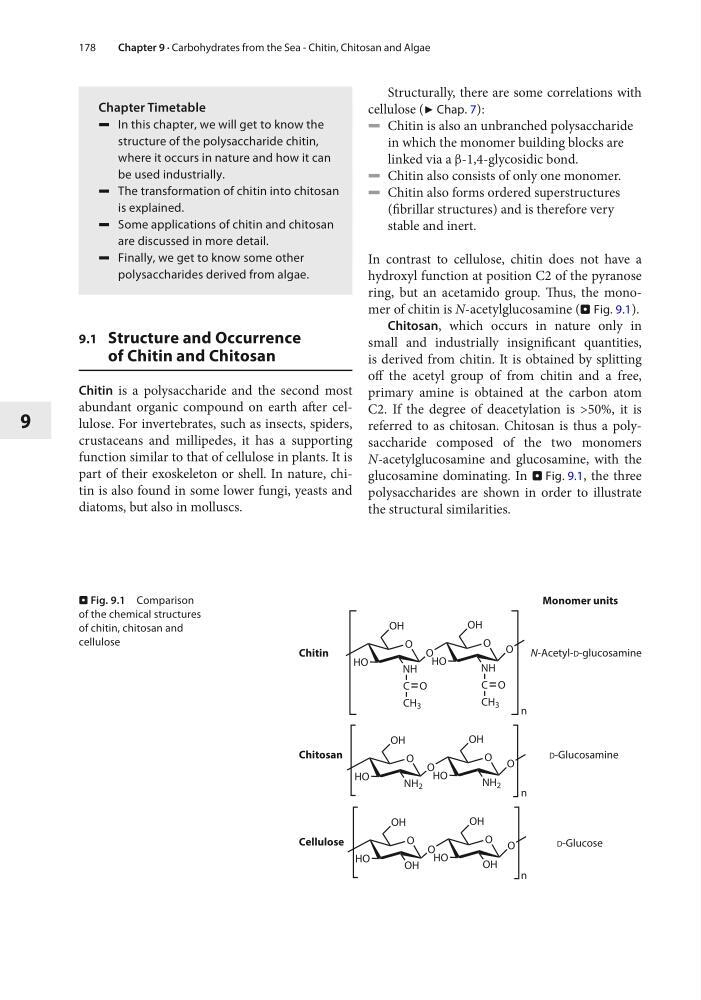
ring, but an acetamido group. Thus, the monomer of chitin is N-acetylglucosamine (. Fig. 9.1).
Chitosan, which occurs in nature only in
small and industrially insignificant quantities,
is derived from chitin. It is obtained by splitting
off the acetyl group of from chitin and a free,
primary amine is obtained at the carbon atom
C2. If the degree of deacetylation is >50%, it is
referred to as chitosan. Chitosan is thus a polysaccharide composed of the two monomers
N-acetylglucosamine and glucosamine, with the
glucosamine dominating. In . Fig. 9.1, the three
polysaccharides are shown in order to illustrate
the structural similarities.
Chapter Timetable
5 In this chapter, we will get to know the
structure of the polysaccharide chitin,
where it occurs in nature and how it can
be used industrially.
5 The transformation of chitin into chitosan
is explained.
5 Some applications of chitin and chitosan
are discussed in more detail.
5 Finally, we get to know some other
polysaccharides derived from algae.
9.1 Structure and Occurrence
of Chitin and Chitosan
Chitin is a polysaccharide and the second most
abundant organic compound on earth after cellulose. For invertebrates, such as insects, spiders,
crustaceans and millipedes, it has a supporting
function similar to that of cellulose in plants. It is
part of their exoskeleton or shell. In nature, chitin is also found in some lower fungi, yeasts and
diatoms, but also in molluscs.
. Fig. 9.1 Comparison
of the chemical structures
of chitin, chitosan and
cellulose
O
HO
NH
O
OH
C O
CH 3
O
HO
NH
OH
C O
CH 3
Chitin
O
Monomer units
N-Acetyl-D-glucosamine
O
HO
NH 2
O
OH
O
HO
NH 2
OH
O
Chitosan
D-Glucosamine
O
HO
OH
O
OH
O
HO
OH
OH
O
Cellulose
D-Glucose
n
n
n
Chapter 9 · Carbohydrates from the Sea - Chitin, Chitosan and Algae
9
Structurally, there are some correlations with
cellulose (7 Chap. 7):
5 Chitin is also an unbranched polysaccharide
in which the monomer building blocks are
linked via a β-1,4-glycosidic bond.
5 Chitin also consists of only one monomer.
5 Chitin also forms ordered superstructures
(fibrillar structures) and is therefore very
stable and inert.
In contrast to cellulose, chitin does not have a
hydroxyl function at position C2 of the pyranose
ring, but an acetamido group. Thus, the monomer of chitin is N-acetylglucosamine (. Fig. 9.1).
Chitosan, which occurs in nature only in
small and industrially insignificant quantities,
is derived from chitin. It is obtained by splitting
off the acetyl group of from chitin and a free,
primary amine is obtained at the carbon atom
C2. If the degree of deacetylation is >50%, it is
referred to as chitosan. Chitosan is thus a polysaccharide composed of the two monomers
N-acetylglucosamine and glucosamine, with the
glucosamine dominating. In . Fig. 9.1, the three
polysaccharides are shown in order to illustrate
the structural similarities.
Chapter Timetable
5 In this chapter, we will get to know the
structure of the polysaccharide chitin,
where it occurs in nature and how it can
be used industrially.
5 The transformation of chitin into chitosan
is explained.
5 Some applications of chitin and chitosan
are discussed in more detail.
5 Finally, we get to know some other
polysaccharides derived from algae.
9.1 Structure and Occurrence
of Chitin and Chitosan
Chitin is a polysaccharide and the second most
abundant organic compound on earth after cellulose. For invertebrates, such as insects, spiders,
crustaceans and millipedes, it has a supporting
function similar to that of cellulose in plants. It is
part of their exoskeleton or shell. In nature, chitin is also found in some lower fungi, yeasts and
diatoms, but also in molluscs.
. Fig. 9.1 Comparison
of the chemical structures
of chitin, chitosan and
cellulose
O
HO
NH
O
OH
C O
CH 3
O
HO
NH
OH
C O
CH 3
Chitin
O
Monomer units
N-Acetyl-D-glucosamine
O
HO
NH 2
O
OH
O
HO
NH 2
OH
O
Chitosan
D-Glucosamine
O
HO
OH
O
OH
O
HO
OH
OH
O
Cellulose
D-Glucose
n
n
n