

180
Chapter 9 · Carbohydrates from the Sea - Chitin, Chitosan and Algae
9
quantities for industrial production. Chitosan
is therefore produced by chemical or enzymatic
deacetylation of chitin.
9.2 Production of Chitin
and Chitosan
The industrial production of chitin is mainly
based on the waste from shrimp fishing. After
the valuable meat of the animals has been
removed, huge amounts of waste are formed.
Chitin is found in about 20–30% of these dried
wastes, the shells of lobsters, crabs, shrimps and
krill. Inorganic substances (minerals), especially
calcium carbonate CaCO 3 , account for about
30–50%. The remainder is proteins, i.e. about
30–40%. The dye astaxanthin (<1%, a dye from
the class of carotenoids, 7 Sect. 12.3), which gives
the animals their pink color, accounts for only a
small proportion.
Further sources for chitin are fungi and
insects, which industrially account for a much
smaller proportion compared to crab shells.
For the successful isolation of chitin from the
raw material, the two other main components of
this composite structure must be removed. After
mechanical crushing and drying, deproteinization and demineralization take place. Industrially, deproteinization is conducted with diluted
bases (caustic soda lye) and demineralization
with diluted acids (hydrochloric acid). However,
it is also possible to use enzymes (proteases) for
deproteinization or both tasks are performed
simultaneously using microorganisms. The pigIt is estimated that each year chitin quantities in the order of 10 9 –10 11 t a −1 are formed
in nature across all organisms. This enormous
quantity is of course not completely industrially usable. According to . Table 9.1, the largest
industrially usable source of chitin is waste from
food production from edible crabs. The annual
quantities of waste produced currently exceed
the actual demand for chitin, so that there is a
very great potential for future applications of chitin and chitosan, respectively.
It is difficult to give exact production volumes; however, it is more in the range of a few
thousand tons and is therefore still negligibly
low compared to other polysaccharides such
as cellulose or starch. In Germany, for example,
this waste has so far mainly been processed into
animal feed. Important chitin producers are the
USA and Japan.
Chitosan itself occurs in nature only in a few
fungi and is therefore not available in sufficient
. Table 9.1 Percentage of chitin in the cell wall or the shell of different living beings
Genus
Organism
Chitin content in cell wall or shell (in %)
Microorganisms
Aspergillus niger
42
Baker’s yeast
2.9
Insects
Cockroach
10
Beetles
5–15
Cockchafer
16
Crustaceans (Crustacea)
Blue crab
15
King crab
35
Prawns
6
Krill
40
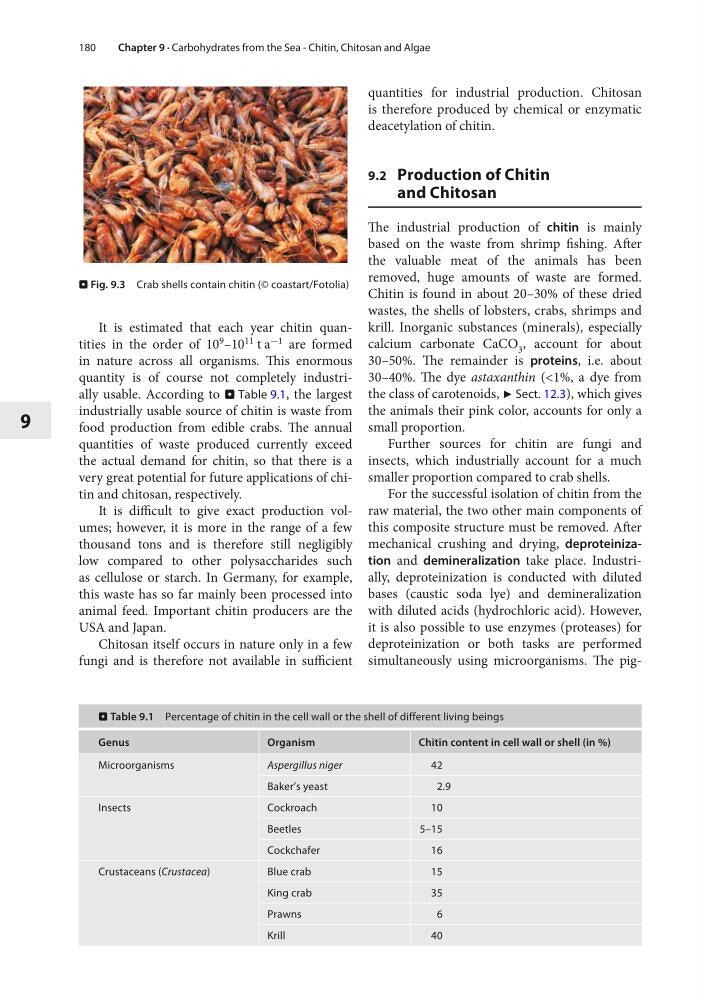
. Fig. 9.3 Crab shells contain chitin (© coastart/Fotolia)
Chapter 9 · Carbohydrates from the Sea - Chitin, Chitosan and Algae
9
quantities for industrial production. Chitosan
is therefore produced by chemical or enzymatic
deacetylation of chitin.
9.2 Production of Chitin
and Chitosan
The industrial production of chitin is mainly
based on the waste from shrimp fishing. After
the valuable meat of the animals has been
removed, huge amounts of waste are formed.
Chitin is found in about 20–30% of these dried
wastes, the shells of lobsters, crabs, shrimps and
krill. Inorganic substances (minerals), especially
calcium carbonate CaCO 3 , account for about
30–50%. The remainder is proteins, i.e. about
30–40%. The dye astaxanthin (<1%, a dye from
the class of carotenoids, 7 Sect. 12.3), which gives
the animals their pink color, accounts for only a
small proportion.
Further sources for chitin are fungi and
insects, which industrially account for a much
smaller proportion compared to crab shells.
For the successful isolation of chitin from the
raw material, the two other main components of
this composite structure must be removed. After
mechanical crushing and drying, deproteinization and demineralization take place. Industrially, deproteinization is conducted with diluted
bases (caustic soda lye) and demineralization
with diluted acids (hydrochloric acid). However,
it is also possible to use enzymes (proteases) for
deproteinization or both tasks are performed
simultaneously using microorganisms. The pigIt is estimated that each year chitin quantities in the order of 10 9 –10 11 t a −1 are formed
in nature across all organisms. This enormous
quantity is of course not completely industrially usable. According to . Table 9.1, the largest
industrially usable source of chitin is waste from
food production from edible crabs. The annual
quantities of waste produced currently exceed
the actual demand for chitin, so that there is a
very great potential for future applications of chitin and chitosan, respectively.
It is difficult to give exact production volumes; however, it is more in the range of a few
thousand tons and is therefore still negligibly
low compared to other polysaccharides such
as cellulose or starch. In Germany, for example,
this waste has so far mainly been processed into
animal feed. Important chitin producers are the
USA and Japan.
Chitosan itself occurs in nature only in a few
fungi and is therefore not available in sufficient
. Table 9.1 Percentage of chitin in the cell wall or the shell of different living beings
Genus
Organism
Chitin content in cell wall or shell (in %)
Microorganisms
Aspergillus niger
42
Baker’s yeast
2.9
Insects
Cockroach
10
Beetles
5–15
Cockchafer
16
Crustaceans (Crustacea)
Blue crab
15
King crab
35
Prawns
6
Krill
40
. Fig. 9.3 Crab shells contain chitin (© coastart/Fotolia)