

156
Chapter 7 · From Wood to Pulp - Cellulose
7
5 Ethyl cellulose (EC)
5 Hydroxypropyl cellulose (HPC).
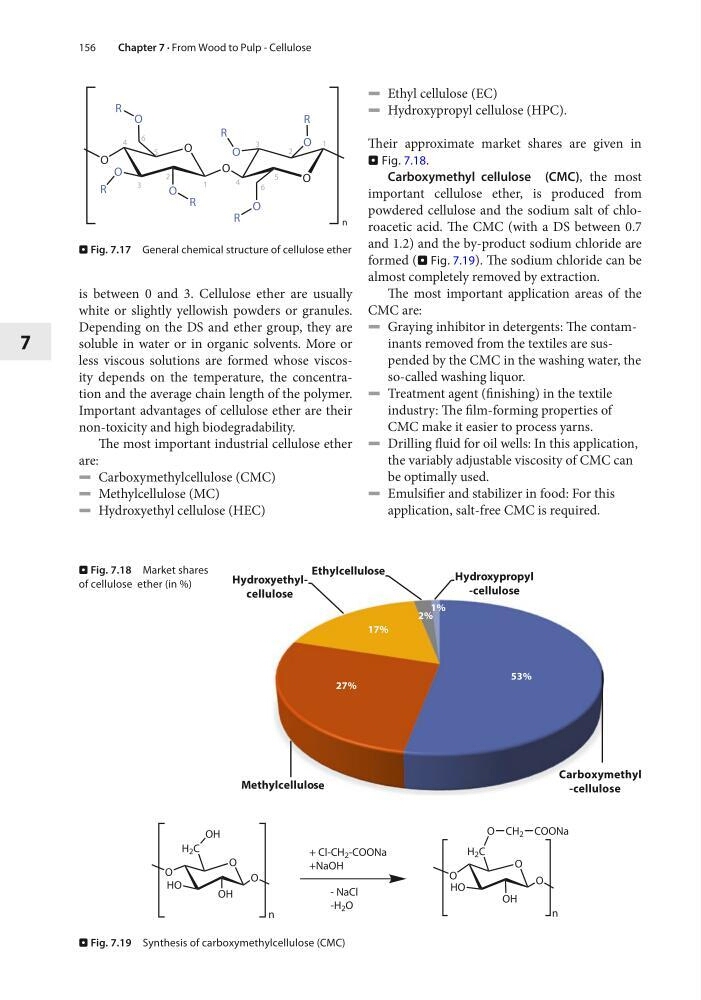
Their approximate market shares are given in
. Fig. 7.18.
Carboxymethyl cellulose (CMC), the most
important cellulose ether, is produced from
powdered cellulose and the sodium salt of chloroacetic acid. The CMC (with a DS between 0.7
and 1.2) and the by-product sodium chloride are
formed (. Fig. 7.19). The sodium chloride can be
almost completely removed by extraction.
The most important application areas of the
CMC are:
5 Graying inhibitor in detergents: The contaminants removed from the textiles are suspended by the CMC in the washing water, the
so-called washing liquor.
5 Treatment agent (finishing) in the textile
industry: The film-forming properties of
CMC make it easier to process yarns.
5 Drilling fluid for oil wells: In this application,
the variably adjustable viscosity of CMC can
be optimally used.
5 Emulsifier and stabilizer in food: For this
application, salt-free CMC is required.
is between 0 and 3. Cellulose ether are usually
white or slightly yellowish powders or granules.
Depending on the DS and ether group, they are
soluble in water or in organic solvents. More or
less viscous solutions are formed whose viscosity depends on the temperature, the concentration and the average chain length of the polymer.
Important advantages of cellulose ether are their
non-toxicity and high biodegradability.
The most important industrial cellulose ether
are:
5 Carboxymethylcellulose (CMC)
5 Methylcellulose (MC)
5 Hydroxyethyl cellulose (HEC)
. Fig. 7.18 Market shares
of cellulose ether (in %)
Methylcellulose
Hydroxyethylcellulose
Ethylcellulose
Hydroxypropyl
-cellulose
53%
27%
17%
2%
1%
Carboxymethyl
-cellulose
O
O
O
O
O
R
R
R
O
O
O
R
O
R
O
R
n
1
2
3
4
5
6
1
2
3
4
5
6
. Fig. 7.17 General chemical structure of cellulose ether
O
O
O
H 2 C
OH
OH
HO
n
O
O
O
H 2 C
O
OH
HO
n
+ Cl-CH 2 -COONa
+NaOH
- NaCl
-H 2 O
CH 2 COONa
. Fig. 7.19 Synthesis of carboxymethylcellulose (CMC)
Chapter 7 · From Wood to Pulp - Cellulose
7
5 Ethyl cellulose (EC)
5 Hydroxypropyl cellulose (HPC).
Their approximate market shares are given in
. Fig. 7.18.
Carboxymethyl cellulose (CMC), the most
important cellulose ether, is produced from
powdered cellulose and the sodium salt of chloroacetic acid. The CMC (with a DS between 0.7
and 1.2) and the by-product sodium chloride are
formed (. Fig. 7.19). The sodium chloride can be
almost completely removed by extraction.
The most important application areas of the
CMC are:
5 Graying inhibitor in detergents: The contaminants removed from the textiles are suspended by the CMC in the washing water, the
so-called washing liquor.
5 Treatment agent (finishing) in the textile
industry: The film-forming properties of
CMC make it easier to process yarns.
5 Drilling fluid for oil wells: In this application,
the variably adjustable viscosity of CMC can
be optimally used.
5 Emulsifier and stabilizer in food: For this
application, salt-free CMC is required.
is between 0 and 3. Cellulose ether are usually
white or slightly yellowish powders or granules.
Depending on the DS and ether group, they are
soluble in water or in organic solvents. More or
less viscous solutions are formed whose viscosity depends on the temperature, the concentration and the average chain length of the polymer.
Important advantages of cellulose ether are their
non-toxicity and high biodegradability.
The most important industrial cellulose ether
are:
5 Carboxymethylcellulose (CMC)
5 Methylcellulose (MC)
5 Hydroxyethyl cellulose (HEC)
. Fig. 7.18 Market shares
of cellulose ether (in %)
Methylcellulose
Hydroxyethylcellulose
Ethylcellulose
Hydroxypropyl
-cellulose
53%
27%
17%
2%
1%
Carboxymethyl
-cellulose
O
O
O
O
O
R
R
R
O
O
O
R
O
R
O
R
n
1
2
3
4
5
6
1
2
3
4
5
6
. Fig. 7.17 General chemical structure of cellulose ether
O
O
O
H 2 C
OH
OH
HO
n
O
O
O
H 2 C
O
OH
HO
n
+ Cl-CH 2 -COONa
+NaOH
- NaCl
-H 2 O
CH 2 COONa
. Fig. 7.19 Synthesis of carboxymethylcellulose (CMC)