

155
7
BOX: The Risky Properties of Cellulose Nitrates
The name gun cotton for
highly nitrated cellulose refers
to an important property
of this material: It can also
be used as a substitute for
gunpowder as an explosive.
It was discovered in 1846 by
Professor Christian Friedrich
Schönbein (. Fig. 7.16) while
experimenting in his home
kitchen: when he spilled a
mixture of sulfuric and nitric
acid, he wiped it up with his
wife’s cotton apron. He then
washed the apron with water
and hung it over the oven to
dry, where it exploded: The gun
cotton was invented!
If 75% cellulose nitrate is
mixed with 25% camphor
(7 Sect. 12.2), celluloid is formed.
This material was introduced
to the market in 1869 and can
be described as the first plastic.
The transparent thermoplastic
was initially used as a carrier
material for movie films, but
due to its flammability, many
cinemas have burned down and
this use was abandoned. Billiard
balls made of celluloid enjoyed
great popularity at the end of
the nineteenth century. They
replaced the common ivory balls
(for which many elephants had
to die). Today, billiard balls are
made of phenolic resin. If you
want to know more about the
exciting history of celluloid, read
the article by Otto Krätz in the
ChiuZ!
7.3 · Derivatization of Cellulose
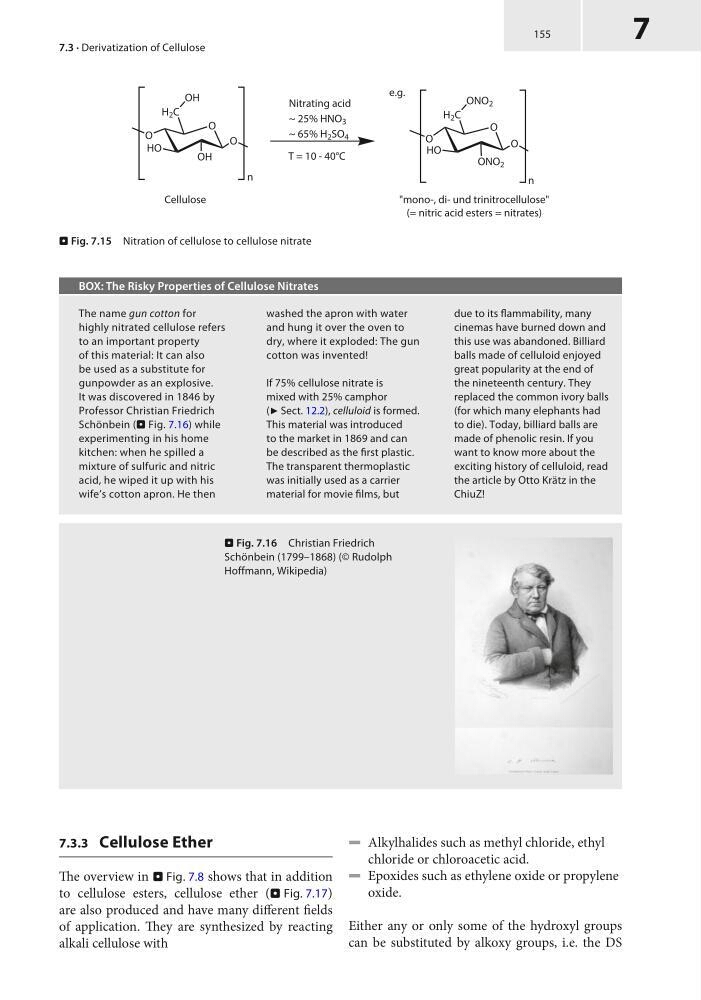
. Fig. 7.16 Christian Friedrich
Schönbein (1799–1868) (© Rudolph
Hoffmann, Wikipedia)
O
O
O
H 2 C
OH
OH
HO
n
O
O
O
H 2 C
ONO 2
ONO 2
HO
n
e.g.
Nitrating acid
~ 25% HNO 3
~ 65% H 2 SO 4
T = 10 - 40°C
Cellulose
"mono-, di- und trinitrocellulose"
(= nitric acid esters = nitrates)
. Fig. 7.15 Nitration of cellulose to cellulose nitrate
7.3.3 Cellulose Ether
The overview in . Fig. 7.8 shows that in addition
to cellulose esters, cellulose ether (. Fig. 7.17)
are also produced and have many different fields
of application. They are synthesized by reacting
alkali cellulose with
5 Alkylhalides such as methyl chloride, ethyl
chloride or chloroacetic acid.
5 Epoxides such as ethylene oxide or propylene
oxide.
Either any or only some of the hydroxyl groups
can be substituted by alkoxy groups, i.e. the DS
7
BOX: The Risky Properties of Cellulose Nitrates
The name gun cotton for
highly nitrated cellulose refers
to an important property
of this material: It can also
be used as a substitute for
gunpowder as an explosive.
It was discovered in 1846 by
Professor Christian Friedrich
Schönbein (. Fig. 7.16) while
experimenting in his home
kitchen: when he spilled a
mixture of sulfuric and nitric
acid, he wiped it up with his
wife’s cotton apron. He then
washed the apron with water
and hung it over the oven to
dry, where it exploded: The gun
cotton was invented!
If 75% cellulose nitrate is
mixed with 25% camphor
(7 Sect. 12.2), celluloid is formed.
This material was introduced
to the market in 1869 and can
be described as the first plastic.
The transparent thermoplastic
was initially used as a carrier
material for movie films, but
due to its flammability, many
cinemas have burned down and
this use was abandoned. Billiard
balls made of celluloid enjoyed
great popularity at the end of
the nineteenth century. They
replaced the common ivory balls
(for which many elephants had
to die). Today, billiard balls are
made of phenolic resin. If you
want to know more about the
exciting history of celluloid, read
the article by Otto Krätz in the
ChiuZ!
7.3 · Derivatization of Cellulose
. Fig. 7.16 Christian Friedrich
Schönbein (1799–1868) (© Rudolph
Hoffmann, Wikipedia)
O
O
O
H 2 C
OH
OH
HO
n
O
O
O
H 2 C
ONO 2
ONO 2
HO
n
e.g.
Nitrating acid
~ 25% HNO 3
~ 65% H 2 SO 4
T = 10 - 40°C
Cellulose
"mono-, di- und trinitrocellulose"
(= nitric acid esters = nitrates)
. Fig. 7.15 Nitration of cellulose to cellulose nitrate
7.3.3 Cellulose Ether
The overview in . Fig. 7.8 shows that in addition
to cellulose esters, cellulose ether (. Fig. 7.17)
are also produced and have many different fields
of application. They are synthesized by reacting
alkali cellulose with
5 Alkylhalides such as methyl chloride, ethyl
chloride or chloroacetic acid.
5 Epoxides such as ethylene oxide or propylene
oxide.
Either any or only some of the hydroxyl groups
can be substituted by alkoxy groups, i.e. the DS