

154
Chapter 7 · From Wood to Pulp - Cellulose
7
processing when glued. They are therefore
used, for example, as carrier materials for
movie films and as films for displays and computer flat screens.
The secondary acetates are processed into
textile fibers or molded products. The fibers
behave similarly to natural silk and are used in
the manufacture of raincoats, umbrellas, shirts
and ties due to their low water absorption. Typical molded articles are spectacle frames, telephones, toys and screwdriver handles. Cellulose
acetate is also used in the manufacture of cigarette filters.
Instead of acetic acid, other organic acids
can also be used, e.g. phthalic acid, propionic
acid or butyric acid. Mixed esters, such as cellulose acetopropionates, are also frequently
produced.
Cellulose can also react with inorganic nitric
acid to form esters. When cellulose is treated
with “nitrating acid” (or nitrating mixture,
7 Sect. 5.2), a mixture of nitric acid and sulfuric
acid, cellulose nitrates with varying degrees of
nitration are formed:
5 highly nitrated gun cotton (DS up to 90%)
5 Collodion wool (DS of 75–85%)
5 Lacquer wool (DS of 60–70%)
. Figure 7.15 shows exemplary the synthesis of
cellulose dinitrate, which is sometimes mistakenly referred to as dinitrocellulose. However, as
the chemical structure shows, the NO 2 -group is
linked to the carbon atom of glucose via another
oxygen atom, i.e. it is a nitrate (in a nitro group,
on the other hand, the NO 2 group is linked
directly to a carbon atom!)
7.3.2 Cellulose Esters
As already listed in . Fig. 7.10, esters of cellulose with either organic or inorganic acids
exist. Particularly cheap acetic acid is used as an
organic acid yielding cellulose acetates. . Figure 7.14 shows a section of a cellulose acetate
(CA) chain with a complete substitution of the
three hydroxyl groups by acetate groups. This
type is called cellulose triacetate (CTA). The term
degree of substitution (DS) was introduced for
the extent of the substitution. Cellulose triacetate
thus has a DS of 3.
Cellulose acetate was first produced as early
as 1865. The reaction to CTA takes place with
acetic anhydride in acetic acid as solvent in the
presence of acidic catalysts such as sulfuric acid.
To produce cellulose acetates with lower acetylation (i.e. DS < 3), CTA is partially hydrolyzed
with a defined amount of water, e.g. to the “secondary acetates”.
Cellulose acetates are often processed into
films which are characterized by high optical
clarity, good antistatic behavior, and ease of
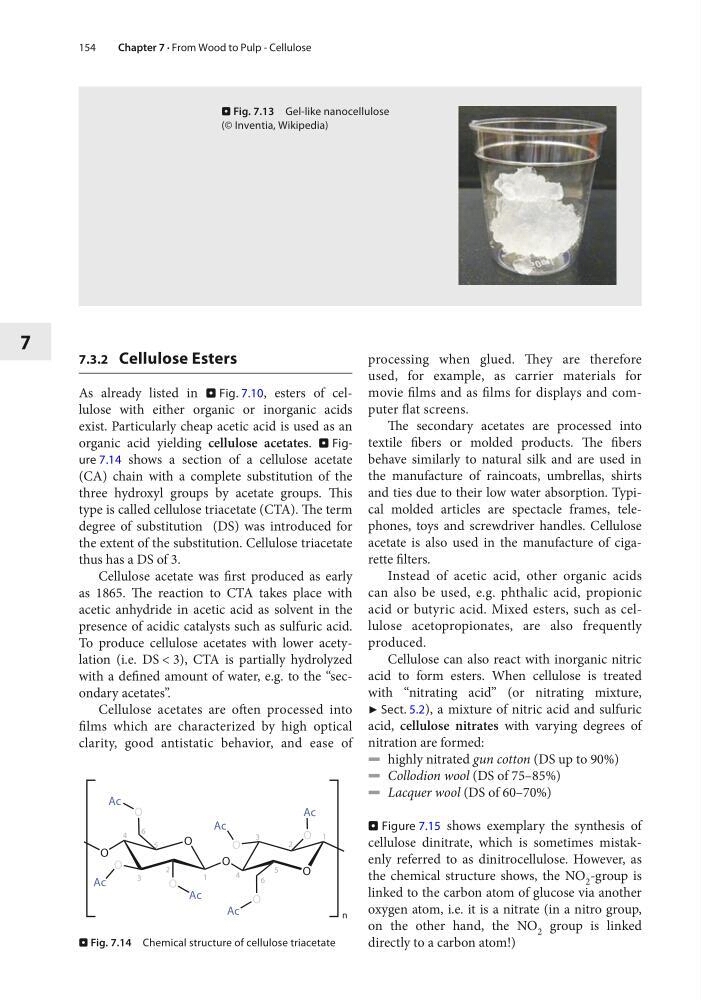
. Fig. 7.13 Gel-like nanocellulose
(© Inventia, Wikipedia)
O
O
O
O
O
Ac
Ac
Ac
O
O
O
Ac
O
Ac
O
Ac
n
1
2
3
4
5
6
1
2
3
4
5
6
. Fig. 7.14 Chemical structure of cellulose triacetate
Chapter 7 · From Wood to Pulp - Cellulose
7
processing when glued. They are therefore
used, for example, as carrier materials for
movie films and as films for displays and computer flat screens.
The secondary acetates are processed into
textile fibers or molded products. The fibers
behave similarly to natural silk and are used in
the manufacture of raincoats, umbrellas, shirts
and ties due to their low water absorption. Typical molded articles are spectacle frames, telephones, toys and screwdriver handles. Cellulose
acetate is also used in the manufacture of cigarette filters.
Instead of acetic acid, other organic acids
can also be used, e.g. phthalic acid, propionic
acid or butyric acid. Mixed esters, such as cellulose acetopropionates, are also frequently
produced.
Cellulose can also react with inorganic nitric
acid to form esters. When cellulose is treated
with “nitrating acid” (or nitrating mixture,
7 Sect. 5.2), a mixture of nitric acid and sulfuric
acid, cellulose nitrates with varying degrees of
nitration are formed:
5 highly nitrated gun cotton (DS up to 90%)
5 Collodion wool (DS of 75–85%)
5 Lacquer wool (DS of 60–70%)
. Figure 7.15 shows exemplary the synthesis of
cellulose dinitrate, which is sometimes mistakenly referred to as dinitrocellulose. However, as
the chemical structure shows, the NO 2 -group is
linked to the carbon atom of glucose via another
oxygen atom, i.e. it is a nitrate (in a nitro group,
on the other hand, the NO 2 group is linked
directly to a carbon atom!)
7.3.2 Cellulose Esters
As already listed in . Fig. 7.10, esters of cellulose with either organic or inorganic acids
exist. Particularly cheap acetic acid is used as an
organic acid yielding cellulose acetates. . Figure 7.14 shows a section of a cellulose acetate
(CA) chain with a complete substitution of the
three hydroxyl groups by acetate groups. This
type is called cellulose triacetate (CTA). The term
degree of substitution (DS) was introduced for
the extent of the substitution. Cellulose triacetate
thus has a DS of 3.
Cellulose acetate was first produced as early
as 1865. The reaction to CTA takes place with
acetic anhydride in acetic acid as solvent in the
presence of acidic catalysts such as sulfuric acid.
To produce cellulose acetates with lower acetylation (i.e. DS < 3), CTA is partially hydrolyzed
with a defined amount of water, e.g. to the “secondary acetates”.
Cellulose acetates are often processed into
films which are characterized by high optical
clarity, good antistatic behavior, and ease of
. Fig. 7.13 Gel-like nanocellulose
(© Inventia, Wikipedia)
O
O
O
O
O
Ac
Ac
Ac
O
O
O
Ac
O
Ac
O
Ac
n
1
2
3
4
5
6
1
2
3
4
5
6
. Fig. 7.14 Chemical structure of cellulose triacetate