

157
7
tor, a fast-running centrifugal mixer unit enables three-dimensional mixing of the reactants.
Several laterally installed cutter heads ensure an
additional intensive mixing.
Important applications of the MC are:
5 Wallpaper paste (e.g. “Metylan®”)
5 Water binder for cement production
5 Thickening agent in latex paints
5 Stabilizer for cosmetics
5 Coating of tablets
5 Contrast agents in diagnostics.
If alkali cellulose is reacted with ethylene oxide
in a water-soluble solvent such as isopropanol,
hydroxyethyl cellulose (HEC) is formed under
epoxy ring opening (. Fig. 7.21). One or more
mole of ethylene oxide can react with, preferentially the primary but also with the secondary,
hydroxyl groups of cellulose to form hydroxyether side chains.
5 Coating of paper and cardboard: The porosity
of the paper is reduced and thus the “smoothness” of the paper is improved.
5 Binding and thickening agent in coatings.
5 Skin cleansing agents: In this application,
soaps are replaced by CMC. This makes these
cleansing agents particularly skin-friendly.
The second most important cellulose ether is
methylcellulose (MC), which is produced via
Williamson synthesis from alkali cellulose and
methyl chloride. The reaction takes place under
pressure at temperatures around 100 °C. By
substituting the hydroxyl groups with methoxy
groups, the tendency of the cellulose to form
hydrogen bridges between the chains and thus
crystalline areas is greatly reduced. Therefore, a
MC with a DS of 1.6–2.4 can form stable aqueous
solutions. A MC with a DS of 2.4–2.8 is soluble
in organic solvents.
The reaction of alkali cellulose with methyl
chloride is not a simple process. One possibility is to gradually introduce the gaseous methyl
chloride (bp: −24 °C) into the aqueous suspension of the alkali cellulose through porous stirrers. In discontinuous processes, this usually
takes several hours of reaction time. In continuous processes, a large excess of methyl chloride is
used, reducing the reaction time to less than one
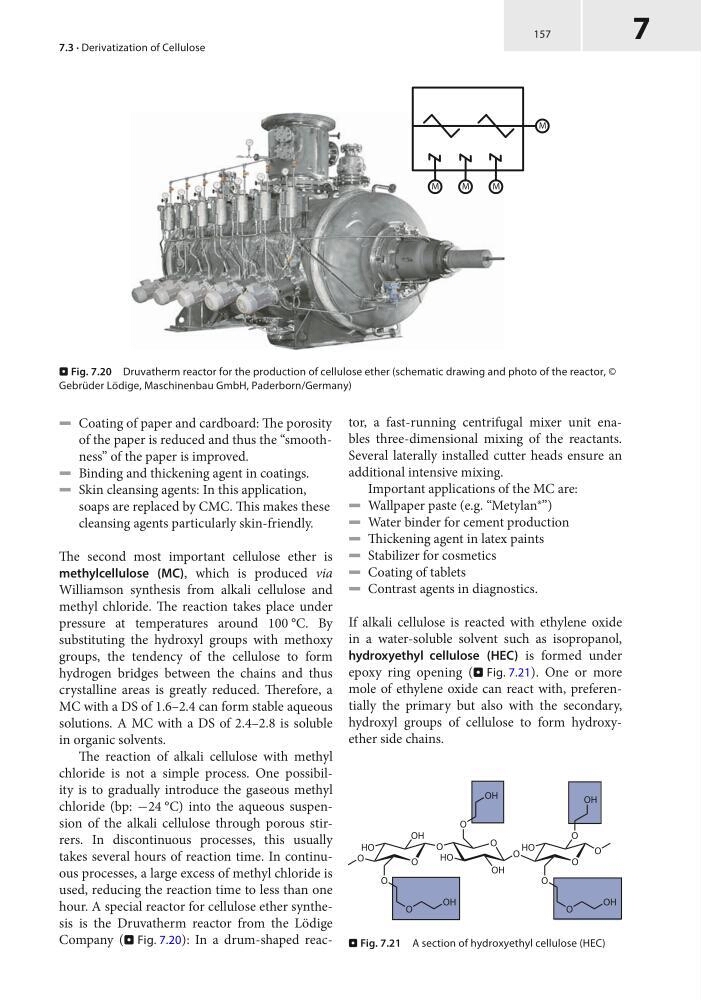
hour. A special reactor for cellulose ether synthesis is the Druvatherm reactor from the Lödige
Company (. Fig. 7.20): In a drum-shaped reac- . Fig. 7.21 A section of hydroxyethyl cellulose (HEC)
O
O
O
OH
O
HO
O
O
O
OH
OH
HO
OH
O
O
HO
O
O
OH
O
OH
O
7.3 · Derivatization of Cellulose
M
M
M
M
. Fig. 7.20 Druvatherm reactor for the production of cellulose ether (schematic drawing and photo of the reactor, ©
Gebrüder Lödige, Maschinenbau GmbH, Paderborn/Germany)
7
tor, a fast-running centrifugal mixer unit enables three-dimensional mixing of the reactants.
Several laterally installed cutter heads ensure an
additional intensive mixing.
Important applications of the MC are:
5 Wallpaper paste (e.g. “Metylan®”)
5 Water binder for cement production
5 Thickening agent in latex paints
5 Stabilizer for cosmetics
5 Coating of tablets
5 Contrast agents in diagnostics.
If alkali cellulose is reacted with ethylene oxide
in a water-soluble solvent such as isopropanol,
hydroxyethyl cellulose (HEC) is formed under
epoxy ring opening (. Fig. 7.21). One or more
mole of ethylene oxide can react with, preferentially the primary but also with the secondary,
hydroxyl groups of cellulose to form hydroxyether side chains.
5 Coating of paper and cardboard: The porosity
of the paper is reduced and thus the “smoothness” of the paper is improved.
5 Binding and thickening agent in coatings.
5 Skin cleansing agents: In this application,
soaps are replaced by CMC. This makes these
cleansing agents particularly skin-friendly.
The second most important cellulose ether is
methylcellulose (MC), which is produced via
Williamson synthesis from alkali cellulose and
methyl chloride. The reaction takes place under
pressure at temperatures around 100 °C. By
substituting the hydroxyl groups with methoxy
groups, the tendency of the cellulose to form
hydrogen bridges between the chains and thus
crystalline areas is greatly reduced. Therefore, a
MC with a DS of 1.6–2.4 can form stable aqueous
solutions. A MC with a DS of 2.4–2.8 is soluble
in organic solvents.
The reaction of alkali cellulose with methyl
chloride is not a simple process. One possibility is to gradually introduce the gaseous methyl
chloride (bp: −24 °C) into the aqueous suspension of the alkali cellulose through porous stirrers. In discontinuous processes, this usually
takes several hours of reaction time. In continuous processes, a large excess of methyl chloride is
used, reducing the reaction time to less than one
hour. A special reactor for cellulose ether synthesis is the Druvatherm reactor from the Lödige
Company (. Fig. 7.20): In a drum-shaped reac- . Fig. 7.21 A section of hydroxyethyl cellulose (HEC)
O
O
O
OH
O
HO
O
O
O
OH
OH
HO
OH
O
O
HO
O
O
OH
O
OH
O
7.3 · Derivatization of Cellulose
M
M
M
M
. Fig. 7.20 Druvatherm reactor for the production of cellulose ether (schematic drawing and photo of the reactor, ©
Gebrüder Lödige, Maschinenbau GmbH, Paderborn/Germany)